



B40, M40 & T20 Malaysia: Latest Household Income Categories and Income Range (2026)

When Malaysians apply for government aid, subsidies, education assistance, housing programmes, or Sumbangan Tunai Rahmah (STR), one question often comes up: which income group does your household belong to?
There are 3 classifications of Malaysian households: B40, M40, and T20. They become important. These categories are not just labels, they help show where a household stands financially and are often used to guide government support, subsidy planning, and social assistance.
However, many people still misunderstand how these groups are measured. B40, M40, and T20 are not based on one person’s salary alone. They are based on total monthly household income, which may include income from salaries, business, freelance work, side jobs, or other household earners.
Understanding your household category can help you check bantuan eligibility, plan your finances better, and understand how Malaysia’s income classification system works.
This guide explains the meaning of B40, M40, T20, and Miskin Tegar, including the latest income ranges and why these classifications matter.
What is B40, M40 and T20?
B40, M40, and T20 are household income categories used in Malaysia to group households based on their monthly income level.
These groups divide Malaysian households into three main income categories:
-
B40: Bottom 40%
-
M40: Middle 40%
-
T20: Top 20%
Every household can fall into one of these categories depending on the total monthly income earned by all household members.
The category is not based on one person’s salary only. Instead, it is based on combined household income.
For example, if a husband, wife, and adult child are all working and living in the same household, their total income may be counted together when identifying the household category.
Latest Income Range for B40, M40 and T20
The B40, M40, and T20 classifications are updated from time to time using household income data from the Department of Statistics Malaysia, also known as DOSM.
The latest household income ranges are:
|
Category |
Meaning |
Monthly Household Income |
|
B40 |
Bottom 40% |
RM5,906 and below |
|
M40 |
Middle 40% |
RM5,906 to RM12,567 |
|
T20 |
Top 20% |
RM12,567 and above |
These income ranges help show where a household stands compared to other households in Malaysia.
B40: Bottom 40%
Households in this category earn RM5,906 and below per month. This group is often the main focus of government support because they may face higher pressure from living costs, limited savings, and financial uncertainty.
M40: Middle 40%
Households in this category earn between RM5,906 and RM12,567 per month. This group is often described as the middle-income group. Many M40 households can cover basic needs, but they may still feel financially stretched, especially in urban areas with high housing, transport, childcare, and food costs.
T20: Top 20%
Households in this category earn RM12,567 and above per month. This group generally has stronger purchasing power, better access to savings or investments, and more room for long-term financial planning.
Not Sure Which Household Category You Belong To?
Check your household income category instantly with this free calculator. Simply enter your total monthly household income and find out whether you're in the B40, M40, or T20 group.
Average Household Income in Malaysia
It is also useful to understand the difference between average income and median income.
Average income is calculated by adding all household income and dividing it by the number of households. However, average income can be affected by very high-income households, which may pull the figure upward.
Median income is the middle value. This means half of households earn below that amount, while the other half earn above it. Median income is often useful because it gives a clearer picture of what a typical household may earn.
For example, if a small number of households earn very high income, the average may look high even though many households earn less than that. This is why both average and median income are useful when understanding household income in Malaysia.
States with stronger urban economies, such as Kuala Lumpur, Putrajaya, and Selangor, usually record higher household income levels compared to many other areas. This is often linked to job opportunities, business activity, and cost of living.
What is Miskin Tegar?
Miskin Tegar refers to households living below the Pendapatan Garis Kemiskinan (PGK) Makanan, also known as the food poverty line.
Miskin Tegar describes households that struggle to meet even basic food needs. This is more severe than general low-income status because it focuses on the minimum income needed for food requirements.
The latest national benchmarks are:
|
Category |
Monthly Income Benchmark |
|
PGK Am / Miskin Mutlak Nasional |
RM2,705 |
|
PGK Makanan / Miskin Tegar Nasional |
RM1,236 |
Households under Miskin Tegar may face serious financial challenges, including difficulty covering food, housing, healthcare, transport, and basic family needs.
This category is especially important for welfare programmes because it helps identify households that may need urgent and targeted assistance.
PGK by State
The poverty line can differ by state because the cost of living is not the same across Malaysia.
For example, the cost of living in Kuala Lumpur may be different from Kedah, Perlis, Sabah, or Sarawak. Housing, transport, food prices, and access to services can vary significantly depending on location.
Here are examples of PGK levels by state:
|
State / Federal Territory |
PGK |
|
Johor |
RM2,775 |
|
Kedah |
RM2,362 |
|
Perak |
RM2,364 |
|
Selangor |
RM2,949 |
|
Perlis |
RM2,217 |
|
WP Labuan |
RM2,723 |
|
Melaka |
RM2,751 |
|
Pahang |
RM2,560 |
|
Sabah |
RM2,843 |
|
Negeri Sembilan |
RM2,493 |
|
Kelantan |
RM2,374 |
|
Sarawak |
RM2,718 |
|
Terengganu |
RM2,841 |
|
Pulau Pinang |
RM2,399 |
|
WP Kuala Lumpur |
RM3,011 |
|
WP Putrajaya |
RM2,628 |
This shows why income classification should not be viewed only as a national number. A household earning the same amount may experience different living standards depending on where they live.
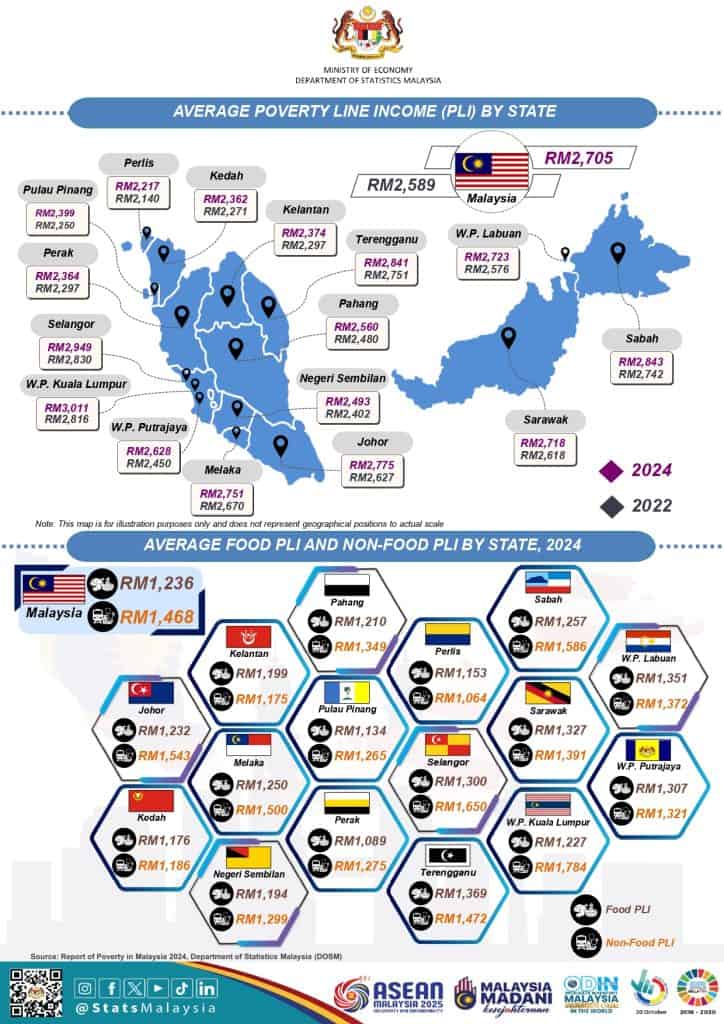
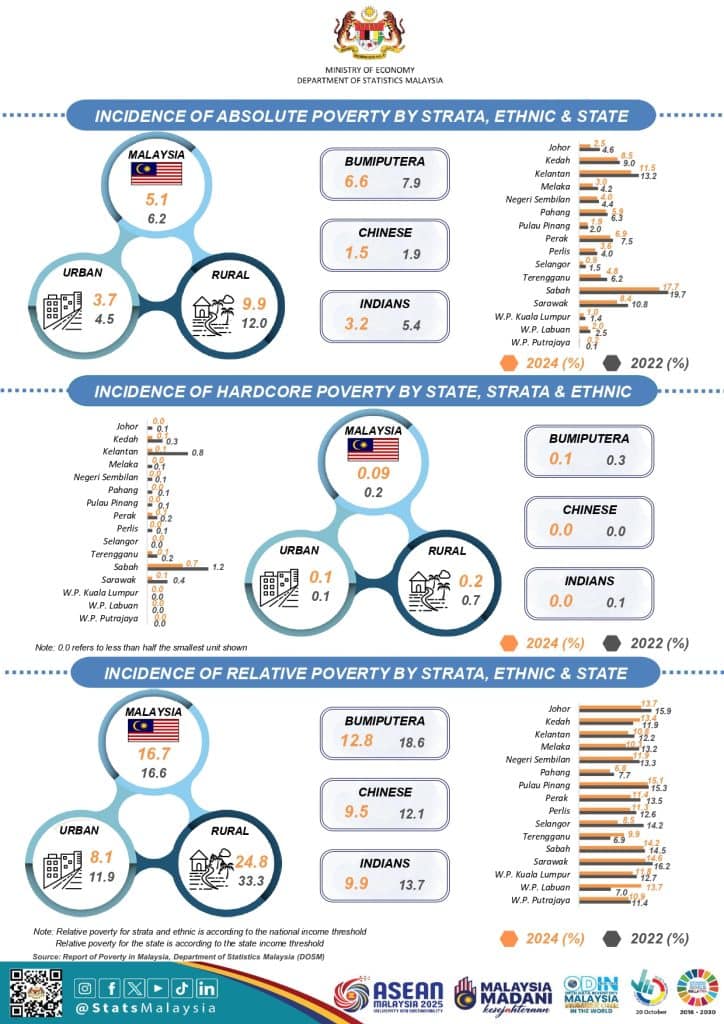
Image source: DOSM
Old vs New Household Classification
Household income classification in Malaysia is updated from time to time.
Previously, income categories were also divided into smaller sub-groups, such as:
-
B1, B2, B3, B4
-
M1, M2, M3, M4
-
T1, T2
These smaller categories gave a more detailed view of income levels within B40, M40, and T20.
For example, not all B40 households face the same level of financial pressure. A household at the lower end of B40 may have very different needs compared to a household near the upper end of B40. The same applies to M40 and T20 households.
The government updates household income categories because income levels and living costs change over time. Several factors can affect the classification, including:
-
Inflation
-
Higher cost of living
-
Wage growth
-
Economic changes
-
Household spending patterns
-
Changes in poverty line measurements
Because of these changes, a household category may not stay the same forever. A family that was previously in B40 may later move into M40 if their income increases. At the same time, a household may also move into a lower category if income drops or household members lose jobs.
Why Household Classification is Important
Household income classification is important because it helps the government decide how to plan and distribute support.
These categories are commonly used for:
-
Government bantuan
-
Targeted subsidies
-
STR-related assistance
-
Housing programmes
-
Education aid
-
Welfare support
-
Poverty reduction policies
-
Economic planning
For example, if the government wants to provide financial aid to households most affected by living costs, it needs income data to identify which groups should receive support first.
The classification also helps policymakers understand the income gap between groups. If the gap between B40, M40, and T20 becomes too wide, the government may need to review policies related to wages, subsidies, housing, and social protection.
For individuals and families, knowing your household category can also help you understand which bantuan, subsidy, or financial support programme you may be eligible for.
Challenges Faced by B40 Households
B40 households often face stronger pressure from daily expenses because a larger portion of income is used for basic needs.
Housing Costs
Rent, housing loans, maintenance fees, and utilities can take up a large part of household income. For lower-income households, even a small increase in housing cost can affect monthly cash flow.
Food Expenses
Food is a basic need, but grocery prices and eating costs can change over time. When food prices increase, B40 households may feel the impact more strongly because they have less room in their budget.
Transportation Costs
Fuel, public transport, vehicle loans, tolls, and maintenance can also add financial pressure. This is especially true for households that need to travel far for work.
Limited Savings
Many B40 households may find it difficult to build emergency savings. This makes them more vulnerable when facing job loss, medical costs, family emergencies, or sudden expenses.
Limited Access to Opportunities
Lower-income households may have fewer resources for education, skills training, digital tools, or business capital. This can make it harder to increase income over time.
Because of these challenges, government aid and targeted subsidies can play an important role in helping B40 and Miskin Tegar households manage essential needs.
Why Government Updates Income Categories
Income categories are not fixed permanently because the economy changes over time.
The government updates household classification to make sure the data reflects the current situation of Malaysians. This is important because outdated income categories may cause aid and subsidies to miss the right target group.
There are several reasons why updates are needed.
Household Income Changes
As wages increase or decrease, the income level of households can change. New jobs, job losses, business income, retirement, and household size can all affect category placement.
Cost of Living Changes
Even if income increases, higher living costs may reduce actual purchasing power. This is why income categories must be reviewed together with inflation and household spending patterns.
Location Differences Matter
A household in Kuala Lumpur may face different costs compared to a household in Perlis or Kelantan. Updating data helps reflect differences across states and regions.
Better Targeted Bantuan
Updated data helps the government provide assistance to the right groups. This is important for targeted subsidies, cash aid, welfare support, and poverty reduction programmes.
Economic Planning
Income classification also helps the government understand social and economic trends, such as income inequality, poverty levels, and the financial position of Malaysian households.
How to Know Your Household Category
To know whether your household is in B40, M40, or T20, you need to calculate total monthly household income.
Start by adding all income earned by household members. This may include:
-
Salary
-
Business income
-
Freelance income
-
Side income
-
Gig work income
-
Allowances
-
Other regular household income
After calculating the total monthly household income, compare it with the latest income ranges:
|
Category |
Monthly Household Income |
|
B40 |
RM5,906 and below |
|
M40 |
RM5,906 to RM12,567 |
|
T20 |
RM12,567 and above |
For example, if one household has two working adults earning RM3,000 and RM2,500 per month, the total household income is RM5,500. This means the household may fall under B40.
If another household has two working adults earning RM7,000 and RM6,000 per month, the total household income is RM13,000. This may place the household under T20.
Practical Financial Tips by Household Category
Each income group may have different financial priorities. While every household situation is different, these general tips can help Malaysians plan better.
B40: Focus on Essentials and Emergency Savings
B40 households should prioritise basic needs, cash flow, and emergency savings.
It is also important to check eligibility for bantuan, subsidies, welfare support, and education aid. These programmes may help reduce financial pressure and support essential expenses.
A small emergency fund can also make a big difference during unexpected situations such as medical needs, job loss, or urgent repairs.
M40: Focus on Planning and Protection
M40 households may have more income than B40 households, but many still face pressure from housing, childcare, education, transport, and urban living costs.
Financial planning is important for this group. Priorities may include budgeting, insurance protection, debt management, retirement savings, and children’s education planning.
M40 households should also review their commitments regularly so lifestyle spending does not grow faster than income.
T20: Focus on Wealth Growth and Diversification
T20 households generally have more room for long-term financial planning.
This may include investment diversification, retirement planning, asset protection, tax planning, and wealth transfer planning.
However, higher income does not automatically mean strong financial health. T20 households still need proper planning to manage debt, lifestyle inflation, and long-term financial goals.
Useful Government Agencies and Platforms
Several government-related agencies and platforms are commonly linked to income data, aid, and household support.
Jabatan Perangkaan Malaysia (DOSM)
DOSM provides official statistics on household income, poverty, population, and economic data. It is the main reference for income classification such as B40, M40, and T20. https://www.dosm.gov.my/
e-Kasih
e-Kasih is commonly associated with poverty data and support for low-income households. It helps identify households that may require welfare support.
STR Portal
The STR portal is used for Sumbangan Tunai Rahmah-related applications and checks. Household income information may affect eligibility for assistance.
Welfare and Subsidy Agencies
Different agencies may manage welfare assistance, education aid, housing support, or targeted subsidies. Applicants should always check the latest requirements before applying.
FAQs
What is B40, M40 and T20 in Malaysia?
B40, M40, and T20 are household income categories in Malaysia. B40 refers to the bottom 40% of households, M40 refers to the middle 40%, and T20 refers to the top 20%.
What income is considered B40?
A household is considered B40 if the monthly household income is RM5,906 and below.
What income is considered M40?
M40 households earn between RM5,906 and RM12,567 per month.
What income is considered T20?
T20 households earn RM12,567 and above per month.
What is Miskin Tegar?
Miskin Tegar refers to households below the food poverty line, also known as PGK Makanan. The national benchmark stated is RM1,236 per month.
How is household income calculated?
Household income is calculated by adding the income of household members. This may include salary, business income, freelance income, side income, and other regular earnings.
Why does the government update income categories?
The government updates income categories because household income, inflation, cost of living, and spending patterns change over time. Updated data helps make bantuan and subsidies more targeted.
Can the household category change every year?
Yes. A household category can change if income increases, decreases, or if household financial circumstances change. Government updates to income thresholds can also affect category placement.
Is B40, M40, and T20 based on individual salary?
No. The classification is based on monthly household income, not individual salary only.
Is an OKU cardholder or single mother automatically considered B40?
Not automatically. Household classification is mainly based on household income first. Other factors may be considered for specific welfare programmes, but income remains the main basis for B40, M40, and T20 classification.
Your Next Hire Could be Just a Click Away!
%20copy.jpg)
At AJobThing, we connect you with million jobseekers in Malaysia, ensuring you hire the best.
Post your job ads today & simplify your hiring process!
Read More:
-
MyKad Online: How to Replace Your MyKad Through the JPN Portal
-
Touch n Go MyKad: How to Claim Your Balance After Getting a New MyKad
-
Anti-Sexual Harassment Act 2022 Malaysia: Employer Responsibilities and Employee Rights
-
Gig Workers Act 2025 Malaysia: What Employers Need to Know in 2026
-
Geran LiKES TalentCorp 2026: RM2,000 Grant & 50% Reimbursement for Intern Hiring
-
Free SSM Registration for B40 & IPT Students Under SPPP 2026
-
Zakat Pendapatan Malaysia: Salary Deduction & Payroll Process for Employers
-
PADURI MADANI Scheme: Financial Assistance for B40 Women Entrepreneurs
-
MyKad Baru June 2026 Released: Do You Need to Change Your IC?
-
Bantuan B40 2026 Ikut Negeri: Full List Malaysia + Eligibility & How to Apply
-
5,900 Workers Affected by March Layoffs, Government Acts to Strengthen Employment Support
-
Malaysia Govt Saves RM678,000 in Fuel in 1 Week After WFH Policy
-
Malaysia Job Loss 2026 Rises 47% to 24,100 Retrenchments in Q1
-
Senarai Barang MyKasih (SARA 2026): What You Can Buy Using Your SARA Credit
-
Senarai Kedai MyKasih 2026: List of Stores That Accept SARA MyKad Assistance
-
Skim Jaminan Kredit Perumahan (SJKP): How Malaysians Can Buy a Home Without a Payslip
-
Semakan SARA 2026: Recipient Categories, Payment Dates and How to Use MyKad
-
SARA 2026 Malaysia Latest Updates and Official Announcements