
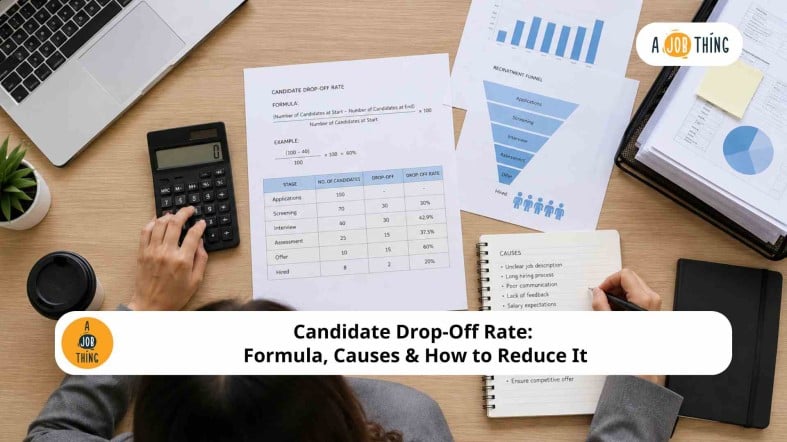
Candidate Drop-Off Rate: Formula, Causes & How to Reduce It

Are You Hiring?
Find candidates in 72 Hours with 5+ million talents in Maukerja Malaysia & Ricebowl using Job Ads.
Hire Now
Attracting candidates is only the first step in recruitment. Employers also need to keep candidates engaged throughout the hiring process.
Some candidates start an application but never complete it. Others may withdraw after an interview, stop responding to recruiters, or reject a job offer.
This is known as candidate drop-off.
A high candidate drop-off rate can indicate that candidates are experiencing problems during the recruitment process. By tracking where candidates leave, HR teams can identify potential issues and improve the candidate experience.
What Is Candidate Drop-Off Rate?
Candidate drop-off rate measures the percentage of candidates who leave the recruitment process before moving to the next stage or completing the hiring process.
Candidate drop-off can happen at different stages, such as:
-
Viewing a job but not applying
-
Starting an application but not completing it
-
Applying but withdrawing before screening
-
Being invited to an interview but not attending
-
Completing an interview but withdrawing before an offer
-
Receiving a job offer but declining it
This means there is not always one single candidate drop-off rate. HR teams should track where candidates leave the recruitment funnel.
For example, if 200 candidates start an application but only 150 complete it, 50 candidates have dropped off during the application stage.
Candidate Drop-Off Rate Formula
The basic candidate drop-off rate formula is:
Candidate Drop-Off Rate = (Number of Candidates Who Dropped Off ÷ Number of Candidates Who Entered the Stage) × 100
For example:
-
200 candidates started an application
-
150 candidates completed the application
-
50 candidates dropped off
Candidate Drop-Off Rate = (50 ÷ 200) × 100 = 25%
The candidate drop-off rate at the application stage is therefore 25%.
HR teams should calculate this separately for each recruitment stage to identify where the biggest drop-off occurs.
Example of Candidate Drop-Off Across the Recruitment Funnel
A recruitment funnel could look like this:
1,000 Job Views
↓
300 Applications Started
↓
220 Applications Completed
↓
100 Candidates Screened
↓
50 Interviews
↓
15 Job Offers
↓
12 Hires
Looking at the funnel helps HR identify where candidates are being lost.
For example:
|
Recruitment Stage |
Candidates Entering |
Candidates Continuing |
Drop-Off Rate |
|
Application |
300 |
220 |
26.7% |
|
Screening |
220 |
100 |
54.5% |
|
Interview |
100 |
50 |
50% |
|
Offer |
15 |
12 |
20% |
The numbers do not necessarily mean that every drop-off is a problem. Some candidates may simply decide that the position is not suitable for them.
The purpose of tracking candidate drop-off is to identify avoidable drop-off caused by problems within the recruitment process.
Why Do Candidates Drop Off During Recruitment?
Candidate drop-off can happen for many reasons. Some are outside the employer's control, but repeated drop-off at the same stage may indicate an issue with the hiring process.
The Application Process Is Too Long
Candidates may abandon applications when they are required to:
-
Create an account before applying
-
Enter information already included in their resume
-
Complete too many questions
-
Fill in lengthy forms
-
Complete unnecessary assessments
-
Navigate through too many pages
Research reported by SHRM has highlighted application friction, including lengthy forms, account creation and repetitive questions, as reasons candidates may abandon online applications.
How to improve:
Keep the application process focused on information that is genuinely needed. Remove unnecessary questions and make it easy for candidates to complete their applications.
Poor Communication
Candidates can lose interest when they do not know what is happening after applying or attending an interview.
For example, telling a candidate that the company will "get back to you soon" without providing a timeframe can create uncertainty.
SHRM reported that poor communication was the top reason candidates withdrew their applications in the 2024 Monster Work Watch Report.
How to improve:
Tell candidates:
-
What the next step is
-
How many interview stages to expect
-
When they can expect an update
-
Who they can contact if they have questions
Even when there is no final decision, providing an update can help maintain candidate engagement.
The Hiring Process Takes Too Long
A candidate may be interested in a position but leave because the recruitment process moves too slowly.
For example:
Application → Screening → Interview 1 → Interview 2 → Assessment → Final Interview → Offer
If every stage takes several days or weeks, candidates may lose interest or accept another opportunity.
How to improve:
Review the time between each recruitment stage. Ask:
-
Is every interview necessary?
-
Can interviews be combined?
-
Are hiring managers taking too long to provide feedback?
-
Are internal approvals delaying the process?
-
Can candidates be given a clear hiring timeline?
A shorter and more organised process can help reduce unnecessary candidate drop-off.
Candidates Have a Poor Interview Experience
Candidates are also evaluating the employer during the interview process.
An interviewer who is unprepared, uninterested or disrespectful can affect whether a candidate continues with the company.
Greenhouse's candidate research found that interview experience can influence candidates' decisions, with 20% of surveyed candidates reporting that they had rejected an offer because of a poor interview experience.
How to improve:
Interviewers should:
-
Prepare before the interview
-
Understand the candidate's background
-
Explain the role clearly
-
Give candidates time to ask questions
-
Avoid irrelevant or inappropriate questions
-
Explain the next steps
A professional interview experience can help keep suitable candidates engaged.
The Job Does Not Match Candidate Expectations
Candidates may withdraw when they discover that the actual role is significantly different from the job description.
For example, a job advertisement may describe a position as office-based, but the candidate later discovers that frequent travel is required.
Clear and accurate job information can reduce this type of candidate drop-off.
Employers should clearly communicate:
-
Main responsibilities
-
Work location or arrangement
-
Required skills
-
Salary and benefits where appropriate
-
Important job requirements
-
Recruitment process
Being transparent can help attract candidates who are more likely to be suitable for the role.
How HR Can Track Candidate Drop-Off
Instead of only tracking the final number of hires, HR teams should monitor candidate movement throughout the recruitment funnel.
Useful recruitment metrics include:
Application Abandonment Rate
Measures candidates who start an application but do not complete it.
Screening Drop-Off Rate
Measures candidates who leave between application completion and screening.
Interview Drop-Off Rate
Measures candidates who withdraw or do not attend an interview.
Offer Drop-Off Rate
Measures candidates who reject or withdraw after receiving an offer.
Overall Candidate Drop-Off Rate
Measures candidates who leave the recruitment process before being hired.
Tracking these metrics separately makes it easier to identify where improvements are needed.
Candidate Drop-Off Rate vs Application Abandonment Rate
These terms are related but have different meanings.
Application abandonment rate focuses specifically on candidates who start an application but leave before completing it.
Candidate drop-off rate is broader and can refer to candidates leaving at any stage of the recruitment process.
|
Metric |
What It Measures |
|
Application Abandonment Rate |
Candidates who start but do not complete an application |
|
Screening Drop-Off Rate |
Candidates who leave before completing screening |
|
Interview Drop-Off Rate |
Candidates who leave before or after an interview |
|
Offer Drop-Off Rate |
Candidates who reject or withdraw before accepting an offer |
|
Candidate Drop-Off Rate |
Candidates who leave at any stage of recruitment |
Understanding the difference helps HR teams choose the right metric for each stage of the hiring process.
How to Reduce Candidate Drop-Off Rate
Simplify the Application Process
Remove unnecessary fields and avoid asking candidates to provide information that is already available on their resume.
Set Clear Expectations
Explain the recruitment process and give candidates an estimated timeline.
Communicate Regularly
Keep candidates updated instead of leaving them uncertain about their application status.
Reduce Unnecessary Interview Stages
Review whether every interview is necessary and whether multiple stages can be combined.
Improve Job Descriptions
Make sure the job description accurately represents the responsibilities, requirements and working conditions.
Improve the Interview Experience
Make sure interviewers are prepared and provide candidates with a professional and respectful experience.
Track Drop-Off by Stage
Monitor candidate movement from application to hire to identify where the largest losses occur.
Ask Candidates for Feedback
A short candidate survey can help HR identify problems that may not be visible in recruitment data.
LinkedIn recommends measuring candidate experience throughout different stages of recruitment, including the application, interview and post-interview stages.
What Is a Good Candidate Drop-Off Rate?
There is no single candidate drop-off rate that is considered good for every employer.
Drop-off can vary depending on:
-
Industry
-
Job type
-
Seniority
-
Recruitment channel
-
Application complexity
-
Hiring process
-
Labour market conditions
-
Candidate expectations
Instead of relying on one general benchmark, HR teams should monitor their own recruitment data and look for changes over time.
For example:
-
January: 35% application drop-off
-
February: 30%
-
March: 22%
This downward trend may indicate that changes to the application process are helping more candidates complete their applications.
The most important question is not simply:
"Is our candidate drop-off rate high?"
It is:
"Where are candidates leaving, and why?"
How Recruitment Platforms Can Help Reduce Candidate Drop-Off
Managing candidates manually can make it difficult to see where candidates are leaving the recruitment funnel.
A recruitment platform can help employers organise job applications, manage candidates and keep track of recruitment activities in one place.
With AJobThing, employers can post job advertisements, reach candidates and manage recruitment more efficiently throughout the hiring process.
A more organised recruitment process can help HR teams respond faster, keep candidates informed and reduce unnecessary delays that may cause candidates to drop off.
FAQs
What is candidate drop-off rate?
Candidate drop-off rate is the percentage of candidates who leave the recruitment process before moving to the next stage or completing the hiring process.
How do you calculate candidate drop-off rate?
Divide the number of candidates who dropped off by the number of candidates who entered that recruitment stage, then multiply by 100.
Why do candidates drop off during recruitment?
Common reasons include lengthy applications, poor communication, slow hiring processes, poor interview experiences and job expectations that do not match reality.
How can HR reduce candidate drop-off?
HR can simplify applications, communicate regularly, shorten unnecessary hiring stages, provide accurate job information and track candidate movement throughout the recruitment funnel.
Should employers aim for zero candidate drop-off?
No. Some candidates will naturally decide that a position is not suitable for them. The goal is to reduce avoidable candidate drop-off caused by unnecessary friction or a poor recruitment experience.
Ready to Reach More Candidates?
%20copy.jpg)
Post your job with AJobThing, reach qualified candidates, and manage applications more efficiently. Post your job today.
Read More:
-
How to Reduce Hiring Bias: Common Interview Biases HR Professionals Should Avoid
-
Staff Immediate Resignation in Malaysia: Employer Rights & Responsibilities
-
Late Salary Payment in Malaysia: Can Employers Delay Employee Salaries?
-
Internship vs Apprenticeship in Malaysia: Key Differences for Employers & HR
-
How to Manage Underperforming Employees in Malaysia: Tips for Employers & HR
-
Warning Letter for Poor Performance in Malaysia: How to Write One (With Sample)
-
Can Employers Reject Annual Leave in Malaysia? Rights, Rules & Employee Entitlements
-
Payroll and Attendance Management in Malaysia: Process, Formula & Best Practices for Employers
-
Workplace Conflict Management in Malaysia: Causes, Solutions, and Best Practices
-
Recruitment Process Outsourcing (RPO): What It Is, Benefits & How It Works in Malaysia
-
SME Hiring Guide: How to Plan, Hire, and Grow Your Team Successfully
-
Competency-Based Interviews: Improve Hiring Quality with a Consistent Interview Process
-
Leave Encashment Malaysia: How to Calculate Unused Annual Leave
-
Online Seller Requirements in Malaysia: 10 Business Details You Must Display
-
Performance Bonus in Malaysia: How It Works, Calculation & Employer Guide
-
Cost Per Hire Malaysia: Formula, Examples & How Employers Can Reduce Hiring Costs
-
Letter of Extension of Contract Malaysia: Free Template, Format & Sample
-
Promotion Letter in Malaysia: How to Write One (+ Free Template & Sample)
-
Probation Extension Letter Malaysia: Template, Sample, and What Employers Need to Know
-
Talent Pool: Benefits, Examples & How to Build One for Better Hiring
-
Sales Turnover: What It Is, Formula, Examples & Tips to Increase It
-
Overtime Rates in Malaysia: When Do 1.5x, 2x and 3x Pay Apply?
-
Prorated Salary in Malaysia: How to Calculate an Employee's First Salary
-
Remote Jobs in Malaysia: Most In-Demand Roles, Salaries & Hiring Guide (2026)
-
Effective Ways to Reduce Absenteeism in the Workplace for HR & Employers
-
Medical Benefits for Employees in Malaysia: Types, Legal Requirements & Best Practices
-
Fresh Graduate Salary in Malaysia (2026): How Much Should Employers Pay?
-
Salary Benchmarking in Malaysia: Are You Paying Enough to Attract Candidates?
-
e-Invoicing Malaysia Explained: What Every Employer and Business Needs to Know
-
EOR vs PEO: What's the Difference and Which Is Right for Your Business?
-
Remote Job Offer Letter: What Employers Should Include (+ Example)
-
Job Offer Letter vs. Employment Contract: What's the Difference? (+ Free Templates)
-
Constructive Dismissal Malaysia: Meaning, Examples & What To Do
-
Contract of Service vs Contract for Service Malaysia: How to Classify Workers Correctly
-
Job Offer Letter Templates: Examples, Formats & Best Practices for HR
-
Employee Retention in Malaysia: Meaning, Importance & How to Improve It
-
Employee Turnover in Malaysia: Causes, Warning Signs & How to Reduce It
-
Retrenchment in Malaysia: Meaning, Process & Employee Rights
-
Gmail Templates for HR: Faster Replies for Interviews, Offers & Rejections
-
7 Key Contract Employee Rights in Malaysia Every HR Should Know
-
GLC vs Private Company Malaysia: Salary, Culture & Hiring Differences
-
Types of Payroll Calculation in Malaysia: Adhoc, Prorated Salary & Final Settlement Explained
-
Types of Payroll Cycle in Malaysia: Which One Is Best for Your Business?
-
Types of Insurance in Malaysia and Their Impact on Employee Benefits
-
How to Create a Strong Candidate Shortlist for Better Hiring Decisions
-
How HR in Malaysia Can Offer a Job Over the Phone (with Script)
-
How Notice Period Really Works in Malaysia for Employers and HR
-
How to Create a Job Posting That Attracts the Right Candidates
-
How HR in Malaysia Can Improve Resume Screening and Candidate Shortlisting
-
How HR Can Reject a Candidate the Right Way (with Templates)
-
How to Conduct a Background Check for Employment in Malaysia
-
Onboarding Process Tips: What HR Needs to Know for Better Retention
-
Onboarding Checklist for New Hires (Free Downloadable Template)
-
Performance Evaluation: Description, Types, and How to Conduct
-
Cover Letter Examples Employers Should Know (With Tips to Spot the Best Ones)
-
Step-by-Step Guide to Writing a Great Job Description (Free Templates)