
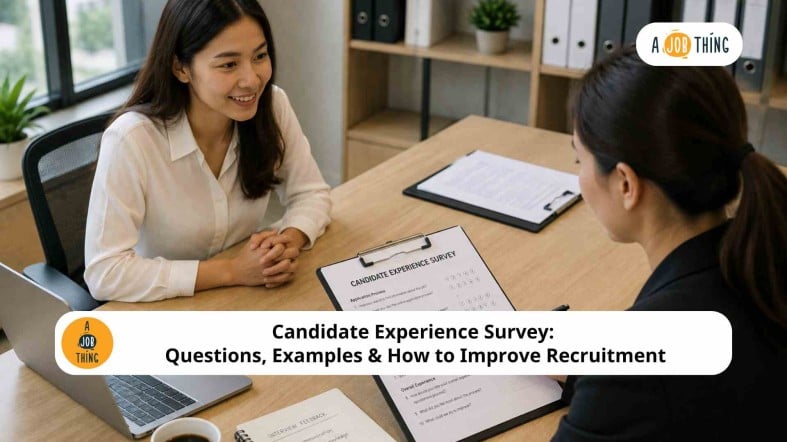
Candidate Experience Survey: Questions, Examples & How to Improve Recruitment

Are You Hiring?
Find candidates in 72 Hours with 5+ million talents in Maukerja Malaysia & Ricebowl using Job Ads.
Hire Now
A candidate's experience starts before the first interview. It includes every interaction they have with an employer, from finding a job advertisement and submitting an application to attending interviews and receiving a final decision.
A candidate experience survey helps employers collect feedback about these interactions and understand what candidates think about the recruitment process.
By asking candidates directly, HR teams can identify problems, improve communication, reduce unnecessary friction, and create a better hiring experience.
What Is a Candidate Experience Survey?
A candidate experience survey is a questionnaire used to collect feedback from job candidates about their experience during the recruitment process.
The survey can cover different stages, including:
-
Finding and viewing the job advertisement
-
Applying for a position
-
Receiving application updates
-
Communicating with recruiters
-
Scheduling interviews
-
Attending interviews
-
Completing assessments
-
Receiving interview feedback
-
Receiving a job offer or rejection
The purpose is not simply to find out whether candidates are satisfied.
A useful candidate experience survey should help HR answer three questions:
-
What is working well?
-
Where are candidates experiencing problems?
-
What should we improve?
SHRM recommends collecting candidate feedback at important stages of the hiring process because it can help employers identify strengths and weaknesses in their recruitment process.
Why Is a Candidate Experience Survey Important?
Candidates are evaluating an employer throughout the recruitment process.
A complicated application, unclear job description, slow communication, or poor interview experience can affect how candidates view the company.
Candidate feedback can help HR identify problems that may not be obvious from recruitment metrics alone.
For example, HR may notice that many candidates are dropping out after interviews. Survey responses could reveal that candidates are waiting too long for feedback or do not understand what happens next.
SHRM's reporting on candidate experience research has highlighted poor communication, lengthy hiring processes, and lack of feedback as common reasons candidates withdraw from recruitment.
A survey can therefore give HR another way to understand why candidates behave differently at different stages of the recruitment funnel.
What Should a Candidate Experience Survey Measure?
A useful survey should cover the main stages of the candidate journey.
1. Job Advertisement
Measure whether candidates understood:
-
The job responsibilities
-
Required qualifications
-
Salary or benefits information, where provided
-
Application requirements
2. Application Process
Ask whether the application was:
-
Easy to complete
-
Clear
-
Reasonably short
-
Easy to navigate
3. Communication
Measure:
-
Response times
-
Frequency of updates
-
Clarity of communication
-
Information about next steps
4. Interview Experience
Ask about:
-
Interview scheduling
-
Interviewer preparation
-
Professionalism
-
Questions asked
-
Opportunity to ask questions
-
Understanding of the role
5. Assessment Process
If assessments or tests are used, ask whether:
-
Instructions were clear
-
The assessment was relevant to the role
-
Candidates had enough information to complete it
-
The amount of time required was reasonable
6. Final Decision
Ask candidates about:
-
How the final decision was communicated
-
Timeliness of the response
-
Clarity of the communication
-
Overall experience
CIPD recommends that employers clearly explain what candidates should expect from the selection process, including the process, timing, technology used, and assessments involved.
When Should You Send a Candidate Experience Survey?
There is no need to wait until the entire recruitment process is finished.
HR can collect feedback at different points in the candidate journey.
After the Application
Ask about the job advertisement and application process.
This can help identify problems such as confusing job information or an application that takes too long.
After an Interview
Ask about:
-
Interview scheduling
-
Interviewer communication
-
Professionalism
-
Clarity of the role
-
Next steps
After an Assessment
Ask candidates whether the instructions were clear and whether the assessment was relevant and reasonable.
After the Recruitment Process
Ask candidates to rate their overall experience and provide suggestions for improvement.
Collecting feedback at different stages can help HR identify problems while they are still closely connected to a particular part of the recruitment process. SHRM has recommended surveying candidates at different stages rather than only collecting feedback from successful hires.
Candidate Experience Survey Questions
The best questions depend on where the candidate is in the recruitment process.
Application Experience Questions
-
How easy was it to apply for this position?
-
Was the job description clear and easy to understand?
-
Was the application process easy to complete?
-
Did the application require a reasonable amount of information?
-
How satisfied were you with the application process?
Communication Questions
-
How satisfied were you with communication during the recruitment process?
-
Did you receive enough updates about your application?
-
Were the next steps clearly explained?
-
Did you receive responses to your questions within a reasonable time?
-
Was the recruitment timeline clearly communicated?
Interview Experience Questions
-
How would you rate your interview experience?
-
Was the interviewer prepared for the interview?
-
Did the interviewer explain the role clearly?
-
Did you have enough opportunity to ask questions?
-
Did the interview feel professional and respectful?
-
Were the next steps explained after the interview?
Assessment Questions
-
Were the assessment instructions clear?
-
Was the assessment relevant to the position?
-
Was the amount of time required reasonable?
-
Were you given enough information to complete the assessment?
Overall Candidate Experience Questions
-
How satisfied were you with the overall recruitment process?
-
Did the recruitment process meet your expectations?
-
Did you feel respected throughout the recruitment process?
-
How likely are you to recommend this company to another job seeker?
-
Would you consider applying for another position with this company?
Open-Ended Candidate Experience Survey Questions
Rating questions make results easier to compare, but open-ended questions can reveal issues that numbers cannot explain.
Consider asking:
-
What did you like most about the recruitment process?
-
What could we have done better?
-
Was there anything that made the process difficult?
-
Was there any point where you felt unclear about what would happen next?
-
What is one thing you would change about the recruitment process?
-
Is there anything else you would like to share?
For example:
What could we have done to improve your recruitment experience?
This type of question gives candidates an opportunity to explain their experience in their own words.
SHRM recommends including open-ended questions because they can provide more detailed feedback than rating questions alone.
Candidate Experience Survey Rating Scale
A consistent rating scale makes survey results easier to analyse.
For example:
How satisfied were you with the recruitment process?
-
Very dissatisfied
-
Dissatisfied
-
Neutral
-
Satisfied
-
Very satisfied
You can use the same scale for different stages of recruitment.
For recommendation-based questions, you can use a 0–10 scale:
How likely are you to recommend this company's recruitment process to another job seeker?
The important thing is to use a consistent approach so results can be compared over time.
Candidate Experience Survey Template
HR teams can use this simple candidate experience survey template and adjust it based on the recruitment stage.
|
Survey Question |
Response Type |
|
How easy was it to apply? |
1–5 rating |
|
Was the job description clear? |
1–5 rating |
|
How satisfied were you with communication? |
1–5 rating |
|
Were the next steps clearly explained? |
1–5 rating |
|
How would you rate the interview experience? |
1–5 rating |
|
Did the interviewer explain the role clearly? |
1–5 rating |
|
Did you feel respected throughout the process? |
1–5 rating |
|
Was the recruitment timeline reasonable? |
1–5 rating |
|
How satisfied were you with the overall process? |
1–5 rating |
|
Would you recommend the company to another candidate? |
0–10 rating |
|
What could we improve? |
Open text |
The survey does not need to include every question.
For example, a survey sent immediately after an application does not need questions about the final job offer.
How to Analyse Candidate Experience Survey Results
Collecting responses is only the first step.
HR teams should turn the feedback into actionable insights.
Calculate Average Scores
For questions using a 1–5 scale, calculate the average score.
For example:
|
Area |
Average Score |
|
Application |
4.3/5 |
|
Communication |
3.2/5 |
|
Interview |
4.1/5 |
|
Overall Experience |
3.7/5 |
In this example, communication has the lowest score and may need further investigation.
Compare Different Recruitment Stages
Review results separately for:
-
Application
-
Screening
-
Interview
-
Assessment
-
Offer
-
Overall experience
This can show where candidate satisfaction decreases.
Review Candidate Comments
Look for repeated feedback.
For example, if several candidates say:
"I did not know when I would receive an update."
HR may need to improve communication and set clearer expectations.
Compare Results Over Time
Track survey results monthly or quarterly.
For example:
|
Month |
Overall Score |
|
January |
3.4/5 |
|
February |
3.7/5 |
|
March |
4.0/5 |
This can help HR determine whether changes to the recruitment process are improving the candidate experience.
SHRM recommends analysing candidate feedback alongside recruitment metrics so employers can identify obstacles within the hiring process.
How to Improve Candidate Experience Based on Survey Feedback
Survey results are only valuable when employers act on them.
If Candidates Say Applications Are Too Long
Remove unnecessary questions and simplify the application process.
If Candidates Say Communication Is Poor
Set clear response timelines and provide regular updates.
If Candidates Say Interviews Are Unclear
Give interviewers structured guidelines and make sure they understand the role and hiring requirements.
If Candidates Wait Too Long for Feedback
Set internal deadlines for recruiters and hiring managers to provide interview feedback.
If Candidates Say the Job Description Is Unclear
Review job advertisements and make responsibilities, requirements, working arrangements, and expectations clearer.
If Candidates Say the Process Takes Too Long
Review each recruitment stage and remove unnecessary steps.
CIPD recommends making selection processes clear and transparent, explaining what candidates should expect, and avoiding recruitment processes that are unnecessarily long.
If Candidates Report an Unfair Experience
Review whether the recruitment process is consistent and structured across candidates.
CIPD's evidence review on fair selection highlights the importance of fair, structured, and transparent selection practices for both candidate experience and better recruitment outcomes.
Best Practices for Candidate Experience Surveys
Keep the Survey Short
Candidates are more likely to complete a survey when it is simple and focused.
You do not need to ask every possible question. Choose questions that can help you make decisions.
Ask Questions at the Right Stage
Do not ask candidates to rate an interview they have not completed.
Match the survey questions to the candidate's current stage.
Include Open-Ended Questions
Rating questions tell you what candidates think.
Open-ended questions can help explain why.
Ask Different Types of Candidates
Do not collect feedback only from successful candidates.
Candidates who were rejected or withdrew can also provide useful information about the recruitment process.
Protect Candidate Privacy
If possible, make it clear how survey responses will be used and whether feedback is anonymous.
Candidates may be more comfortable providing honest feedback when they understand that their responses will not affect their application.
Compare Feedback With Recruitment Data
Do not look at survey scores in isolation.
Compare candidate feedback with metrics such as:
-
Application completion rate
-
Time to hire
-
Interview attendance
-
Offer acceptance rate
This can help HR understand whether a problem is affecting both candidate sentiment and recruitment performance.
Act on the Feedback
Do not collect survey responses simply to create a report.
Use the results to identify problems, make improvements, and measure whether those changes work.
Candidate experience should be treated as an ongoing improvement process rather than a one-time survey exercise.
Candidate Experience Survey vs Candidate Satisfaction Survey
These terms are closely related but can have different focuses.
A candidate experience survey looks at the candidate's interactions throughout the recruitment journey.
A candidate satisfaction survey focuses more specifically on how satisfied candidates are with the recruitment experience.
|
Survey Type |
Main Focus |
|
Candidate Experience Survey |
The candidate's overall recruitment journey |
|
Candidate Satisfaction Survey |
How satisfied the candidate was |
|
Interview Feedback Survey |
The interview experience |
|
Application Feedback Survey |
The application experience |
A candidate experience survey can include satisfaction questions, but it should also examine specific interactions and recruitment stages.
How Candidate Experience Surveys Can Improve Hiring
Candidate surveys can help HR connect candidate feedback with recruitment performance.
For example:
Survey Feedback: Candidates say interview scheduling is slow.
↓
HR Action: Improve interview scheduling and communication.
↓
Recruitment Result: Candidates receive faster updates and move through the process more smoothly.
The same approach can be applied to communication, application complexity, interviews, assessments, and other recruitment stages.
This creates a continuous feedback loop:
Collect Feedback → Identify Problems → Make Changes → Measure Results → Improve Again
The goal is not simply to achieve a higher survey score.
It is to create a recruitment process that is clear, efficient, consistent, and respectful of candidates' time.
FAQs
What is a candidate experience survey?
A candidate experience survey is a questionnaire used by employers to collect feedback about a candidate's experience during the recruitment process.
What questions should a candidate experience survey include?
Questions can cover the job advertisement, application process, communication, screening, interviews, assessments, recruitment timeline, and overall experience.
When should HR send a candidate experience survey?
HR can send surveys after an application, interview, assessment, or completed recruitment process. Collecting feedback at different stages can provide a clearer view of the candidate journey.
How long should a candidate experience survey be?
There is no fixed number of questions. Keep the survey focused and ask questions that can help HR make improvements.
How can HR improve candidate experience?
HR can improve candidate experience by simplifying applications, communicating regularly, setting clear expectations, respecting candidates' time, improving interviews, reducing unnecessary delays, and acting on candidate feedback.
Improve Your Recruitment Process
%20copy.jpg)
Candidate feedback can help HR identify what works and where the recruitment process needs improvement.
With AJobThing, employers can post job ads, reach candidates, and manage applications more efficiently throughout the hiring process.
Post your job with AJobThing and start reaching candidates today.
Read More:
-
How to Reduce Hiring Bias: Common Interview Biases HR Professionals Should Avoid
-
Staff Immediate Resignation in Malaysia: Employer Rights & Responsibilities
-
Late Salary Payment in Malaysia: Can Employers Delay Employee Salaries?
-
Internship vs Apprenticeship in Malaysia: Key Differences for Employers & HR
-
How to Manage Underperforming Employees in Malaysia: Tips for Employers & HR
-
Warning Letter for Poor Performance in Malaysia: How to Write One (With Sample)
-
Can Employers Reject Annual Leave in Malaysia? Rights, Rules & Employee Entitlements
-
Payroll and Attendance Management in Malaysia: Process, Formula & Best Practices for Employers
-
Workplace Conflict Management in Malaysia: Causes, Solutions, and Best Practices
-
Recruitment Process Outsourcing (RPO): What It Is, Benefits & How It Works in Malaysia
-
SME Hiring Guide: How to Plan, Hire, and Grow Your Team Successfully
-
Competency-Based Interviews: Improve Hiring Quality with a Consistent Interview Process
-
Leave Encashment Malaysia: How to Calculate Unused Annual Leave
-
Online Seller Requirements in Malaysia: 10 Business Details You Must Display
-
Performance Bonus in Malaysia: How It Works, Calculation & Employer Guide
-
Cost Per Hire Malaysia: Formula, Examples & How Employers Can Reduce Hiring Costs
-
Letter of Extension of Contract Malaysia: Free Template, Format & Sample
-
Promotion Letter in Malaysia: How to Write One (+ Free Template & Sample)
-
Probation Extension Letter Malaysia: Template, Sample, and What Employers Need to Know
-
Talent Pool: Benefits, Examples & How to Build One for Better Hiring
-
Sales Turnover: What It Is, Formula, Examples & Tips to Increase It
-
Overtime Rates in Malaysia: When Do 1.5x, 2x and 3x Pay Apply?
-
Prorated Salary in Malaysia: How to Calculate an Employee's First Salary
-
Remote Jobs in Malaysia: Most In-Demand Roles, Salaries & Hiring Guide (2026)
-
Effective Ways to Reduce Absenteeism in the Workplace for HR & Employers
-
Medical Benefits for Employees in Malaysia: Types, Legal Requirements & Best Practices
-
Fresh Graduate Salary in Malaysia (2026): How Much Should Employers Pay?
-
Salary Benchmarking in Malaysia: Are You Paying Enough to Attract Candidates?
-
e-Invoicing Malaysia Explained: What Every Employer and Business Needs to Know
-
EOR vs PEO: What's the Difference and Which Is Right for Your Business?
-
Remote Job Offer Letter: What Employers Should Include (+ Example)
-
Job Offer Letter vs. Employment Contract: What's the Difference? (+ Free Templates)
-
Constructive Dismissal Malaysia: Meaning, Examples & What To Do
-
Contract of Service vs Contract for Service Malaysia: How to Classify Workers Correctly
-
Job Offer Letter Templates: Examples, Formats & Best Practices for HR
-
Employee Retention in Malaysia: Meaning, Importance & How to Improve It
-
Employee Turnover in Malaysia: Causes, Warning Signs & How to Reduce It
-
Retrenchment in Malaysia: Meaning, Process & Employee Rights
-
Gmail Templates for HR: Faster Replies for Interviews, Offers & Rejections
-
7 Key Contract Employee Rights in Malaysia Every HR Should Know
-
GLC vs Private Company Malaysia: Salary, Culture & Hiring Differences
-
Types of Payroll Calculation in Malaysia: Adhoc, Prorated Salary & Final Settlement Explained
-
Types of Payroll Cycle in Malaysia: Which One Is Best for Your Business?
-
Types of Insurance in Malaysia and Their Impact on Employee Benefits
-
How to Create a Strong Candidate Shortlist for Better Hiring Decisions
-
How HR in Malaysia Can Offer a Job Over the Phone (with Script)
-
How Notice Period Really Works in Malaysia for Employers and HR
-
How to Create a Job Posting That Attracts the Right Candidates
-
How HR in Malaysia Can Improve Resume Screening and Candidate Shortlisting
-
How HR Can Reject a Candidate the Right Way (with Templates)
-
How to Conduct a Background Check for Employment in Malaysia
-
Onboarding Process Tips: What HR Needs to Know for Better Retention
-
Onboarding Checklist for New Hires (Free Downloadable Template)
-
Performance Evaluation: Description, Types, and How to Conduct
-
Cover Letter Examples Employers Should Know (With Tips to Spot the Best Ones)
-
Step-by-Step Guide to Writing a Great Job Description (Free Templates)