

Cost Per Hire Malaysia: Formula, Examples & How Employers Can Reduce Hiring Costs

Are You Hiring?
Find candidates in 72 Hours with 5+ million talents in Maukerja Malaysia & Ricebowl using Job Ads.
Hire Now
Do you know how much it actually costs your company to hire one employee?
Many employers focus on salary when planning to hire, but recruitment comes with many other expenses. Job advertisements, HR staff time, interviews, recruitment agency fees, and assessment tools all add up.
That's why tracking cost per hire is important. It helps Malaysian employers understand how much they spend to fill each vacancy, identify unnecessary costs, and make better hiring decisions.
What Is Cost Per Hire?
Cost per hire is the average amount your company spends to hire one employee. It includes both internal recruitment costs, such as HR staff time, and external costs, such as job portal advertising or recruitment agency fees.
Tracking this metric helps employers plan recruitment budgets and measure whether their hiring process is cost-effective.
The Cost Per Hire Formula
Cost Per Hire = (Total Internal Costs + Total External Costs) ÷ Total Number of Hires
Example
A company hired 5 employees in one month.
|
Cost Item |
Amount (RM) |
|
HR staff time |
4,000 |
|
Interview expenses |
800 |
|
Job portal advertising |
2,500 |
|
Recruitment agency fee |
6,000 |
|
Background checks |
700 |
|
Total Recruitment Cost |
14,000 |
Cost Per Hire = RM14,000 ÷ 5 = RM2,800
In this example, the company spent RM2,800 to hire each employee.
What Counts as Internal Recruiting Costs?
Internal costs are expenses that come from within your organisation.
These may include:
-
HR staff time – Time spent screening resumes, arranging interviews, and preparing offer letters.
-
Hiring manager time – Managers involved in interviews and candidate evaluations.
-
Employee referral bonuses – Rewards paid to employees for successful referrals.
-
Interview expenses – Meeting rooms, refreshments, or travel reimbursements.
-
Recruitment software – Applicant Tracking Systems (ATS) or HR software subscriptions.
-
Training for recruiters – Courses or workshops related to recruitment.
One of the most commonly overlooked costs is HR staff time. Although no external payment is made, it is still a business cost.
What Counts as External Recruiting Costs?
External costs are payments made to third-party providers.
Common examples include:
-
Job portal advertising (such as AJobThing, LinkedIn Jobs, and others)
-
Recruitment agency fees (typically around 15%–20% of a candidate's annual salary in Malaysia, depending on the role and agreement)
-
Assessment and psychometric tests
-
Career fair participation
-
Employer branding campaigns
-
Recruitment marketing services
Cost Per Hire Benchmarks in Malaysia
There is no fixed "ideal" cost per hire. The amount depends on the role, industry, hiring urgency, company size, and whether you use a recruitment agency.
|
Position Level |
Estimated Cost Per Hire |
|
Entry-level |
RM800 – RM2,000 |
|
Executive |
RM2,000 – RM4,500 |
|
Senior Executive |
RM3,500 – RM7,000 |
|
Manager |
RM5,000 – RM12,000 |
|
Senior Manager / Specialist |
RM10,000 – RM20,000+ |
These figures are estimates and should only be used as a general guide.
Why Cost Per Hire Matters
Knowing your cost per hire helps you identify where your recruitment budget is going. Many employers are surprised to find that interview time, HR resources, and agency fees make up a significant portion of their hiring costs.
It also helps justify recruitment budgets. Instead of estimating expenses, HR teams can present actual hiring costs backed by data.
Tracking cost per hire also shows which recruitment channels deliver the best value. For example, one job portal may consistently generate quality hires at a lower cost than another.
Finally, cost per hire should be viewed together with quality of hire. Spending less is good, but not if new hires leave after a few months or fail to perform.
How to Reduce Cost Per Hire in Malaysia
1. Build an Employee Referral Programme
Encourage employees to refer suitable candidates. Referral hires are often faster and cost less than sourcing through external agencies.
2. Use Job Portals Strategically
Choose job portals that provide strong reach at a reasonable cost. AJobThing helps employers reach millions of job seekers across Malaysia through platforms such as Maukerja, Ricebowl, and Epicareer, making it a cost-effective option for many hiring needs.
3. Reduce Recruitment Agency Dependency
Recruitment agencies are valuable for executive or niche positions, but relying on them for every vacancy can significantly increase hiring costs. Consider handling standard roles internally whenever possible.
4. Build a Talent Pipeline
Keep promising candidates in your database, even if they were not hired previously. This reduces sourcing time when new vacancies become available.
5. Strengthen Your Employer Brand
Candidates are more likely to apply to companies with a positive reputation. A strong employer brand can reduce advertising costs while increasing application quality.
6. Streamline Your Hiring Process
Long recruitment processes often lead to candidate drop-offs and repeated advertising. Review each hiring stage to remove unnecessary delays.
7. Use an Applicant Tracking System (ATS)
An ATS helps organise applications, automate repetitive tasks, and reduce the administrative workload for HR teams, improving overall recruitment efficiency.
Cost Per Hire vs Other Recruitment Metrics
|
Metric |
Measures |
|
Cost Per Hire |
Average hiring cost for each employee |
|
Time to Fill |
Days taken to fill a vacancy |
|
Quality of Hire |
Performance and long-term success of new hires |
|
Offer Acceptance Rate |
Percentage of candidates accepting job offers |
|
Source of Hire |
Where successful candidates came from |
|
90-Day Retention Rate |
Percentage of new hires who remain after three months |
Looking at these metrics together provides a clearer picture of your recruitment performance.
How to Track Cost Per Hire
Getting started is easier than many employers think.
-
Decide the period you want to measure (monthly, quarterly, or yearly).
-
Add up all internal recruitment costs.
-
Add up all external recruitment costs.
-
Count the total number of successful hires.
-
Apply the cost per hire formula and compare the results over time.
Tracking the same metric consistently helps identify trends and opportunities to reduce recruitment costs.
Cost Per Hire Calculator
Use the table below to estimate your company's cost per hire.
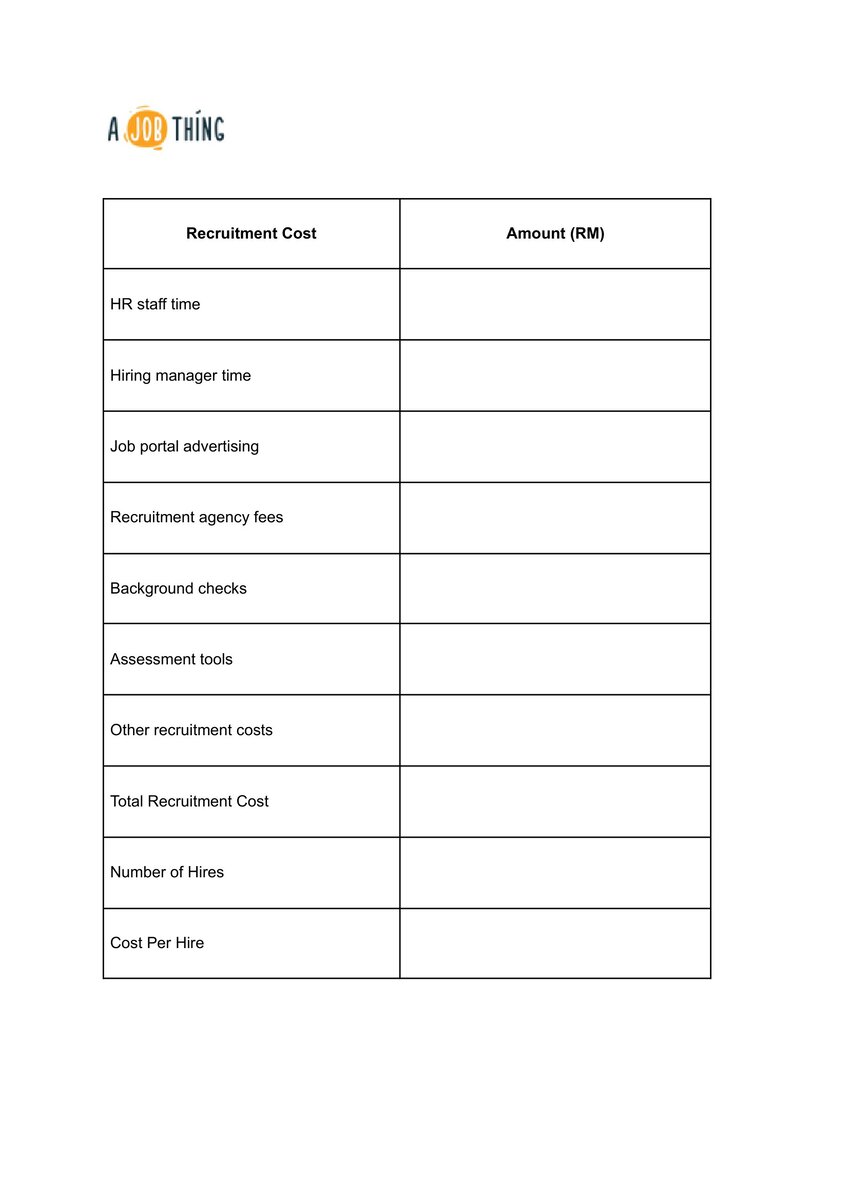
Download the document here.
Tip: If job portal advertising is your biggest external cost, compare platform rates before committing. AJobThing offers cost-effective job posting packages for Malaysian employers. Visit ajobthing.com/pricing to view the latest packages.
Disclaimer: The figures and benchmarks in this article are estimates based on the Malaysian market and may vary depending on company size, industry, hiring approach, and recruitment methods.
FAQs
Is there a standard cost per hire in Malaysia?
No. Cost per hire varies depending on the industry, job level, recruitment method, company size, and whether external agencies are used.
Should onboarding costs be included?
Generally, no. Cost per hire usually covers recruitment expenses up to the hiring stage. Costs such as orientation, training, EPF and SOCSO onboarding administration are often tracked separately as onboarding or new hire costs.
How often should I calculate cost per hire?
Most employers calculate it monthly or quarterly. Businesses with frequent hiring may prefer monthly tracking to identify changes more quickly.
What is the difference between cost per hire and cost of vacancy?
Cost per hire measures how much it costs to recruit someone. Cost of vacancy estimates the financial impact of leaving a position unfilled, such as lost productivity or sales.
Is a lower cost per hire always better?
Not necessarily. A very low cost per hire may lead to poor candidate quality if employers reduce spending on sourcing or screening. The goal is to balance cost with hiring quality.
How does recruitment agency use affect cost per hire?
Recruitment agencies can speed up hiring and provide access to specialised talent, but agency fees can significantly increase overall recruitment costs. Many employers reserve agency support for difficult-to-fill or senior positions.
Reduce Your Cost Per Hire
%20copy.jpg)
Hiring through the right recruitment channel can help lower your cost per hire while reaching more qualified candidates.
With AJobThing, employers can reach millions of job seekers across Malaysia through Maukerja, Ricebowl, and Epicareer.
View our job posting packages at ajobthing.com/pricing.
Read more:
-
Letter of Extension of Contract Malaysia: Free Template, Format & Sample
-
Promotion Letter in Malaysia: How to Write One (+ Free Template & Sample)
-
Probation Extension Letter Malaysia: Template, Sample, and What Employers Need to Know
-
Talent Pool: Benefits, Examples & How to Build One for Better Hiring
-
Sales Turnover: What It Is, Formula, Examples & Tips to Increase It
-
Overtime Rates in Malaysia: When Do 1.5x, 2x and 3x Pay Apply?
-
Prorated Salary in Malaysia: How to Calculate an Employee's First Salary
-
Remote Jobs in Malaysia: Most In-Demand Roles, Salaries & Hiring Guide (2026)
-
Effective Ways to Reduce Absenteeism in the Workplace for HR & Employers
-
Medical Benefits for Employees in Malaysia: Types, Legal Requirements & Best Practices
-
Fresh Graduate Salary in Malaysia (2026): How Much Should Employers Pay?
-
Salary Benchmarking in Malaysia: Are You Paying Enough to Attract Candidates?
-
e-Invoicing Malaysia Explained: What Every Employer and Business Needs to Know
-
EOR vs PEO: What's the Difference and Which Is Right for Your Business?
-
Remote Job Offer Letter: What Employers Should Include (+ Example)
-
Job Offer Letter vs. Employment Contract: What's the Difference? (+ Free Templates)
-
Constructive Dismissal Malaysia: Meaning, Examples & What To Do
-
Contract of Service vs Contract for Service Malaysia: How to Classify Workers Correctly
-
Job Offer Letter Templates: Examples, Formats & Best Practices for HR
-
Employee Retention in Malaysia: Meaning, Importance & How to Improve It
-
Employee Turnover in Malaysia: Causes, Warning Signs & How to Reduce It
-
Retrenchment in Malaysia: Meaning, Process & Employee Rights
-
Gmail Templates for HR: Faster Replies for Interviews, Offers & Rejections
-
7 Key Contract Employee Rights in Malaysia Every HR Should Know
-
GLC vs Private Company Malaysia: Salary, Culture & Hiring Differences
-
Types of Payroll Calculation in Malaysia: Adhoc, Prorated Salary & Final Settlement Explained
-
Types of Payroll Cycle in Malaysia: Which One Is Best for Your Business?
-
Types of Insurance in Malaysia and Their Impact on Employee Benefits
-
How to Create a Strong Candidate Shortlist for Better Hiring Decisions
-
How HR in Malaysia Can Offer a Job Over the Phone (with Script)
-
How Notice Period Really Works in Malaysia for Employers and HR
-
How to Create a Job Posting That Attracts the Right Candidates
-
How HR in Malaysia Can Improve Resume Screening and Candidate Shortlisting
-
How HR Can Reject a Candidate the Right Way (with Templates)
-
How to Conduct a Background Check for Employment in Malaysia
-
Onboarding Process Tips: What HR Needs to Know for Better Retention
-
Onboarding Checklist for New Hires (Free Downloadable Template)
-
Performance Evaluation: Description, Types, and How to Conduct
-
Cover Letter Examples Employers Should Know (With Tips to Spot the Best Ones)
-
Step-by-Step Guide to Writing a Great Job Description (Free Templates)