
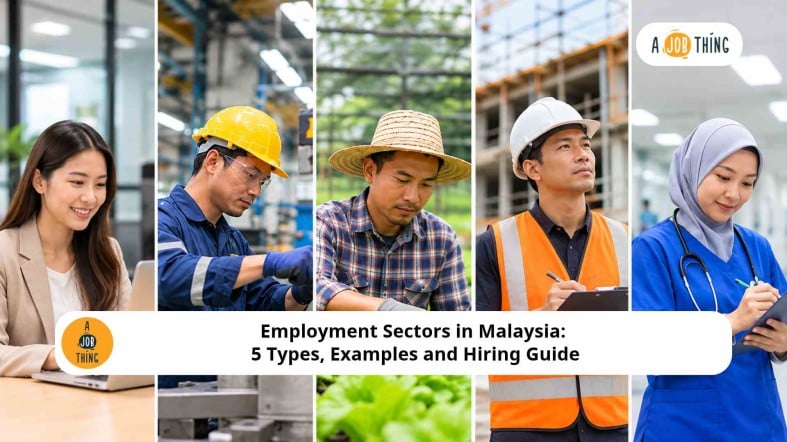
Employment Sectors in Malaysia: 5 Types, Examples and Hiring Guide

Are You Hiring?
Find candidates in 72 Hours with 5+ million talents in Maukerja Malaysia & Ricebowl using Job Ads.
Hire Now
Employment sectors in Malaysia refer to the five main categories of economic activity: Agriculture, Mining and Quarrying, Manufacturing, Construction and Services. Each sector has different business operations, job opportunities and workforce requirements. Understanding these sectors helps Malaysian employers, HR professionals and business owners plan recruitment, identify skills needs and manage their workforce more effectively.
Whether you operate a manufacturing company, retail business, construction firm or professional services company, understanding your employment sector can help you make better workforce decisions.
What Is An Employment Sector?
An employment sector refers to a category of economic activity that groups businesses and organisations based on the main products they produce or services they provide.
For example, companies involved in producing electronic components belong to the Manufacturing sector, while businesses providing transportation, banking or retail services generally fall under the Services sector.
In Malaysia, the Department of Statistics Malaysia (DOSM) uses five major economic activity categories in its Employment Statistics:
- Agriculture
- Mining and Quarrying
- Manufacturing
- Construction
- Services
These categories help organise labour demand data and provide information about the number of jobs, filled positions, vacancies and jobs created across different industries.
For employers, understanding the employment sector is useful when conducting workforce planning, identifying required skills and comparing recruitment needs with businesses operating in similar industries.
What Is The Difference Between An Employment Sector, Industry And Occupation?
Although these terms are related, they describe different things.
| Term | Meaning | Example |
| Employment Sector | A broad category of economic activity | Manufacturing |
| Industry | A specific type of business activity | Semiconductor manufacturing |
| Occupation | The type of work performed by an individual | Production Operator |
For example, a semiconductor manufacturing company belongs to the Manufacturing sector. However, its employees may work in different occupations, including engineering, production, quality control, finance and human resources.
An important point for employers is that a company's economic sector is generally determined by its principal business activity, not every individual job position within the organisation.
Businesses can refer to DOSM's Malaysian Standard Industrial Classification (MSIC) to understand how economic activities are classified in Malaysia.
What Are The Five Main Employment Sectors In Malaysia?
Malaysia's economy consists of different industries, but they can be grouped into five major economic sectors.
Each sector has different business activities, job functions and workforce requirements. Understanding these differences helps employers identify the types of employees they may need and prepare suitable recruitment strategies.
1. Agriculture Sector
The Agriculture sector covers businesses involved in growing crops, raising livestock, forestry, fishing and other agricultural activities.
Malaysia has an established agricultural industry, particularly in oil palm, rubber, food production and fisheries.
Examples Of Industries Within The Agriculture Sector:
- Oil palm and rubber plantations.
- Crop and vegetable farming.
- Livestock and poultry farming.
- Fisheries and aquaculture.
- Forestry and logging.
Common Job Positions:
| Job Position | Main Responsibilities |
| Farm Worker | Handles daily farming and agricultural activities |
| Plantation Supervisor | Oversees plantation operations and workers |
| Agricultural Technician | Supports agricultural equipment and technical activities |
| Livestock Assistant | Assists with animal care and farm operations |
| Quality Control Assistant | Checks agricultural products against quality requirements |
| Farm Operations Manager | Manages farm operations, resources and productivity |
What Should Employers Consider When Hiring?
Agricultural businesses may have different workforce requirements depending on their location, production schedules and seasonal demand.
Employers should consider:
- Whether additional workers are required during harvesting periods.
- The availability of candidates near plantations or farming locations.
- Training requirements for operating agricultural equipment.
- Transportation and accommodation arrangements where relevant.
- Workplace safety and physical job requirements.
- The need for supervisors who can manage workers across different sites.
For example, an oil palm plantation may need additional harvesting workers during certain operating periods. HR teams should plan staffing requirements based on plantation size, harvesting schedules and expected production needs.
HR Recommendation: Build a recruitment plan around production and harvesting schedules. Employers should also identify suitable local recruitment channels and prepare clear job requirements before hiring additional workers.
2. Mining And Quarrying Sector
The Mining and Quarrying sector involves extracting natural resources from the ground, including minerals, crude petroleum, natural gas and other materials.
In Malaysia, this sector includes businesses involved in oil and gas extraction, mineral mining, quarrying and supporting mining activities.
Examples Of Industries Within The Mining And Quarrying Sector:
- Oil and gas extraction.
- Natural gas production.
- Mineral mining.
- Quarrying of stone, sand and clay.
- Mining support services.
Common Job Positions:
| Job Position | Main Responsibilities |
| Mining Engineer | Plans and oversees mining operations |
| Geologist | Studies rock formations and mineral resources |
| Drilling Technician | Supports drilling activities and equipment |
| Heavy Equipment Operator | Operates machinery used in extraction activities |
| Maintenance Technician | Maintains industrial equipment and machinery |
| Health, Safety and Environment (HSE) Officer | Supports workplace safety and environmental requirements |
What Should Employers Consider When Hiring?
Recruitment in mining and quarrying may involve specialised technical requirements, workplace safety considerations and project-based staffing needs.
Employers should focus on:
- Relevant technical qualifications and experience.
- Industry-specific training and competencies.
- Equipment operation skills.
- Safety awareness and required certifications.
- Experience working in remote or industrial locations.
- Contractor and workforce coordination.
For example, an oil and gas company may need experienced technicians, engineers and maintenance personnel for specific projects.
The recruitment process should clearly identify the technical requirements and relevant experience needed for each position.
HR Recommendation: Identify essential technical qualifications and safety competencies before advertising vacancies. Avoid using general job requirements for highly specialised positions because employers need to assess candidates against the actual work and safety requirements.
3. Manufacturing Sector
The Manufacturing sector involves businesses that transform raw materials, components or parts into finished or semi-finished products.
Malaysia's manufacturing industry includes electronics, electrical equipment, food processing, chemicals, machinery, automotive components and other manufactured goods.
Examples Of Industries Within The Manufacturing Sector:
- Electrical and electronics manufacturing.
- Semiconductor production.
- Food and beverage manufacturing.
- Automotive and automotive components.
- Chemical and pharmaceutical manufacturing.
- Textile and apparel production.
- Machinery and equipment manufacturing.
Common Job Positions:
| Job Position | Main Responsibilities |
| Production Operator | Operates machines and supports production activities |
| Quality Control Inspector | Checks products for defects and quality standards |
| Production Supervisor | Oversees production teams and daily output |
| Manufacturing Engineer | Improves manufacturing processes and production efficiency |
| Maintenance Technician | Performs equipment maintenance and repairs |
| Warehouse Assistant | Manages inventory and supports material movement |
| Production Planner | Coordinates production schedules and resources |
What Should Employers Consider When Hiring?
Manufacturing companies often require a combination of operational workers, technical specialists, supervisors and engineering professionals.
Some positions require previous experience, while others may be suitable for entry-level employees who can receive workplace training.
Employers should consider:
- Production volume and expected staffing requirements.
- Shift arrangements and working schedules.
- Machine operation and technical skills.
- Quality control requirements.
- Workplace safety and equipment training.
- The availability of candidates near manufacturing locations.
For example, a semiconductor manufacturer may need technicians and production operators who can follow specific manufacturing procedures and quality requirements.
A company experiencing increased production orders may also need additional operators, quality inspectors and maintenance personnel to support its operations.
Hiring Tip: Employers should distinguish between positions requiring previous technical experience and entry-level positions where suitable candidates can be trained. This can help widen the potential candidate pool.
For more recruitment guidance, read our article on Hiring Production Workers In Malaysia: How Employers Can Find Skilled Staff.
4. Construction Sector
The Construction sector includes businesses involved in building development, infrastructure projects, civil engineering and specialised construction activities.
This sector plays an important role in residential and commercial development, road construction, public infrastructure and industrial projects.
Examples Of Industries Within The Construction Sector:
- Residential and commercial building construction.
- Infrastructure development.
- Road and highway construction.
- Civil engineering projects.
- Electrical and plumbing installation.
- Specialised construction activities.
Common Job Positions:
| Job Position | Main Responsibilities |
| Construction Worker | Supports daily construction activities |
| Civil Engineer | Plans and oversees civil engineering work |
| Site Supervisor | Monitors daily site operations |
| Quantity Surveyor | Manages construction costs and project expenses |
| Project Manager | Oversees project delivery, schedules and resources |
| Electrical Technician | Handles electrical installation and maintenance |
| Safety Officer | Supports construction site safety requirements |
What Should Employers Consider When Hiring?
Construction companies may need to adjust their workforce according to project stages, deadlines and contract requirements.
Unlike businesses with consistent daily operations, some construction companies experience changing staffing needs depending on the projects they undertake.
Employers should consider:
- Project timelines and expected completion dates.
- The number of workers required at each project stage.
- Technical qualifications and relevant experience.
- Site location and worker availability.
- Equipment and safety training requirements.
- Coordination between permanent employees, subcontractors and project teams.
For example, a construction company starting a new commercial building project may need additional civil engineers, site supervisors, electricians and general construction workers.
HR teams should work closely with project managers to identify staffing requirements before major project activities begin.
HR Recommendation: Plan recruitment according to project milestones. Identify which positions are needed during each construction stage instead of hiring the entire workforce too early or waiting until deadlines become difficult to meet.
5. Services Sector
The Services sector includes businesses that provide services rather than primarily producing physical goods.
It covers a wide range of industries, making it the largest employment sector in Malaysia based on DOSM's Q3 2026 labour demand statistics.
Examples include retail, wholesale trade, hospitality, financial services, transportation, education, healthcare, information technology and professional services.
Examples Of Industries Within The Services Sector:
- Wholesale and retail trade.
- Food and beverage services.
- Accommodation and hospitality.
- Transportation and logistics.
- Banking and financial services.
- Information and communication technology.
- Education and healthcare.
- Professional and business services.
- Real estate and property services.
Common Job Positions:
| Industry | Common Job Positions |
| Retail | Sales Assistant, Cashier, Store Supervisor |
| Food and Beverage | Restaurant Manager, Service Crew, Kitchen Assistant |
| Hospitality | Hotel Receptionist, Front Office Executive |
| Logistics | Warehouse Assistant, Logistics Coordinator |
| Finance | Accountant, Finance Executive, Financial Analyst |
| Information Technology | Software Developer, IT Support Specialist |
| Education | Teacher, Academic Coordinator, Education Executive |
| Healthcare | Nurse, Medical Assistant, Healthcare Administrator |
| Professional Services | HR Executive, Marketing Executive, Business Consultant |
What Should Employers Consider When Hiring?
Because the Services sector covers many different industries, its recruitment requirements can vary significantly.
For example, a retail company may need employees with customer service and communication skills, while a technology company may require software development experience or specialised technical knowledge.
Employers should consider:
- Customer service and communication requirements.
- Technical and professional qualifications.
- Working hours and shift arrangements.
- Language requirements relevant to the role.
- Digital skills and technology knowledge.
- Recruitment requirements across different business locations.
For companies operating multiple outlets, HR teams may also need to coordinate recruitment across different branches.
For example, a retail business with outlets in Kuala Lumpur, Johor Bahru and Penang may need to recruit sales assistants, cashiers and store supervisors simultaneously.
For logistics and warehouse businesses, employers should also identify whether candidates need experience in inventory management, stock handling, picking and packing or warehouse systems.
Read our guides on How To Hire Warehouse Staff In Malaysia and How To Manage Recruitment For Multiple Branches In Malaysia.
HR Recommendation: Do not treat the entire Services sector as one recruitment market. A retail business, financial institution and technology company have very different hiring requirements. Define the actual job responsibilities, skills and working arrangements for each position.
Employment Sector Statistics In Malaysia: Which Sector Has The Most Jobs?
Understanding employment sector statistics helps business owners and HR teams see how employment is distributed across different industries.
According to DOSM's Employment Statistics for the Third Quarter of 2026, Malaysia recorded approximately 9.31 million jobs across registered private-sector business establishments.
Of these, 9.11 million jobs were filled, while approximately 196,700 remained vacant.
The Services sector accounted for the largest share of jobs, while Manufacturing recorded the largest share of vacancies.
Distribution Of Jobs By Employment Sector
The following table shows the percentage share of jobs across Malaysia's five main economic sectors.
| Employment Sector | Share Of Total Jobs |
| Services | 52.4% |
| Manufacturing | 27.6% |
| Construction | 13.7% |
| Agriculture | 5.5% |
| Mining And Quarrying | 0.8% |
| Total | 100% |
Source: DOSM Employment Statistics, Third Quarter 2026, released 12 November 2026.
The data shows that Services accounted for more than half of total jobs in the reporting dataset. Manufacturing was the second-largest sector, contributing more than one-quarter of the total.
Which Sector Has The Most Job Vacancies?
The number of jobs in a sector does not necessarily indicate how many vacancies employers are currently trying to fill.
DOSM reported approximately 196,700 vacancies in Q3 2026, with Manufacturing contributing the largest share.
| Employment Sector | Number Of Vacancies | Share Of Total Vacancies |
| Manufacturing | 116,100 | 59.0% |
| Agriculture | 30,700 | 15.6% |
| Construction | 26,200 | 13.3% |
| Services | 23,200 | 11.9% |
| Mining And Quarrying | Not separately stated in the release | 0.2% |
| Total | 196,700 | 100% |
Source: DOSM, Employment Statistics Q3 2026.
Manufacturing accounted for 59.0% of reported vacancies. Within this sector, electrical, electronic and optical products recorded 35,500 vacancies.
This is an important finding for employers because the sector with the largest workforce does not always have the largest share of vacancies.
For HR teams, this highlights the importance of monitoring actual recruitment demand instead of relying only on overall employment figures.
What Do These Employment Statistics Mean For Employers?
The Q3 2026 statistics provide several useful insights for workforce planning.
Services Has The Largest Employment Base
Services represented 52.4% of total jobs. Businesses in retail, hospitality, logistics, finance, healthcare and other service industries make up a substantial part of the reporting workforce.
Employers should plan their staffing requirements according to customer demand, operating hours, business locations and the skills needed for each service.
Manufacturing Has The Largest Share Of Vacancies
Manufacturing accounted for 59.0% of reported vacancies. This makes it important for manufacturers to review their recruitment channels, production staffing requirements and candidate availability.
For companies with recurring production vacancies, maintaining an organised candidate sourcing process can help HR respond to future hiring needs.
Semi-Skilled Jobs Represent A Major Part Of Labour Demand
DOSM reported that semi-skilled positions represented 62.0% of total jobs and 55.4% of vacancies in Q3 2026.
This highlights the importance of practical skills across Malaysian industries, including production, operations, retail, logistics and technical support.
Employers should consider candidates with relevant practical experience and transferable skills, rather than focusing only on academic qualifications.
Important: These percentages represent each sector's share of total reported jobs or vacancies. They are not the percentage of employees who are unemployed or the vacancy rate within each sector.
The statistics are based on DOSM's Quarterly Employment Survey among registered private-sector business establishments. They should not be interpreted as a complete count of all public and private employment in Malaysia.
For more information, refer to the official DOSM Employment Statistics Q3 2026 release.
What Is The Difference Between Economic Sectors, Public Sector And Private Sector?
The terms employment sector, public sector and private sector are sometimes used interchangeably. However, they describe different things.
An economic sector classifies businesses according to their main activities, while public and private sectors distinguish organisations based on their ownership or operating structure.
Economic Sector
This refers to the type of economic activity carried out by a business.
Examples include:
- Agriculture.
- Manufacturing.
- Construction.
- Services.
- Mining and Quarrying.
Public Sector
The public sector consists of government departments, agencies and other government-related organisations that provide public services.
Examples include:
- Government ministries.
- Public administration.
- Government schools.
- Public healthcare institutions.
Private Sector
The private sector includes businesses and organisations operated by private owners or companies.
Examples include:
- Manufacturing companies.
- Retail businesses.
- Private hospitals.
- Financial institutions.
- Technology companies.
A business can belong to a particular economic sector while operating in either the public or private sector.
For example, a government hospital and a private hospital both provide healthcare services. However, they belong to different ownership categories.
Understanding this distinction helps HR teams classify their organisations more accurately when reviewing employment information and workforce requirements.
Why Should Employers Understand Their Employment Sector?
Understanding the employment sector is not just about knowing which industry your company belongs to.
It also helps business owners and HR teams make better decisions about recruitment, employee management and long-term workforce planning.
Here are five important reasons.
Improve Workforce Planning
Different industries have different operating requirements.
A manufacturing company may need to plan staffing based on production volume and shift schedules, while a retail business may need additional employees during busy shopping periods.
Understanding your employment sector helps you estimate:
- How many employees are required.
- Which positions need to be filled.
- When additional employees may be needed.
- Which skills are important to business operations.
- Whether permanent, contract or temporary staffing arrangements are appropriate.
For example, a food manufacturing company expecting an increase in production orders may need additional production operators, quality control inspectors and warehouse assistants.
Planning these requirements early can help HR avoid unnecessary last-minute recruitment.
Identify The Right Skills And Qualifications
Different industries require different combinations of technical, professional and interpersonal skills.
For example:
| Industry | Skills Employers May Need |
| Manufacturing | Machine operation, quality control, technical knowledge |
| Construction | Project management, technical skills, site safety |
| Retail | Customer service, sales, communication |
| Finance | Financial reporting, accounting, analytical skills |
| Agriculture | Farm operations, equipment handling, agricultural knowledge |
| Information Technology | Programming, cybersecurity, system management |
Employers should identify the skills needed for each position rather than relying only on job titles.
This can also help HR identify candidates with transferable skills from related industries.
Set More Relevant Salary Benchmarks
Salary expectations can vary across industries, positions, locations and experience levels.
A company hiring an experienced engineer may need a different salary budget from a business recruiting an entry-level administrative assistant.
Understanding your employment sector helps HR compare salary information from more relevant roles and industries.
When reviewing salary benchmarks, consider:
- Job responsibilities.
- Required experience.
- Technical qualifications.
- Location.
- Company size.
- Market demand for specific skills.
Avoid setting salaries based only on broad industry averages. Compare jobs with similar responsibilities and requirements.
For further guidance, read AJobThing's Malaysia Salary Guide 2026: Salary Benchmarks By Industry.
You can also refer to Salary Structure In Malaysia: How To Create Job Grades And Pay Ranges to understand how to organise salary bands within your company.
Choose More Suitable Recruitment Channels
Not every recruitment channel works equally well for every industry.
For example, companies recruiting production operators or warehouse assistants may need to focus on job advertising platforms and candidates near their operating locations.
Meanwhile, employers looking for experienced IT specialists or finance professionals may benefit from targeted candidate sourcing and professional networks.
Choosing recruitment channels based on job requirements can help HR teams reach more relevant candidates.
A strong recruitment strategy should consider the type of candidates required, sourcing channels, screening process and hiring budget.
Prepare For Business And Workforce Changes
Industries can change because of technology, customer demand, competition, investment and new business requirements.
Employers should monitor these changes to understand whether their current workforce has the right skills and capacity.
For example, a traditional retail business expanding into e-commerce may need employees with experience in digital marketing, online order management, inventory systems and logistics.
Understanding these changes allows employers to prepare their workforce before new requirements become urgent.
For more insights, read Malaysia Calls For Better Workforce Planning As AI, Gig Economy And E-Commerce Reshape Jobs.
How Can HR And Business Owners Plan Recruitment Based On Their Employment Sector?
Knowing your company's employment sector is only the starting point. The next step is translating that information into a practical recruitment plan.
Here are six steps employers can follow.
Identify Your Company's Main Business Activity
Start by identifying the main activity that generates your company's products, services or revenue.
For statistical and industry classification purposes, businesses are generally classified according to their principal economic activity.
For example, a company that manufactures furniture may employ accountants, HR executives, salespeople and warehouse assistants.
However, its main economic activity remains Manufacturing rather than being separately classified into Finance, HR, Sales and Logistics based on every department.
Employers can refer to the Malaysian Standard Industrial Classification (MSIC) through DOSM to understand the relevant industry classifications.
Identify Current And Future Manpower Requirements
Work with department managers to understand the company's current staffing needs and upcoming business plans.
Consider:
- Current employee numbers.
- Existing vacancies.
- Expected employee resignations.
- Business expansion plans.
- New projects or contracts.
- Skills required for future operations.
For example, a logistics company planning to expand its warehouse operations may need additional warehouse assistants, forklift operators, inventory coordinators and operations supervisors.
Identify Skills Gaps Within The Organisation
Once hiring requirements are clear, compare the skills your company needs with the capabilities of its existing employees.
This can help HR determine whether the company should:
- Recruit new employees.
- Provide additional employee training.
- Introduce internal transfers.
- Promote suitable employees.
- Hire specialised professionals.
Not every workforce gap requires external recruitment. Some positions may be filled by employees who already understand the company's operations.
Plan Your Recruitment Budget
Recruitment costs can vary depending on the number of vacancies, position requirements, sourcing channels and hiring timelines.
Employers should estimate:
- Job advertising costs.
- Recruitment platform subscriptions.
- Candidate assessment costs.
- Interview and recruitment administration expenses.
- Employee onboarding and training costs.
A clear recruitment budget helps business owners understand the cost of expanding their workforce.
When setting salary offers, also consider the role, experience and market rate. Refer to AJobThing's Malaysia Salary Guide 2026 for additional salary benchmarking information.
Choose Suitable Candidate Sourcing Methods
After confirming the job requirements and budget, decide how the company will reach potential candidates.
Possible sourcing methods include:
- Job advertising platforms.
- Employee referral programmes.
- Social media recruitment.
- Recruitment agencies.
- Professional networks.
- Candidate databases.
- Campus recruitment and career events.
The most appropriate method depends on the position, industry, location and type of candidates required.
Employers should also write clear job advertisements that communicate the actual responsibilities, qualifications, salary and working arrangements.
Read How To Create A Job Posting That Attracts The Right Candidates for practical guidance.
Monitor Recruitment Performance
Once recruitment begins, HR teams should monitor the results to identify areas that need improvement.
Useful recruitment KPIs include:
| Recruitment KPI | What It Measures |
| Time-to-Fill | Time needed to fill a vacancy |
| Cost per Hire | Total recruitment cost for each successful hire |
| Qualified Applicant Rate | Percentage of applicants who meet job requirements |
| Offer Acceptance Rate | Percentage of job offers accepted |
| Employee Retention Rate | How well the company retains employees |
| Vacancy Rate | Proportion of available positions that remain unfilled |
Review these results regularly to understand whether your recruitment approach is supporting business requirements.
Companies with multiple outlets or operating locations should also compare hiring results across branches to identify differences in candidate availability and recruitment performance.
For more guidance, see How To Manage Recruitment For Multiple Branches In Malaysia.
Common Workforce Planning Challenges Across Different Employment Sectors
Although every industry has its own requirements, employers may face several common workforce challenges.
Difficulty Finding Candidates With The Right Skills
Some positions require specialised experience or technical knowledge that may not be readily available through general job advertising.
Employers should define their actual job requirements and consider transferable skills, training opportunities and alternative sourcing channels.
High Employee Turnover
Businesses may experience frequent resignations, particularly in positions involving demanding schedules, customer-facing responsibilities or physically intensive work.
HR teams should review employee feedback, compensation, working conditions and management practices to identify possible reasons for turnover.
Unclear Manpower Planning
Without proper workforce planning, companies may recruit too many employees or struggle with insufficient staffing during busy periods.
Work with department managers to forecast staffing requirements based on business demand.
Differences In Candidate Availability By Location
A company operating in several states may find that candidate availability differs between locations.
For example, recruitment requirements in Kuala Lumpur may differ from those in Johor, Penang, Sabah or Sarawak.
Employers should adapt their sourcing strategies to the local candidate market instead of using exactly the same recruitment approach everywhere.
Changing Skills Requirements
Technology and business operations continue to change, creating new skills requirements across different industries.
Employers should regularly review job descriptions, training needs and workforce capabilities to keep their teams prepared.
How AJobThing Can Help Malaysian Employers Find Suitable Candidates
Regardless of your employment sector, finding suitable employees is an important part of running a successful business.
Whether you are hiring production operators, warehouse assistants, retail staff, customer service executives or professional employees, having access to relevant candidates can support your recruitment activities.
AJobThing provides recruitment solutions for Malaysian employers through its job advertising and candidate sourcing platforms.
With AJobThing AI Candidate Search, employers can search for potential candidates using job titles, skills, locations, expected salaries and experience filters.
The platform also provides AI-powered candidate recommendations, match insights and project folders to help HR teams organise their candidate searches.
Instead of relying on only one recruitment channel, employers can combine job advertising and targeted candidate sourcing to reach different types of talent.
Looking for suitable candidates for your industry?

Explore AJobThing AI Candidate Search and discover potential candidates for your next recruitment needs.
Final Thoughts
Understanding employment sectors helps Malaysian employers, HR professionals and business owners make better decisions about recruitment, workforce planning and employee management.
From Agriculture and Manufacturing to Construction and Services, every sector has different operating requirements, skills needs and recruitment challenges.
By understanding these differences, employers can identify the right talent, prepare suitable recruitment strategies and plan their workforce according to business requirements.
Rather than using the same hiring approach for every industry, businesses should consider their sector, job requirements, location and future workforce needs.
A more informed approach to employment sectors can help companies build stronger teams and prepare for long-term business growth.
FAQs
What are the five main employment sectors in Malaysia?
The five main employment sectors in Malaysia are Agriculture, Mining and Quarrying, Manufacturing, Construction and Services. Each sector covers different types of business activities.
Which employment sector has the most jobs in Malaysia?
According to DOSM's Q3 2026 data, the Services sector has the most jobs, with 52.4% of total jobs or around 4.88 million jobs.
What is the difference between an employment sector and an industry?
An employment sector is a broad business category, while an industry is a specific type of business within that category. For example, Manufacturing is a sector, while food processing is an industry.
What is the difference between the public sector and private sector?
The public sector includes government departments and agencies, while the private sector includes businesses owned and operated by individuals or companies.
Why is understanding employment sectors important for employers?
It helps employers understand hiring needs, find the right talent, plan recruitment budgets and prepare for future workforce needs.
Read More
- Malaysia Labour Demand Grew 1.7% in Q2 2026: What Employers Need to Know
- 66 Critical Jobs in Malaysia (2026): Full MyCOL List by TalentCorp
- Hiring Production Workers in Malaysia: How Employers Can Find Skilled Staff
- How to Hire Warehouse Staff in Malaysia: Recruitment Tips for Employers
- Malaysia Salary Guide 2026: Salary Benchmarks by Industry
- Salary Structure in Malaysia: How to Create Job Grades and Pay Ranges
- How to Manage Recruitment for Multiple Branches in Malaysia