
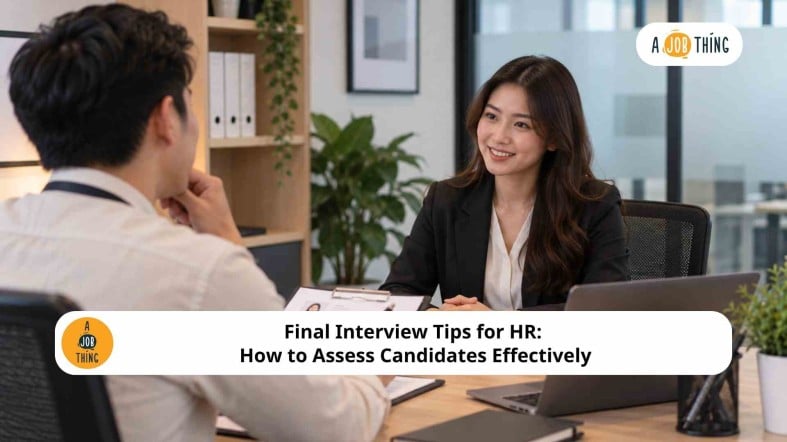
Final Interview Tips for HR: How to Assess Candidates Effectively

Are You Hiring?
Find candidates in 72 Hours with 5+ million talents in Maukerja Malaysia & Ricebowl using Job Ads.
Hire Now
The final interview is often the last major step before a company decides whether to hire a candidate.
By this stage, the candidate may have already passed resume screening, an initial interview and other assessments. The final interview gives HR and hiring managers a chance to confirm whether the candidate is suitable for the role before making a hiring decision.
Instead of repeating earlier interview questions, the final interview should focus on the areas that still need to be confirmed, such as skills, experience, motivation, expectations and availability.
For HR teams, a structured final interview can make the hiring process more consistent and help hiring managers make better decisions.
What Is a Final Interview?
A final interview is usually the last interview stage before a company makes a hiring decision.
It may be conducted by:
-
HR representatives
-
Hiring managers
-
Department heads
-
Senior managers
-
Company directors
-
Other key decision-makers
The final interview may focus on:
-
Relevant experience
-
Technical or job-related skills
-
Communication
-
Problem-solving
-
Motivation
-
Career goals
-
Salary expectations
-
Working arrangements
-
Team fit
The exact format depends on the role and the company's hiring process.
What Should HR Assess in a Final Interview?
The main purpose of a final interview is to confirm whether the candidate is the right match for the role.
Relevant Skills and Experience
Check whether the candidate has the skills and experience needed to perform the job.
Ask for specific examples of previous responsibilities, projects or achievements instead of relying only on what is written in the resume.
Communication Skills
Pay attention to how clearly the candidate explains their ideas and responds to questions.
Good communication is especially important for roles that involve customers, teamwork, presentations or management.
Problem-Solving Ability
Ask the candidate about difficult situations they have handled.
Look at how they identify problems, consider options and make decisions.
Motivation
A strong candidate should have a clear reason for wanting the role.
HR can assess whether the candidate understands the position and is genuinely interested in the opportunity.
Career Goals
Consider whether the candidate's career goals are reasonably aligned with the role and the opportunities the company can provide.
Salary and Job Expectations
Confirm whether the candidate's salary expectations, working arrangements and other requirements match what the company can offer.
Availability
For candidates who are currently employed, confirm their notice period and expected start date early enough to plan the hiring timeline.
Why Is the Final Interview Important?
A final interview gives the company an opportunity to confirm important details before making a hiring decision.
It can help HR:
-
Verify information discussed earlier
-
Clarify unanswered questions
-
Compare final candidates
-
Confirm expectations
-
Identify potential concerns
-
Decide whether to proceed with an offer
It is also an opportunity for the candidate to decide whether the company and role are right for them.
How HR Should Prepare for a Final Interview
Good preparation can make the final interview more focused and useful.
Review Previous Interview Notes
Read the candidate's resume, previous interview notes and assessment results before the meeting.
This helps avoid asking the same questions unnecessarily.
Review the Job Requirements
Make sure everyone involved understands the key responsibilities, skills and requirements of the role.
Identify What Still Needs to Be Confirmed
Focus the final interview on areas that were not fully covered earlier.
For example:
-
Leadership experience
-
Technical knowledge
-
Problem-solving
-
Teamwork
-
Motivation
-
Salary expectations
-
Availability
Prepare Structured Questions
Use a consistent set of questions for candidates applying for the same role.
This makes comparison easier and can reduce inconsistent evaluation.
Prepare the Candidate
Tell the candidate who they will meet, what the interview will cover and what they should prepare.
This also helps create a better candidate experience.
Final Interview Questions for HR
The questions should match the role and the information already gathered during previous stages.
Experience and Achievements
-
What achievement are you most proud of?
-
Which part of your previous experience is most relevant to this role?
-
Tell us about a difficult challenge you handled at work.
-
What did you learn from your previous role?
Motivation
-
Why are you interested in this position?
-
Why do you want to join our company?
-
What are you looking for in your next job?
-
What would make you accept an offer from us?
Problem-Solving
-
Tell us about a difficult problem you solved.
-
How do you approach a problem when you do not have all the information?
-
Tell us about a time you had to make a difficult decision.
Teamwork
-
How do you handle disagreements with colleagues?
-
What type of team environment helps you perform well?
-
Tell us about a time you worked with someone who had a different working style.
Career Goals
-
What are your career goals?
-
What skills would you like to develop?
-
What type of responsibilities would you like to take on in the future?
Final Interview Questions About Salary and Expectations
The final interview can also be used to confirm whether the candidate's expectations match what the company can offer.
HR may ask:
-
What are your salary expectations?
-
Which benefits are important to you?
-
Are you currently considering other job offers?
-
When would you be available to start?
-
What is your current notice period?
-
Are you comfortable with the company's working arrangement?
Be clear about the role, compensation and working conditions.
Avoid making promises that have not been approved.
Final Interview Red Flags HR Should Watch For
A single concern does not automatically mean a candidate should be rejected. However, repeated or serious concerns may require further review.
HR should pay attention when a candidate:
-
Gives inconsistent information
-
Cannot explain important parts of their experience
-
Shows little understanding of the role
-
Has unrealistic expectations
-
Gives unclear or weak examples
-
Shows unprofessional behaviour
-
Appears uninterested in the opportunity
-
Cannot explain why they want to join the company
Focus on job-related evidence and avoid making decisions based on personal preference or assumptions.
How to Score a Final Interview
A simple scorecard can help HR and hiring managers evaluate candidates more consistently.
| Assessment Area | Score |
|---|---|
| Relevant experience | /5 |
| Technical or job-related skills | /5 |
| Communication | /5 |
| Problem-solving | /5 |
| Motivation | /5 |
| Teamwork | /5 |
| Salary and expectations | /5 |
| Overall suitability | /5 |
HR can also add notes to explain each score.
This makes it easier to compare candidates based on evidence rather than relying only on memory.
Final Interview Evaluation Example
After the interview, HR can record a simple summary.
|
Candidate: [Candidate Name] Position: [Job Title] Strengths:
Concerns:
Overall Recommendation: Proceed / Hold / Reject |
A simple evaluation can help HR and hiring managers make decisions more consistently.
What Happens After the Final Interview?
The final interview does not always mean that an offer will be made immediately.
The company may still need to:
-
Compare final candidates
-
Complete required checks
-
Obtain management approval
-
Confirm the compensation package
-
Prepare the offer
-
Confirm the candidate's start date
HR should keep the candidate updated during this stage.
For example:
Thank you for taking the time to meet with our team. We are completing our final review and will update you once a decision has been made.
How Long Should HR Take After a Final Interview?
There is no single timeline that works for every company.
However, HR should give the candidate a realistic expectation.
For example:
We expect to complete our final review this week and will update you by Friday.
If the decision takes longer than expected, send another update instead of leaving the candidate without information.
Should HR Make a Job Offer During the Final Interview?
It depends on the company's hiring process.
Some companies may make a verbal offer after the final interview when the candidate has been approved.
Others may need additional internal approval before making an offer.
HR should only make commitments that have been properly approved.
The formal offer should clearly explain the relevant employment terms.
How to Reject a Candidate After the Final Interview
Not every candidate who reaches the final stage will be selected.
HR should communicate the decision professionally and respectfully.
For example:
Thank you for taking the time to meet with our team and for your interest in the position. After careful consideration, we have decided to proceed with another candidate whose experience more closely matches our current requirements. We appreciate your time and wish you all the best in your career.
A professional rejection helps maintain a positive candidate experience.
Final Interview Checklist for HR

FAQs
What is a final interview?
A final interview is usually the last interview stage before a company makes a hiring decision.
Who should conduct a final interview?
It may be conducted by HR, the hiring manager, department head or other key decision-makers.
What questions should HR ask in a final interview?
Focus on experience, skills, motivation, problem-solving, career goals, salary expectations and suitability for the role.
How long should a final interview take?
There is no fixed duration. It should be long enough to assess the areas that still need to be confirmed.
What happens after a final interview?
The company may compare candidates, complete approvals or checks, and then make an offer or communicate the hiring decision.
Should HR tell candidates when they will hear back?
Yes. Giving candidates a realistic timeline helps manage expectations and supports a better candidate experience.
Ready to Find Your Next Hire?
%20copy.jpg)
Finding the right candidate does not have to be complicated.
AJobThing helps employers post job vacancies and connect with relevant candidates.
Post your job vacancy today and find your next hire with AJobThing.
Read More:
-
Malaysia Day Greetings: 100+ Wishes & Messages for the Workplace
-
Candidate Withdrawal During the Hiring Process: How HR Can Reduce Drop-Off
-
How to Keep Candidates Interested During a Long Hiring Process
-
Candidates Stop Responding After an Interview? What HR Should Do
-
Management Trainee Programme In Malaysia: How Employers Can Build A Graduate Pipeline That Retains
-
Job Requisition: What It Is, What to Include & How HR Can Create One
-
Panel Interviews: How HR Can Plan, Conduct & Evaluate Candidates
-
Interview-to-Hire Ratio: How to Calculate, Benchmark & Improve It
-
Candidate Experience Survey: Questions, Examples & How to Improve Recruitment
-
How to Reduce Hiring Bias: Common Interview Biases HR Professionals Should Avoid
-
Staff Immediate Resignation in Malaysia: Employer Rights & Responsibilities
-
Late Salary Payment in Malaysia: Can Employers Delay Employee Salaries?
-
Internship vs Apprenticeship in Malaysia: Key Differences for Employers & HR
-
How to Manage Underperforming Employees in Malaysia: Tips for Employers & HR
-
Warning Letter for Poor Performance in Malaysia: How to Write One (With Sample)
-
Can Employers Reject Annual Leave in Malaysia? Rights, Rules & Employee Entitlements
-
Payroll and Attendance Management in Malaysia: Process, Formula & Best Practices for Employers
-
Workplace Conflict Management in Malaysia: Causes, Solutions, and Best Practices
-
Recruitment Process Outsourcing (RPO): What It Is, Benefits & How It Works in Malaysia
-
Competency-Based Interviews: Improve Hiring Quality with a Consistent Interview Process
-
Leave Encashment Malaysia: How to Calculate Unused Annual Leave
-
Online Seller Requirements in Malaysia: 10 Business Details You Must Display
-
Performance Bonus in Malaysia: How It Works, Calculation & Employer Guide
-
Cost Per Hire Malaysia: Formula, Examples & How Employers Can Reduce Hiring Costs
-
Letter of Extension of Contract Malaysia: Free Template, Format & Sample
-
Promotion Letter in Malaysia: How to Write One (+ Free Template & Sample)
-
Probation Extension Letter Malaysia: Template, Sample, and What Employers Need to Know
-
Talent Pool: Benefits, Examples & How to Build One for Better Hiring
-
Sales Turnover: What It Is, Formula, Examples & Tips to Increase It
-
Overtime Rates in Malaysia: When Do 1.5x, 2x and 3x Pay Apply?
-
Prorated Salary in Malaysia: How to Calculate an Employee's First Salary
-
Remote Jobs in Malaysia: Most In-Demand Roles, Salaries & Hiring Guide (2026)
-
Effective Ways to Reduce Absenteeism in the Workplace for HR & Employers
-
Medical Benefits for Employees in Malaysia: Types, Legal Requirements & Best Practices
-
Fresh Graduate Salary in Malaysia (2026): How Much Should Employers Pay?
-
Salary Benchmarking in Malaysia: Are You Paying Enough to Attract Candidates?
-
e-Invoicing Malaysia Explained: What Every Employer and Business Needs to Know
-
EOR vs PEO: What's the Difference and Which Is Right for Your Business?
-
Remote Job Offer Letter: What Employers Should Include (+ Example)
-
Job Offer Letter vs. Employment Contract: What's the Difference? (+ Free Templates)
-
Constructive Dismissal Malaysia: Meaning, Examples & What To Do
-
Contract of Service vs Contract for Service Malaysia: How to Classify Workers Correctly
-
Job Offer Letter Templates: Examples, Formats & Best Practices for HR
-
Employee Retention in Malaysia: Meaning, Importance & How to Improve It
-
Employee Turnover in Malaysia: Causes, Warning Signs & How to Reduce It
-
Retrenchment in Malaysia: Meaning, Process & Employee Rights
-
Gmail Templates for HR: Faster Replies for Interviews, Offers & Rejections
-
7 Key Contract Employee Rights in Malaysia Every HR Should Know
-
GLC vs Private Company Malaysia: Salary, Culture & Hiring Differences
-
Types of Payroll Calculation in Malaysia: Adhoc, Prorated Salary & Final Settlement Explained
-
Types of Payroll Cycle in Malaysia: Which One Is Best for Your Business?
-
Types of Insurance in Malaysia and Their Impact on Employee Benefits
-
How to Create a Strong Candidate Shortlist for Better Hiring Decisions
-
How HR in Malaysia Can Offer a Job Over the Phone (with Script)
-
How Notice Period Really Works in Malaysia for Employers and HR
-
How to Create a Job Posting That Attracts the Right Candidates
-
How HR in Malaysia Can Improve Resume Screening and Candidate Shortlisting
-
How HR Can Reject a Candidate the Right Way (with Templates)
-
How to Conduct a Background Check for Employment in Malaysia
-
Onboarding Process Tips: What HR Needs to Know for Better Retention
-
Onboarding Checklist for New Hires (Free Downloadable Template)
-
Performance Evaluation: Description, Types, and How to Conduct
-
Cover Letter Examples Employers Should Know (With Tips to Spot the Best Ones)
-
Step-by-Step Guide to Writing a Great Job Description (Free Templates)