

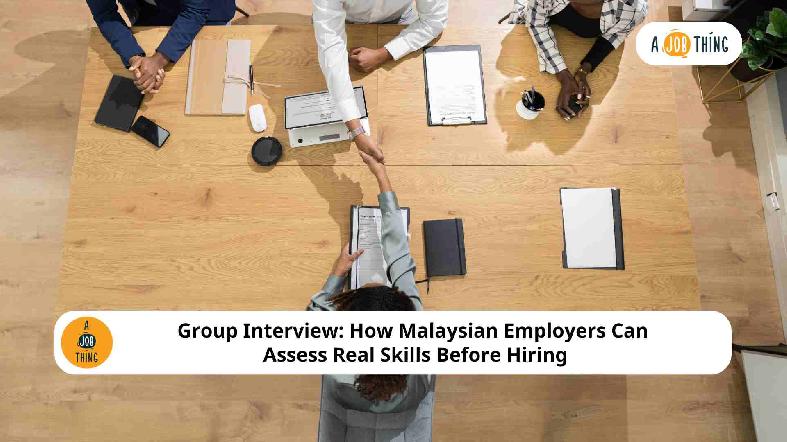
Group Interview: How Malaysian Employers Can Assess Real Skills Before Hiring

Hiring decisions are often made based on CVs and one-to-one interviews. But these methods do not always show how candidates behave in real workplace situations.
To evaluate this, employers usually use group interviews. It provides a practical way to observe teamwork, communication, leadership, and problem-solving skills, especially in roles where people interaction matters.
Why Use Group Interviews?
Group interviews allow employers to assess multiple candidates at the same time while observing how they interact with others.
Group interviews are particularly useful for high-volume hiring, where speed and consistency matter. They make it easier to observe teamwork and communication skills in real time, and they help identify leadership potential, attitude, and confidence early in the hiring process.
Roles that benefit most from group interviews include sales, customer service, F&B, operations, graduate hiring, and entry-level roles, where collaboration and communication are core job requirements.
What is a Group Interview?
A group interview is a hiring method where multiple candidates are assessed together through structured questions, discussions, and tasks.
Unlike a traditional panel interview, where candidates answer questions individually, a group interview focuses on interaction. Candidates work together in activities, respond to scenarios, and demonstrate behaviour in a group setting.
A recommended structure includes:
-
Whole-group activities to warm candidates up
-
Small-group tasks to observe teamwork and leadership
-
Short individual reflections to assess communication and accountability.
Recommended Group Interview Flow (Step-by-Step)
A group interview only works when HR has a clear flow and a clear observation plan. The goal is not to pick the loudest person, it is to identify who will work well with others, communicate under pressure, and behave professionally in a real workplace setting.
Suggested setup (to keep it fair): Start as a whole group for warm-up, then split into smaller groups (3–5) with a hiring manager observing each group.
1. Icebreaker & Communication
A warm-up stage designed to break tension and observe how candidates introduce themselves in a group setting.
Question 1: “What are two truths and one lie about yourself?”
What HR should observe:
-
Confidence: Not “loudness,” but calm presence.
-
Clarity: Do they explain smoothly or ramble?
-
Group comfort: Can they speak without over-dominating?
Green flags:
-
Speaks clearly within 20–40 seconds, good pacing.
-
Makes eye contact, doesn’t interrupt others.
-
Reacts positively when others speak (nods, smiles, listens).
Red flags:
-
Talks too long, hijacks attention.
-
Makes jokes that are inappropriate or insensitive.
-
Struggles to speak at all and refuses to try when prompted.
HR tip: Timebox each candidate (e.g., 45 seconds). This prevents one person from taking over and gives quieter candidates a fair chance.
2. Creativity & Innovation
This step explores how candidates think beyond standard answers and express ideas under light pressure.
Question 2: “What is a unique solution for a common problem in this industry?”
What HR should observe:
-
Creative thinking: Do they go beyond generic answers?
-
Practical reasoning: Can they explain why it works?
-
Communication: Can they sell the idea in simple terms?
Green flags:
-
Proposes a realistic idea with basic reasoning (who it helps, how it works).
-
Builds on others’ ideas instead of competing.
-
Clarifies assumptions rather than pretending to know everything.
Red flags:
-
“Big idea” with no logic or steps.
-
Dismisses others’ ideas quickly.
-
Overconfident claims without explanation.
HR tip: Give 5 minutes to write down ideas first (quiet thinking), then share. This reduces bias toward extroverts and improves idea quality.
3. Team Formation & Leadership
Here, HR can observe how leadership emerges naturally when structure is not predefined.
Question 3: “Split into groups of 3–5 and appoint a leader within 10 minutes.”
What HR should observe:
-
Leadership emergence: Who facilitates versus who dominates?
-
Decision speed: How fast they move from discussion to decision.
-
Inclusion: Do they bring quieter members in?
Green flags:
-
Someone proposes a simple structure (“Let’s do quick intros then pick leader”).
-
Leader's role is chosen with minimal friction.
-
Candidates use language like “What do you think?” to include others.
Red flags:
-
“Power grab” leadership (“I’ll lead” with no consent).
-
The group is stuck, and no one proposes a process.
-
One person gets ignored consistently.
HR tip: Don’t reward “leader = loudest.” Reward leaders who organise, include, and move the group forward.
4. Workplace Scenario Role-Play
A simulation that mirrors real workplace situations to reveal practical teamwork and problem-solving behaviour.
Question 4: “Role-play this workplace scenario and demonstrate how your team resolves it.”
What HR should observe:
-
Collaboration: Do they divide roles and work together?
-
Customer handling (if relevant): Tone, empathy, professionalism.
-
Problem-solving: Steps and logic, not just “apologies.”
Green flags:
-
Group quickly clarifies the problem and assigns roles (speaker, note-taker).
-
Uses calm language, acknowledges emotions in the scenario.
-
Proposes a resolution with a clear next action.
Red flags:
-
Blames customer or teammate.
-
Argues internally in front of “customer.”
-
No structure: random talking, no clear resolution.
HR tip: Observe prep time too, not just performance. Often the “real work behaviours” show during preparation.
5. Resource & Budget Thinking
Checks their business awareness. Are they able to think about constraints, cost, and feasibility?
Question 5: “What resources would you need to solve this issue, and how would you allocate them?”
What HR should observe:
-
Business awareness: Do they think of manpower, time, tools?
-
Cost sensitivity: Do they understand trade-offs?
-
Planning: Can they prioritise resources logically?
Green flags:
-
Lists resources clearly (people, time, process changes, tools).
-
Mentions trade-offs (“We can’t do everything; prioritize X first”).
-
Suggests low-cost improvements before expensive solutions.
Red flags:
-
Only asks for “more budget” with no justification.
-
No prioritisation. Everything is “must have.”
-
Ignores constraints (time, staffing).
HR tip: Ask them to estimate cost roughly (high/medium/low) rather than exact numbers, still reveals thinking.
6. Conflict Resolution
Conflict is normal in teams. This step shows maturity, self-awareness, and how a leader handles tension.
Question 6: “Write down one conflict your group faced. The leader will read and resolve it.”
What HR should observe:
-
Conflict awareness: Do they notice real friction or deny it?
-
Emotional intelligence: How respectfully they address issues.
-
Leadership maturity: Does the leader resolve or escalate?
Green flags:
-
Leader summarises fairly (“We had two different approaches…”).
-
Uses calm language, invites input, proposes a way forward.
-
Team accepts resolution without hostility.
Red flags:
-
Blames individuals by name.
-
Becomes defensive or sarcastic.
-
Avoids conflict completely (“No conflict at all”) when there clearly was.
HR tip: This is where you spot “toxic confidence.” Calm resolution beats aggressive dominance.
7. Presentation & Persuasion
This measures how well candidates communicate as a team and persuade others with structure.
Question 7: “Present your solution and convince others it works.”
What HR should observe:
-
Presentation skills: Structure, clarity, confidence.
-
Persuasion: Can they justify the solution?
-
Team coordination: Does everyone contribute or only one person?
Green flags:
-
Clear flow (problem → solution → why it works).
-
Shares speaking time fairly.
-
Handles questions calmly.
Red flags:
-
Disorganised pitch, unclear solution.
-
One person speaks 100%, team looks disengaged.
-
Becomes defensive when challenged.
HR tip: Keep presentations short (3–5 minutes) so evaluation stays consistent across groups.
8. Active Listening & Recall
Listening is a workplace skill. This tests whether candidates understand others and give respectful summaries.
Question 8: “Summarise another group’s solution in 30 seconds.”
What HR should observe:
-
Listening skills: Accuracy, key points captured.
-
Respect: Fair representation, no mocking.
-
Comprehension: Can they simplify correctly?
Green flags:
-
Captures the key idea and reasoning.
-
Credits other group properly.
-
Stays within time.
Red flags:
-
Misrepresents intentionally.
-
Adds sarcasm or dismissive tone.
-
Rambling or unable to summarise.
HR tip: If leader struggles, let another member volunteer—this reveals team dynamics and confidence distribution.
9. Peer Feedback & Empathy
This shows professionalism and whether candidates can give feedback like a mature colleague.
Question 9: “Give one positive feedback and one constructive suggestion to another candidate.”
What HR should observe:
-
Empathy: Tone and word choice.
-
Professionalism: Focus on behaviour, not personality.
-
Balance: Can they give both positive + improvement?
Green flags:
-
Specific feedback (“Your explanation was clear…”) and safe suggestion (“You could involve others more…”).
-
Keeps it respectful.
-
Doesn’t over-criticise.
Red flags:
-
Personal attacks (“You’re too quiet / too weak”).
-
Vague statements with no substance.
-
Overly harsh “constructive” comments.
HR tip: This step can reveal future team conflict risk quickly.
10. Group Self-Evaluation
This step shows accountability and growth mindset, how teams reflect after a task.
Question 10: “As a group, list your strengths and weaknesses.”
What HR should observe:
-
Accountability: Do they admit real weaknesses?
-
Honesty: Are they realistic or performative?
-
Growth mindset: Do they propose improvements?
Green flags:
-
Balanced evaluation (not all perfect).
-
Mentions process improvements (“Next time we’ll assign roles earlier”).
-
Shared ownership (“We struggled with time…”).
Red flags:
-
Blame shifting (“He caused the issue”).
-
Avoiding weaknesses entirely.
-
Overly negative self-talk without learning.
11. Time Management & Prioritisation
This tests prioritisation under constraint, like real operations work.
Question 11: “You have 30 minutes and 5 tasks, but only 3 can be completed. Which do you prioritise and why?”
What HR should observe:
-
Decision-making: Speed and logic.
-
Time management: Can they timebox discussion?
-
Justification: Can they explain trade-offs?
Green flags: Clear priority framework (impact, urgency, customer risk).
Red flags: Endless debate, no decision, or purely “gut feel” without reasons.
12. Adaptability Under Change
Work changes fast. This checks how candidates adapt without panicking or blaming.
Question 12: “Halfway through the task, management changes the requirement. How does your team adapt?”
What HR should observe:
-
Flexibility: Re-plan quickly.
-
Stress handling: Calm tone, no blame.
-
Change management: Updates plan and roles.
Green flags: Reframes task, updates priorities.
Red flags: Complains, freezes, or refuses to adjust.
13. Ethics & Integrity
This checks judgment and whether candidates will protect the company under peer pressure.
Question 13: “A team member suggests taking a shortcut that may break company rules. What do you do?”
What HR should observe:
Integrity, ethical judgement, and ability to influence peers.
Green flags: Clarifies rules, proposes compliant alternative, escalates if needed.
Red flags: “Asalkan siap” mindset, normalising rule-breaking.
14. Accountability & Ownership
This reveals whether candidates focus on solutions or blame when results are bad.
Question 14: “If the project fails, who is responsible and what should happen next?”
What HR should observe:
Accountability, leadership maturity, and response to failure.
Green flags: Shared ownership + corrective action plan.
Red flags: Blame shifting, punishment-first without learning.
15. Decision-Making Under Pressure (Final Challenge)
A high-pressure closing task that shows how teams reach consensus, manage disagreement, and conclude decisions quickly.
Question 15: “You have 5 minutes to make a final decision as a team on the best solution so far. You must agree unanimously.”
What HR should observe:
Decision speed, consensus building, influence vs collaboration, and stress behaviour.
Green flags: Facilitator emerges, summarises options, aligns decision quickly.
Red flags: One person forces decision, passive silence, or argument escalation.
Benefits of Group Interviews for Employers
By having group interviews, employers are able to:
Save Time and Hiring Resources
Allows employers to assess multiple candidates at once instead of running many one-to-one interviews.
Show Real Teamwork and Collaboration
Reveals how candidates interact, communicate, and work with others in real time.
Identify Leadership and Influence Early
Highlights those who naturally lead, facilitate discussion, or support the team.
Reveal Attitude and Behaviour Under Pressure
Shows how candidates react to stress, disagreement, and changing requirements.
Make Candidate Comparison Fairer
Candidates are assessed in the same environment, tasks, and time constraints.
Surface Skills Beyond the CV
Highlights communication style, problem-solving approach, confidence, and resilience that may not appear on paper.
Best Practices for HR Running Group Interviews
Good group interviews require structure, fair observation, and clear scoring.
-
Maintain 3–5 candidates per hiring manager so each group can be properly observed.
-
Use consistent evaluation criteria (communication, teamwork, leadership, problem-solving).
-
Rotate observers to reduce bias.
-
Ensure quieter candidates get chances to speak through timed rounds.
-
Balance dominant personalities with structured tasks and timeboxes.
Typical Challenges and HR Strategies to Tackle Them
Group interviews can be unfair if HR doesn’t control the environment. Here’s how to manage the most common issues.
-
Dominant candidates overshadow others → Use smaller groups and strict speaking time.
-
Nervous candidates → Start with a simple icebreaker to lower anxiety.
group interview -
Bias in observation → Use scoring sheets and consistent criteria.
-
Time overruns → Assign strict time limits per task and appoint a timekeeper.
FAQs
How many candidates should be in one group interview?
Aim for 3–5 candidates per hiring manager for better observation quality.
Are group interviews suitable for all roles?
They work best for roles requiring teamwork, communication, and customer interaction (sales, service, F&B, ops, and graduate hiring).
Can introverts perform well in group interviews?
Yes, especially when tasks are structured, timeboxed, and include written thinking before speaking.
How long should a group interview last?
Typically 60–120 minutes, depending on the number of activities and group size.
Looking for Qualified Candidates? We’re Here to Help!
With AJobThing, access a massive pool of jobseekers and hire the right talent faster than ever.
Get started today and fill your vacancies with ease!
Read More:
-
Preboarding in Malaysia: Why Employers Should Start Before Day One (Free Checklist Template)
-
How HR and Employers Should Handle Salary Expectations in Interviews
-
How HR Can Reject a Candidate the Right Way (with Templates)
-
Skills-Based Interview Questions Every HR Should Use (with Examples)
-
20 Common Interview Questions Candidates Ask and How HR Should Respond
-
10 Interview Invitation Templates to Attract Quality Candidates
-
12 Interview Types that Help HR in Malaysia Hire the Right Talent
-
How to Conduct a Background Check for Employment in Malaysia
-
Onboarding Process Tips: What HR Needs to Know for Better Retention
-
Onboarding Checklist for New Hires (Free Downloadable Template)
-
Performance Evaluation: Description, Types, and How to Conduct
-
Cover Letter Examples Employers Should Know (With Tips to Spot the Best Ones)
-
Step-by-Step Guide to Writing a Great Job Description (Free Templates)