
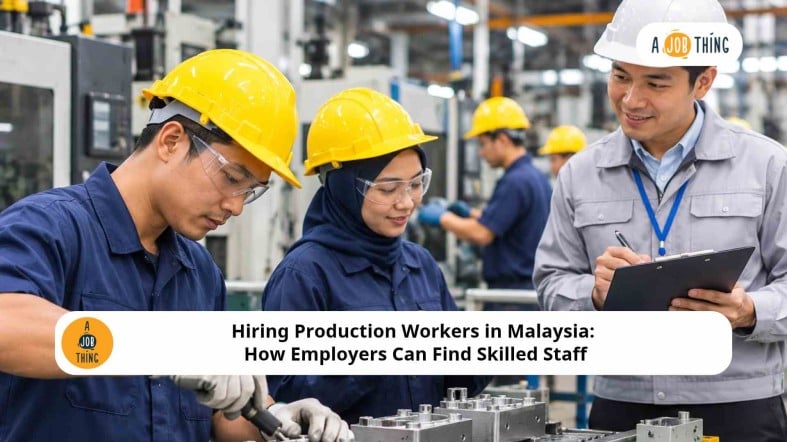
Hiring Production Workers in Malaysia: How Employers Can Find Skilled Staff

Are You Hiring?
Find candidates in 72 Hours with 5+ million talents in Maukerja Malaysia & Ricebowl using Job Ads.
Hire Now
Hiring production operators is important for manufacturers that need to maintain daily production, product quality and delivery schedules.
However, finding suitable candidates can be challenging. Some positions require previous machine experience, while others are suitable for entry-level workers who can learn through company training.
For Malaysian employers, a good recruitment process starts with understanding the production requirements, setting realistic job expectations and finding candidates with the right skills and availability.
This guide explains how to hire production operators in Malaysia, where to find candidates and how HR teams can improve their manufacturing recruitment process.
What Does A Production Operator Do?
A Production Operator is responsible for carrying out manufacturing activities according to the company's production instructions, quality requirements and workplace procedures.
The exact responsibilities depend on the factory, industry and type of product being manufactured.
Common duties include:
- Operating production machinery and equipment.
- Assembling products or components.
- Checking products for defects.
- Following production instructions and standard procedures.
- Monitoring production output.
- Recording production information.
- Maintaining a clean and organised workstation.
- Reporting machine issues or production problems.
Production Operators may work in industries such as electronics, food manufacturing, automotive, medical devices, plastics and general manufacturing.
Different Types Of Production Positions
Employers should identify the actual position before advertising a vacancy.
| Job Position | Main Responsibilities |
| Production Operator | Operate machinery and carry out production tasks |
| Assembly Operator | Assemble components and finished products |
| Machine Operator | Operate and monitor specific production machines |
| Production Packer | Pack finished products according to requirements |
| Quality Control Inspector | Check products for defects and quality issues |
| Production Line Worker | Complete assigned tasks along a production line |
| Production Supervisor | Monitor production activities and coordinate workers |
Although these positions may have similar working environments, their responsibilities and skill requirements can differ.
For example, a Machine Operator may need experience with specific equipment, while a Production Packer may mainly need accuracy, attention to detail and the ability to follow packing instructions.
What Should Employers Consider Before Hiring Production Operators?
Before starting recruitment, employers should understand what their production team needs.
This helps HR prepare a suitable job advertisement and avoid attracting candidates who do not match the actual position.
Understand Your Production Requirements
Start by identifying the production activities that require additional employees.
Consider:
- What products does the factory manufacture?
- How many production operators are needed?
- Which machines or equipment will employees use?
- Does the role involve assembly, packing or quality inspection?
- Does the company require experienced operators or entry-level workers?
For example, an electronics manufacturer may need operators to assemble small components, while a food manufacturer may require employees to handle production, packaging and product inspection.
Decide On The Required Experience
Not every Production Operator position requires previous manufacturing experience.
Some employers may accept fresh candidates and provide on-the-job training.
However, positions involving specialised machinery, technical production processes or equipment operation may require relevant experience.
Clearly separate essential requirements from skills that can be taught after hiring.
Identify The Working Schedule
Manufacturing operations may run beyond normal office hours.
Employers should decide whether the role involves:
- Normal working hours.
- Morning or evening shifts.
- Night shifts.
- Rotating shifts.
- Weekend work.
- Overtime when required.
The job advertisement should explain the expected schedule so candidates can decide whether it suits their availability.
Prepare The Hiring Budget
Before advertising the vacancy, determine the salary range and additional benefits available for the role.
Consider the responsibilities, experience required, working location, shift arrangements and skills needed.
A realistic salary offer helps attract candidates whose expectations match the company's hiring budget.
What Skills Should Employers Look For In Production Operators?
The right candidate does not always need advanced technical knowledge. However, production work often requires consistency, accuracy and the ability to follow instructions.
Here are some useful skills to consider.
| Skill | Why It Matters |
| Attention To Detail | Helps identify product defects and avoid production mistakes |
| Basic Technical Skills | Helps candidates understand machine operations and production procedures |
| Ability To Follow Instructions | Supports consistent production processes |
| Basic Numeracy | Helps with counting products, recording quantities and checking measurements |
| Teamwork | Helps employees coordinate with production colleagues and supervisors |
| Time Management | Helps employees complete assigned tasks within production schedules |
| Problem-Solving | Helps employees identify and report production issues |
| Safety Awareness | Encourages employees to follow workplace safety procedures |
Employers should also consider whether candidates can perform the essential duties of the specific job.
For example, a production role involving repetitive assembly work may require good hand-eye coordination and concentration. A position involving machinery may require relevant technical knowledge or training.
Where To Find Production Operators In Malaysia
Choosing the right recruitment channel can help manufacturers reach candidates who are interested in factory and production jobs.
Job Portals And Online Recruitment Platforms
Job portals allow employers to advertise vacancies and receive applications from jobseekers looking for manufacturing positions.
Employers can use AJobThing to advertise vacancies and reach Malaysian jobseekers through Maukerja, Ricebowl and Epicareer.
This can be useful for companies hiring Production Operators, Machine Operators, Assembly Operators and other operational employees.
MYFutureJobs
MYFutureJobs is Malaysia's national employment platform managed by PERKESO.
Employers can consider the platform when looking for local candidates and advertising manufacturing vacancies.
Technical And Vocational Institutions
Manufacturers looking for candidates with technical skills can consider reaching out to technical and vocational education and training (TVET) institutions.
These institutions may help employers connect with graduates who have studied areas related to manufacturing, electrical work, mechanical processes or industrial operations.
This can be useful when recruiting junior operators or employees who need a technical foundation before receiving further workplace training.
Employee Referral Programmes
Existing employees may know people who are interested in factory work.
A company can introduce an employee referral programme and encourage current production staff to recommend suitable candidates.
Referrals may help employers reach candidates who already understand the working environment.
Social Media And Local Community Groups
Employers can share production vacancies through Facebook groups, community pages and other relevant social media platforms.
This may help reach jobseekers looking for work near the factory location.
Make sure the advertisement clearly explains the job location, salary, working schedule and application process.
For more ideas, read AJobThing's Recruitment Strategy: How To Attract And Hire Better Talent.
Recruitment Agencies
Companies with large recruitment requirements may consider working with recruitment agencies.
This can be useful when manufacturers need to recruit several operators quickly or hire for multiple production lines.
Before engaging an agency, clarify its recruitment services, fees, candidate screening process and responsibilities.
How Much Salary Should Employers Offer Production Operators In Malaysia?
Salary is an important factor when attracting production candidates.
Employers should consider the position, experience, industry, working location and production requirements before deciding on an offer.
AJobThing's 40 Free Job Description Templates In Malaysia includes an indicative monthly salary range of RM1,700 to RM3,000 for Production Operator positions.
This is an editorial estimate for recruitment planning, not an official salary benchmark or a guaranteed market rate.
For broader market information, employers can refer to the Department of Statistics Malaysia's Annual Salaries And Wages By Occupation Dataset.
DOSM uses the occupational category "Plant And Machine Operators And Assemblers", which provides a broader reference for production-related roles. However, it does not represent the salary of every Production Operator position.
Employers should also consider the current minimum wage when preparing an offer. The Department of Labour Peninsular Malaysia confirms the minimum wage of RM1,700 per month.
Official References:
- Department of Labour Peninsular Malaysia: Minimum Wage Increased To RM1,700
- Ministry Of Human Resources: FAQ On The Minimum Wages Order 2024
Factors That Can Affect Production Operator Salaries
| Factor | What Employers Should Consider |
| Experience | Whether the candidate has previous manufacturing experience |
| Technical Skills | Whether the role requires machine or equipment knowledge |
| Industry | Different manufacturing industries may have different requirements |
| Location | Salary expectations may vary by state and industrial area |
| Shift Arrangements | Consider the working schedule and applicable shift arrangements |
| Job Responsibilities | Whether the employee handles basic production or specialised tasks |
| Additional Benefits | Applicable allowances, incentives and other benefits |
Before publishing a vacancy, employers should compare the proposed salary with similar job advertisements and their available budget.
For more guidance, read AJobThing's What Salary Should You Put In A Job Ad In Malaysia?
How To Write A Production Operator Job Advertisement
A clear job advertisement helps candidates understand the production role before applying.
Instead of using a general title such as "Factory Worker Wanted", employers should explain the actual production tasks, job requirements and working arrangements.
Information To Include In A Production Operator Job Ad
| Section | Information To Include |
| Job Title | Production Operator, Machine Operator or Assembly Operator |
| Company Information | Company name and brief manufacturing background |
| Job Location | Factory address or industrial area |
| Employment Type | Full-time, contract or temporary |
| Salary | Monthly salary range |
| Working Schedule | Shift hours, working days and rest days |
| Responsibilities | Machine operation, assembly, packing or inspection |
| Requirements | Experience, skills and qualifications |
| Benefits | Applicable allowances, incentives and other benefits |
| Application Method | How candidates can apply |
Sample Production Operator Job Advertisement
Employers can use the following example as a starting point.
Job Title: Production Operator
Location: Shah Alam, Selangor
Employment Type: Full-Time
Salary: RM1,900 – RM2,600 per month (Illustrative example, subject to the company's actual salary budget)
Job Summary:
We are looking for a responsible Production Operator to support our daily manufacturing activities. The successful candidate will assist with production tasks, operate assigned equipment and ensure products meet the company's quality requirements.
Key Responsibilities:
- Operate assigned production machines and equipment according to training and instructions.
- Assemble products or components according to production requirements.
- Inspect finished products for visible defects.
- Follow production procedures and quality standards.
- Record production output when required.
- Maintain a clean and organised workstation.
- Report machine problems or production issues to the supervisor.
Requirements:
- SPM or equivalent qualification.
- Previous manufacturing experience is an advantage.
- Able to follow instructions and production procedures.
- Good attention to detail and teamwork skills.
- Willing to work according to the assigned shift schedule.
- Able to perform the essential duties of the position.
How To Apply:
Interested candidates can submit their application through the company's job advertisement or recruitment platform.
Employers should replace the illustrative salary, location and requirements with the actual vacancy details. Mention any specific machine experience or training requirements that genuinely apply to the role.
For more job advertisement guidance, read AJobThing's How To Create A Job Posting That Attracts The Right Candidates.
How To Screen Production Operator Applicants
After receiving applications, HR should check whether candidates have the skills, experience and availability needed for the position.
Not every production role requires previous factory experience. Screening criteria should match the actual job requirements.
| Screening Criteria | What HR Should Check |
| Work Experience | Previous experience in manufacturing or production environments |
| Machine Experience | Familiarity with relevant machinery or equipment |
| Attention To Detail | Ability to check products and follow instructions accurately |
| Basic Numeracy | Ability to count products and record quantities |
| Working Availability | Whether the candidate can work the required schedule |
| Safety Awareness | Understanding of workplace procedures and instructions |
| Teamwork | Ability to work with production colleagues and supervisors |
For entry-level positions, employers can consider candidates with transferable experience from warehouse, retail, logistics or other operational roles.
HR should also avoid making previous factory experience a requirement when the company is prepared to train suitable candidates.
For more guidance, read AJobThing's Candidate Screening: Methods, Tools And Best Practices For Employers.
Production Operator Interview Questions Employers Should Ask
Production interviews should focus on the candidate's ability to perform the actual job responsibilities.
Employers can ask questions about previous experience, attention to detail, teamwork and how candidates respond to production problems.
| Interview Question | What HR Wants To Understand |
| Have you worked in a manufacturing or production environment before? | Relevant experience |
| What machines or equipment have you used previously? | Technical knowledge |
| What would you do if you noticed a defective product? | Quality awareness |
| How do you make sure you follow production instructions correctly? | Attention to detail |
| What would you do if a machine started making an unusual noise? | Problem reporting and safety awareness |
| Are you comfortable working according to a shift schedule? | Working availability |
| How would you handle repetitive tasks while maintaining accuracy? | Concentration and consistency |
Consider A Practical Assessment
For some production positions, a simple practical assessment may help employers understand a candidate's abilities.
For example, employers may ask candidates to:
- Identify defects in sample products.
- Follow a simple assembly instruction.
- Count and record sample production items.
- Identify the correct steps in a production checklist.
The assessment should match the actual job requirements and take place in a safe, controlled environment.
Candidates should not be asked to operate machinery without the required training and authorisation.
For more interview ideas, read AJobThing's Interview Questions To Ask Candidates In Malaysia.
Common Production Recruitment Challenges And How To Address Them
Manufacturing employers may face several recruitment challenges when hiring production operators.
| Hiring Challenge | What Employers Can Do |
| Not Enough Applications | Advertise through suitable recruitment channels and explain the job clearly |
| Candidates Lack Machine Experience | Identify which skills are essential and which can be taught |
| Candidates Reject Job Offers | Review salary, shift arrangements and benefits |
| Interview No-Shows | Confirm interview details and send reminders |
| Candidates Leave Shortly After Joining | Set realistic job expectations and provide proper training |
| Difficult To Fill Multiple Vacancies | Plan recruitment early and consider additional sourcing channels |
One common problem is giving candidates incomplete information about the production environment.
For example, candidates should know whether a job involves rotating shifts, repetitive assembly work, machine handling or standing for extended periods.
Clear expectations can help reduce unsuitable applications and misunderstandings after hiring.
How To Retain Production Operators After Hiring
Recruiting suitable candidates is important, but employers also need to provide a working environment that encourages employees to stay.
Here are some practical ways to support retention.
Provide Proper Training
New production operators should understand the machines, production instructions, quality requirements and workplace procedures relevant to their roles.
Explain Job Expectations Clearly
Employees should understand their daily tasks, output expectations, working schedule and reporting responsibilities.
Support Employees Through Supervisors
Production supervisors should guide new employees, answer questions and help resolve work-related problems.
Maintain Consistent Work Arrangements
Communicate shift schedules, rest days, salary arrangements and applicable benefits clearly.
Recognise Good Performance
Employers can recognise employees who demonstrate good attendance, consistent work quality, teamwork and improvement in their responsibilities.
Provide Opportunities To Develop Skills
Employees who gain experience may be able to develop into senior operators, machine specialists, quality inspectors or production team leaders.
How To Measure Your Production Recruitment Performance
HR teams can monitor recruitment metrics to understand whether their hiring process is effective.
| Recruitment Metric | What It Measures |
| Time To Fill | How long it takes to fill a production vacancy |
| Number Of Applications | How many candidates apply for the position |
| Interview Attendance Rate | How many shortlisted candidates attend interviews |
| Offer Acceptance Rate | How many selected candidates accept the offer |
| New Hire Retention | How many new employees remain after 30 or 90 days |
| Time To Productivity | How long new employees take to perform their assigned tasks independently |
For example, if many candidates accept the job but leave shortly after joining, employers should review whether the actual production environment matches the job advertisement.
Tracking these metrics can help HR identify areas that need improvement and make better recruitment decisions.
FAQs
What qualifications are needed to become a production operator?
Many entry-level positions accept candidates with SPM or equivalent qualifications. Technical roles may require additional skills or relevant experience.
How much is the salary of a production operator in Malaysia?
An indicative monthly salary range is RM1,700 to RM3,000, depending on experience, location, industry and job responsibilities.
Where can employers find production operators in Malaysia?
Employers can advertise vacancies through job portals, MYFutureJobs, TVET institutions, employee referrals, social media and recruitment agencies.
What skills should employers look for when hiring production operators?
Look for attention to detail, teamwork, basic technical skills, ability to follow instructions, safety awareness and time management.
Find Production Operators With AJobThing

Hiring suitable production operators helps manufacturers maintain production schedules, support product quality and manage daily factory operations.
With AJobThing, employers can advertise vacancies and reach jobseekers through Maukerja, Ricebowl and Epicareer, while managing recruitment activities through one platform.
Looking for Production Operators, Machine Operators or Assembly Workers? Post a job with AJobThing and connect with potential candidates in Malaysia.
Read More
- How to Hire Warehouse Staff in Malaysia: Recruitment Tips for Employers
- 40 Free Job Description Templates in Malaysia (English & Bahasa Malaysia)
- Recruitment Strategy: How to Attract and Hire Better Talent
- What Salary Should You Put in a Job Ad in Malaysia?
- How to Create a Job Posting That Attracts the Right Candidates
- How HR in Malaysia Can Improve Resume Screening and Candidate Shortlisting
- Candidate Screening: Methods, Tools, and Best Practices for Employers
- Interview Questions to Ask Candidates in Malaysia (By Role, with Scoring Guide & Template)
- How Employers Can Use MYFutureJobs for Hiring in Malaysia