

Hiring the Right Salesperson in Malaysia: From Sourcing to Onboarding

Are You Hiring?
Find candidates in 72 Hours with 5+ million talents in Maukerja Malaysia & Ricebowl using Job Ads.
Hire Now
Salespeople sit right at the front line of your business. A good salesperson brings in revenue, keeps customers coming back, and helps your brand grow. A wrong hire, on the other hand, can mean low sales, high turnover, and unhappy customers that never return.
Many employers still treat sales hiring as long as they can talk. In reality, you need a structured approach: clear criteria, proper screening, and the right support after hiring.
This guide is for HR and employers in Malaysia who want practical, simple steps to find, select, and support the right salesperson, from sourcing to onboarding and performance.
What Makes a Good Salesperson?
A strong salesperson is more than just talkative. They are consistent, disciplined, and customer-focused. Key traits to look for:
Communication & Persuasion skills
They can explain products clearly, ask good questions, and guide customers to a decision without being pushy.
Resilience and Self-Motivation
Sales always involve rejection. Good salespeople bounce back, stay motivated, and keep following up.
Customer Focus and Service Mindset
They listen first, understand customer needs, and propose solutions — not just force a product.
Result-Driven and Goal-Oriented
They care about hitting targets, tracking numbers, and improving performance month by month.
Integrity and Honesty
They don’t over-promise or mislead customers just to close a deal. This protects your brand.
Adaptability and Learning Attitude
They can learn new products, adapt to different customer types, and adjust their sales style.
Understanding of the Local Market and Customer Behaviour
In Malaysia, this includes language mix (BM, English, Chinese/Tamil where relevant), cultural sensitivity, and awareness of local buying habits (e.g. festival seasons, payday patterns, online vs offline).
Use this list as a baseline competency profile when screening and interviewing.
Where to Find Potential Sales Talent
Good salespeople rarely appear by chance. You need to go where they are. Practical sourcing channels for Malaysian employers:
Job Portals & Online Job Boards
Post clear, attractive ads on local job portals (including platforms like AJobThing) and niche boards depending on your industry.
Employee Referrals
Salespeople often know other salespeople. Encourage your team to recommend friends or ex-colleagues. Offer a referral bonus if their referral is hired and stays.
Social Media & Professional Networks
-
LinkedIn for B2B, corporate, and higher-level sales roles.
-
Facebook, Instagram, TikTok for retail, F&B, and field sales roles, especially via groups and community pages.
Industry Referrals & Local Networks
Tap into:
-
Supplier/partner networks
-
Industry events and exhibitions
-
Community associations or chambers of commerce
Recruitment Platforms & Agencies
Use recruitment platforms (e.g. AJobThing) or sales-focused agencies for high-volume or specialised sales roles.
The key is to match channel to role: a mall retail salesperson and a senior B2B account manager will not come from the same place.
How to Screen and Interview Sales Candidates
To hire the right salesperson, you need a clear, structured way to screen and interview candidates.
Use Structured Interviews with Clear Criteria
Before interviews start, define:
-
5–7 core criteria (e.g. communication, resilience, customer focus, integrity, target orientation).
-
A simple rating scale (1–5) for each.
This helps you compare candidates more fairly and reduce bias.
Ask Skills-Based and Scenario Questions
Go beyond “Tell me about yourself”. Use questions like:
-
“Tell me about a time you turned a ‘no’ into a ‘yes’.”
-
“How do you handle a customer who says, ‘Your product is too expensive’?”
-
“Describe your sales process from first contact to closing.”
Look for specific examples, not vague answers.
Use Small Assignments or Mock Sales Pitches
A simple 10–15 minute exercise can reveal a lot:
-
Give a product or service description and ask them to pitch it.
-
Ask them to handle a “difficult customer” role-play.
-
Ask them to write a short follow-up message to a potential client.
Here you can see tone, structure, persuasion, and professionalism in action.
Verify Past Performance, Not Just CV Claims
Ask for:
-
Past sales targets vs results (in broad terms if needed).
-
Typical sales cycle and client type.
-
Referees from past managers if appropriate.
You’re not looking for exact numbers if they’re confidential, but for consistency of performance story.
Evaluate Cultural Fit and Service Mindset
Ask questions like:
-
“What does good customer service mean to you?”
-
“Tell me about a time you lost a sale. What did you learn?”
-
“What kind of team or manager helps you perform your best?”
Sales skills matter, but attitude and ethics matter just as much.
What to Offer to Attract & Retain Good Sales Talent
In Malaysia, sales compensation usually mixes basic salary + performance-based rewards.
Common structures are:
Basic Salary + Commission
Basic gives stability. Commission rewards results and can be tiered (higher commission for higher sales).
Bonus or Incentive Schemes
Quarterly or annual bonuses based on sales growth, team targets, or KPIs.
Clear Career Progression Path
Junior Sales → Senior Sales → Team Leader → Sales Manager. Put this clearly in the job description and during interviews, so candidates see a future.
Additional Perks that Matter to Salespeople
-
Transport or petrol allowance (field sales).
-
Travel allowance for client visits.
-
Phone/data allowance.
-
Flexible schedule or WFH options where suitable.
-
Regular training and certification (e.g. negotiation skills, product training, industry knowledge).
Onboarding & Early Support for New Sales Hires
New sales hires perform better when their first 30–90 days are structured, guided, and well-supported. Make the first 30–90 days structured:
Product & Service Training
-
Features, pricing, key selling points.
-
Common objections and how to handle them.
-
Competitor overview.
Assigned Mentor or Buddy
Pair them with a more experienced salesperson for the first 1–3 months. Let them make shadow calls or client visits.
Clear Performance Targets and Expectations
Set realistic ramp-up targets (e.g. first 3 months) and explain KPIs: revenue, meetings set, calls, proposals, etc.
Regular Feedback and Support
Do weekly or bi-weekly check-ins in the first 3 months. Identify blockers early (lead quality, process issues, training gaps).
A good onboarding plan can turn a decent salesperson into a strong one, and reduce early resignations.
How to Evaluate & Monitor Salesperson Performance After Hire
After hiring, you need clear metrics and behaviours to track whether a salesperson is truly performing. Key metrics and indicators:
Sales Targets
Monthly and quarterly revenue or unit targets. Track the trend also on whether they are improving, stagnating, or declining.
Conversion Rate and Close Rate
Leads → meetings → proposals → closed deals. This will help you see if the problem is top-of-funnel (not enough leads) or closing skill.
Customer Feedback and Satisfaction
-
Compliments vs complaints.
-
NPS or simple feedback from key accounts.
Attendance, Reliability, Professionalism
-
Time management, punctuality, follow-up discipline.
-
How they represent your brand to clients and partners.
-
Customer retention or follow-up success
Repeat orders, upsell/cross-sell, renewing contracts.
Sales Growth Over Time
Are they learning and scaling? A strong salesperson should show a learning curve, not a flat line.
Use these indicators during probation review and performance appraisals to give clear, data-based feedback.
Checklist Onboarding PDF & Excel
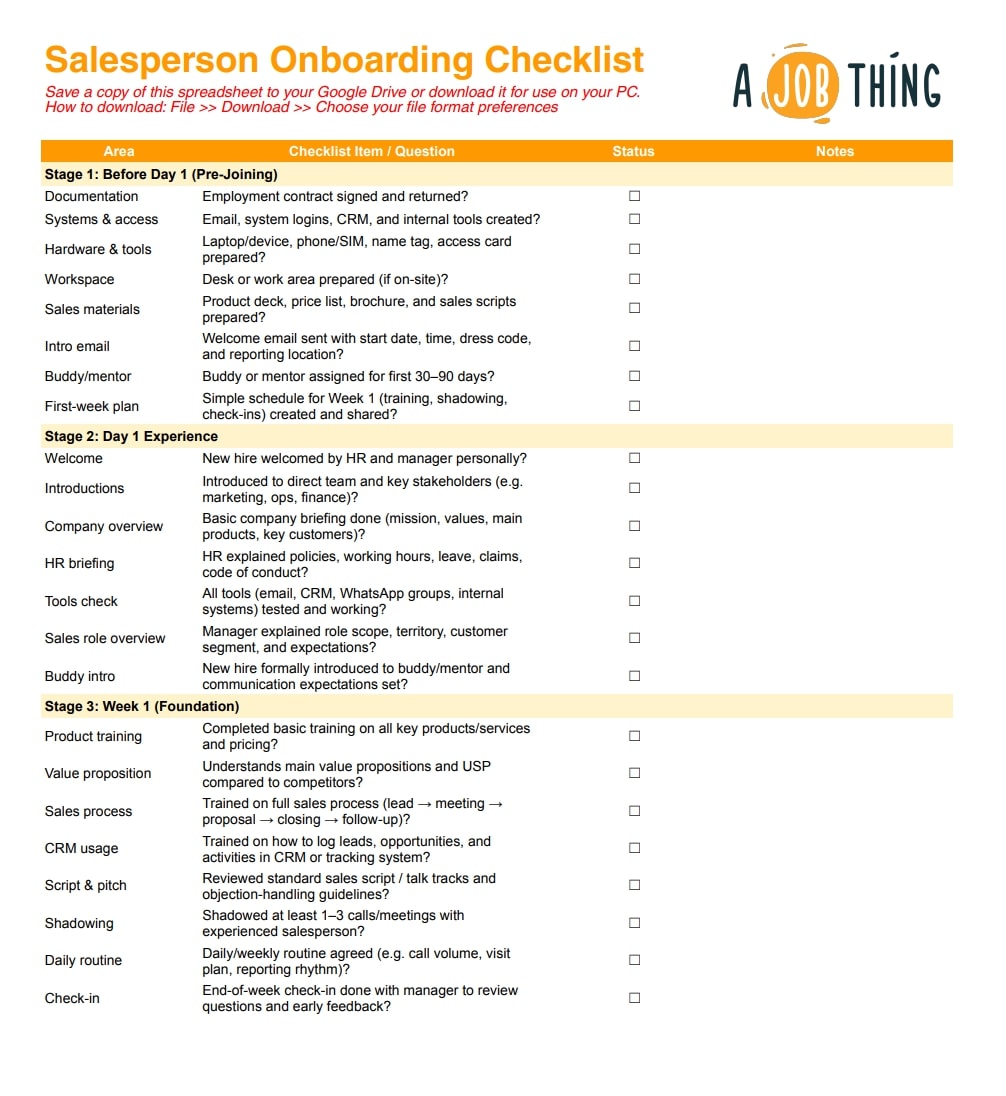
Free Download Salesperson Onboarding Checklist Sheets
Free Download Salesperson Onboarding Checklist PDF
FAQ Section
1. What if none of the candidates meet expectations?
If no one is a strong fit:
-
Review your job ad and salary. Are you attracting the right level of talent?
-
Check your channels, maybe you need different platforms or referral programmes.
-
Consider hiring the closest fit with a strong learning attitude, and invest in training, rather than waiting forever for a “perfect” profile.
2. Should I hire fresh graduates or experienced salespeople?
It depends on your needs:
-
Fresh graduates
-
Lower starting cost
-
Can be trained to your style
-
Good for high-volume, simpler products
-
-
Experienced salespeople
-
Faster ramp-up
-
Bring existing skills and sometimes networks
-
Better for complex or high-value solutions
-
Many companies use a mix: seniors for key accounts, juniors for support and lead generation.
3. How much salary + commission is fair for a salesperson in Malaysia?
There is no one fixed number. It depends on:
-
Industry (F&B, retail, tech, property, etc.)
-
Role type (telesales, field sales, B2B, key account, etc.)
-
Location (Klang Valley vs smaller towns)
-
Complexity and value of product
Benchmark using local salary data, similar job ads, and internal budget. As a rule, make sure the total earning potential is competitive enough that good salespeople feel they can grow with you.
4. How long should probation be for a new salesperson?
Commonly 3–6 months. Shorter (3 months) for simpler roles, longer (up to 6 months) for complex or high-value sales cycles. Whatever you choose:
-
Be clear in the offer letter.
-
Set milestones for each month, not just a final “pass/fail”.
5. Can training improve a weak salesperson?
Training can improve product knowledge, sales techniques, and confidence. But training cannot fully fix chronic lack of effort and poor attitude, or integrity issues.
If someone has a good attitude + effort + basic aptitude, training and coaching can make them strong. If these basics are missing, it may be better to let them go and restart the hiring process.
Looking to Hire Top Sales Talent?

With AJobThing, reach a wide pool of qualified Malaysian sales candidates and fill your sales roles with confidence.
Post your job on AJobThing today.
Read More:
-
How HR and Employers Should Handle Salary Expectations in Interviews
-
How HR Can Reject a Candidate the Right Way (with Templates)
-
Skills-Based Interview Questions Every HR Should Use (with Examples)
-
20 Common Interview Questions Candidates Ask and How HR Should Respond
-
10 Interview Invitation Templates to Attract Quality Candidates
-
12 Interview Types that Help HR in Malaysia Hire the Right Talent
-
How to Conduct a Background Check for Employment in Malaysia
-
Onboarding Process Tips: What HR Needs to Know for Better Retention
-
Onboarding Checklist for New Hires (Free Downloadable Template)
-
Performance Evaluation: Description, Types, and How to Conduct
-
Cover Letter Examples Employers Should Know (With Tips to Spot the Best Ones)
-
Step-by-Step Guide to Writing a Great Job Description (Free Templates)