



How to Create a Strong Candidate Shortlist for Better Hiring Decisions

Recruitment can quickly become overwhelming, especially when a job posting attracts a high volume of applications. Malaysian HR teams often face tight deadlines, skills mismatch, and pressure from hiring managers to move quickly.
Reviewing every resume in detail is simply not practical. Without a structured approach, good candidates may be overlooked, and weak candidates may move forward by mistake. A well-developed candidate shortlist helps solve this problem. It is a carefully selected group of applicants who meet the key job criteria and are suitable for further assessment.
A strong shortlisting process improves hiring quality, supports objective decision-making, and makes the entire recruitment journey more organised.
What Is a Candidate Shortlist?
A candidate shortlist is a collection of top applicants who meet your key job criteria and show potential for the role.
You may create several shortlists during the hiring process:
-
First shortlist: Candidates whose resumes meet minimum requirements
-
Second shortlist: Candidates selected for assessment or phone screening
-
Final shortlist: Candidates ready for interviews or job offer
The purpose of shortlisting is to streamline and organise the recruitment process. It allows HR teams to focus on quality over quantity.
Why Candidate Shortlisting Matters for HR & Employers
In Malaysia, HR teams often face a high volume of applications, skills mismatch between applicants and job requirements, and tight hiring timelines
By having a structured shortlisting process, employers are able to:
-
Save time by narrowing down large applicant pools
-
Improve hiring quality by focusing on relevant skills and experience
-
Make more objective decisions using clear criteria
-
Reduce recruitment costs linked to poor hires
Step-by-Step Guide to Building an Effective Candidate Shortlist
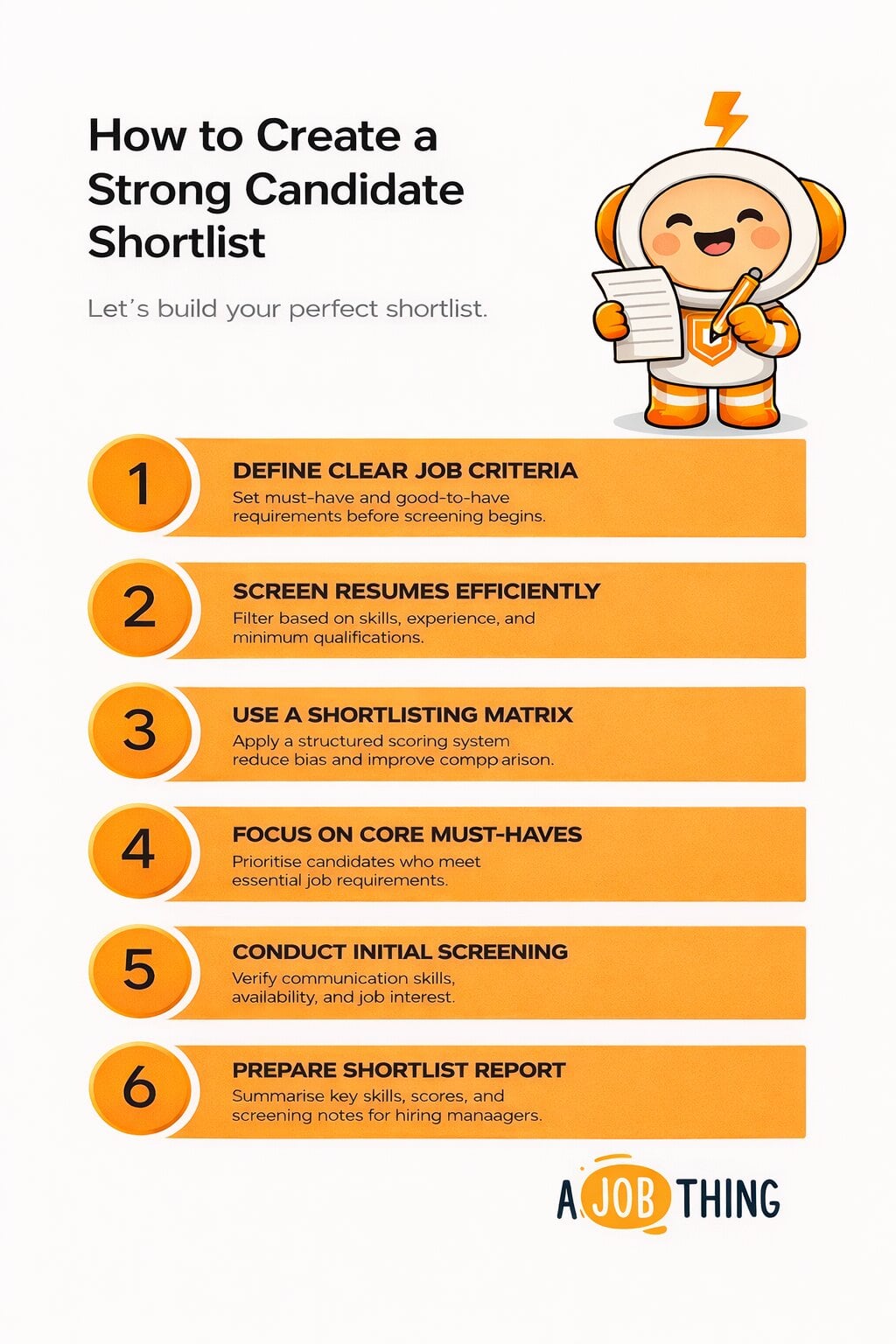
Follow the step-by-step on how to build an effective candidate shortlist.
Step 1: Define Clear Job Criteria
Start with a well-written job description. It should clearly state:
-
Essential skills and qualifications
-
Desirable skills
-
Required experience level
-
Education or certification requirements
-
Core competencies
Divide requirements into:
-
Minimum requirements (must-have)
-
Additional qualifications (good to have)
HR and hiring managers should align on these criteria before screening begins. Stakeholder alignment reduces confusion later.
Tips:
-
Align criteria with company values and culture
-
Be clear in job ads to attract relevant candidates
-
Avoid vague descriptions that lead to irrelevant applications
Step 2: Screen Resumes Efficiently
Once applications come in, start by checking key criteria first:
-
Relevant work experience
-
Required education or certifications
-
Skills match
Eliminate candidates who do not meet minimum requirements.
You can use ATS (Applicant Tracking System) to filter based on keywords or manual screening for smaller applicant pools.
For Malaysian HR teams managing high volumes from platforms like Maukerja or AJobThing, filtering by skills, location, and experience helps reduce screening time.
Step 3: Use Rating or Scoring Systems
A scoring system helps standardise evaluation.Create a simple scorecard where each requirement is assigned points.
Example scoring scale:
-
5 = Excellent match
-
3 = Meets minimum requirement
-
1 = Below expectation
You may also assign weight to important criteria.
Benefits of scoring:
-
Reduces bias
-
Makes comparison easier
-
Highlights strongest candidates clearly
The highest score does not automatically mean hiring, but it helps guide decision-making.
Step 4: Shortlist Based on Core Must-Haves
After scoring, focus on candidates who meet all essential requirements.
Then organise your shortlist into categories:
-
A-list: Top priority candidates
-
B-list: Backup candidates
-
C-list: Consider only if needed
For niche roles, experts recommend keeping the shortlist small. For example, an initial shortlist of no more than ten candidates can be effective, with fewer moving to interviews.
Step 5: Conduct Initial Screening (Optional)
If your shortlist is still large, conduct short phone or video screenings. Use this step to verify:
-
Communication skills
-
Job interest
-
Salary expectations
-
Availability
Use consistent questions for every candidate to ensure fairness.
Step 6: Prepare a Shortlist Report
Once your shortlist is finalised, prepare a summary report for the hiring manager. Include:
-
Candidate name
-
Key skills
-
Score or ranking
-
Resume highlights
-
Screening notes
Documenting this information keeps the hiring process transparent and structured. You may also keep the shortlist on file for future openings.
Common Shortlisting Mistakes to Avoid
HR teams should avoid:
-
Over-filtering too early and missing strong potential candidates
-
Ignoring transferable skills
-
Letting personal bias influence decisions
-
Skipping phone screening when needed
-
Focusing only on technical skills without cultural fit
Cultural fit matters because values alignment supports long-term retention.
How Technology Can Help
Technology supports better shortlisting, helps reduce manual workload, and improve consistency. Useful tools include:
-
ATS with keyword filtering
-
Resume parsing systems
-
Automated scoring features
-
Online assessment platforms
In Malaysia, HR teams commonly use:
Benefits of a Good Candidate Shortlist Process
A structured candidate shortlist process:
-
Saves time during interviews
-
Improves hiring success rate
-
Creates better candidate experience
-
Ensures fairness and transparency
FAQs
What is a candidate shortlist?
A candidate shortlist is a list of top applicants who meet the key job requirements and are selected to move forward in the hiring process.
How many candidates should be on a shortlist?
It depends on the role. For niche positions, around 6–10 candidates is often manageable before interviews.
What is the difference between screening and shortlisting?
Screening is the initial review of resumes to remove unqualified applicants. Shortlisting is selecting the strongest candidates for the next stage.
Should reference checks happen after shortlisting?
Reference checks are usually done after interviews and before making a final offer.
How do you reduce bias in shortlisting?
Use clear criteria, scoring systems, and consistent screening questions. Structured evaluation helps reduce personal bias.
Need Staff Urgently? We’ve Got You Covered!
 copy.jpg)
With AJobThing, access a massive pool of jobseekers and hire the right talent faster than ever.
Get started today and fill your vacancies with ease!
Read More:
-
Ramadan 2026 Malaysia: Start Date, Public Holiday & Employer Planning Guide
-
Pengeluaran KWSP Untuk Haji 2026: How to Apply & Who Is Eligible
-
Cuti Sarawak 2026: Official Holiday List & HR Planning Guide
-
Cuti Umum Johor 2026: Full Holiday List & HR Manpower Planning Guide
-
Ramadan Working Hours in Malaysia: Can Employers Legally Reduce Hours?
-
How to Create and Optimize a LinkedIn Company Page for Employer Branding
-
Employee Emergency Contact Form: Simple Guide with a Ready-to-Use Template
-
How HR in Malaysia Can Offer a Job Over the Phone (with Script)
-
How Notice Period Really Works in Malaysia for Employers and HR
-
Why Employers Should Offer Health Insurance to Employees in Malaysia
-
Salary Increment Letter Malaysia: Samples, Format & HR Guide
-
How to Create a Job Posting That Attracts the Right Candidates
-
How Employers Should Handle Employee Misconduct in Malaysia Fairly
-
How HR in Malaysia Can Improve Resume Screening and Candidate Shortlisting
-
Preboarding in Malaysia: Why Employers Should Start Before Day One (Free Checklist Template)
-
How HR Can Reject a Candidate the Right Way (with Templates)
-
How to Conduct a Background Check for Employment in Malaysia
-
Onboarding Process Tips: What HR Needs to Know for Better Retention
-
Onboarding Checklist for New Hires (Free Downloadable Template)
-
Performance Evaluation: Description, Types, and How to Conduct
-
Cover Letter Examples Employers Should Know (With Tips to Spot the Best Ones)
-
Step-by-Step Guide to Writing a Great Job Description (Free Templates)