
How to Create and Use an Appraisal Form in Malaysia (With Templates)

Are You Hiring?
Find candidates in 72 Hours with 5+ million talents in Maukerja Malaysia & Ricebowl using Job Ads.
Hire Now
Performance reviews are part of almost every company, but without a proper appraisal form, things can get messy. A good form helps employers stay fair, give structured feedback, and make better decisions about salary, promotion, or training.
Here are practical steps for preparing the appraisal process and creating an effective form, along with a sample.
What is an Appraisal Form?
An appraisal form is a document used by employers to evaluate employee performance over a specific period. It provides a structured way for managers to assess an employee’s contributions, behaviour, and progress against company goals.
In Malaysian companies, appraisal forms are a key part of HR processes such as salary reviews, promotions, bonus decisions, and staff development planning.
The form helps guide performance conversations between the manager and employee. It also acts as a written record that can be used for future references, such as during internal transfers or policy audits. When done properly, appraisals help both the company and the employee grow together.
Why Employers in Malaysia Use Appraisal Forms
For most companies, performance appraisals are more than just a yearly routine. Malaysian employers use appraisal forms to track whether staff meet their KPIs, to provide formal feedback, and to help with bonus or increment decisions.
Appraisal results are also helpful for talent planning, especially when deciding who to promote or which department may need extra support.
Without a proper form, feedback can become inconsistent or biased. A clear appraisal form ensures every employee is evaluated fairly using the same set of criteria. It helps supervisors stay objective and gives employees a chance to reflect on their own work too.
How Often Should Appraisal Forms Be Completed?
Most companies conduct performance appraisals annually, with an optional mid-year review to track progress. However, modern workplaces are shifting toward quarterly or continuous feedback cycles to improve engagement and responsiveness.
-
Annual appraisals are best for promotions, increments, and long-term planning.
-
Mid-year or quarterly reviews work well for roles with measurable KPIs or short project cycles.
-
Probation appraisals (for new hires) typically occur at 3 or 6 months, depending on the company policy and Employment Act 1955 guidelines.
HR should define clear timelines in their employee handbook and ensure consistency across departments to maintain fairness.
How to Create an Effective Appraisal Form
Creating an effective appraisal form involves a few important steps. Below are the steps on how employers and HR teams in Malaysia can build one that works well:
-
Set a clear purpose
Start by identifying why you are conducting the appraisal. Is it for salary adjustments, promotions, or training plans? This helps shape what the form should focus on.
-
Add basic employee information
Include fields for the employee’s name, department, job title, manager's name, and the review period. This keeps the form organised and traceable.
-
Define key performance areas
Decide which categories you want to evaluate. Common areas include work quality, communication, punctuality, teamwork, and leadership. These should reflect the employee’s actual role and responsibilities.
-
Choose a rating scale
Use a consistent and simple rating system. Most companies prefer a 1–5 scale or labels such as "Needs Improvement," "Meets Expectation," and "Exceeds Expectation." This helps with clear evaluation and comparison.
-
Include comment sections
Let supervisors explain their ratings with written feedback. These comments give context to the score and guide employee development. Leave space for the employee to add their own comments too.
-
Add an overall performance summary
At the end of the form, provide a space where the supervisor can summarise the overall evaluation and highlight areas for improvement or praise.
-
Include signatures and dates
Add a final section where both the supervisor and employee can sign and date the form. This confirms that the appraisal discussion took place and that both parties have reviewed the content.
-
Keep the layout clean and easy to follow
Use tables or sections to separate content clearly. Avoid crowding the page. A well-formatted form helps users stay focused and reduces confusion.
Performance Appraisal Template: What to Include
A well-designed appraisal form should be easy to fill in and easy to understand. To build a useful appraisal form, you need to include the right structure and sections. Check out the essential parts of the form below:
Rating scale
Use a simple scale to help supervisors evaluate consistently. Most forms use a 1 to 5 scale (1 = Poor, 5 = Excellent) or labels such as "Below Expectation," "Meets Expectation," and "Exceeds Expectation."
Performance categories
Choose relevant areas to assess based on the employee’s role. Common categories include:
-
Quality of work
-
Job knowledge
-
Communication
-
Attendance and punctuality
-
Teamwork and collaboration
-
Initiative and problem-solving
-
Leadership potential (for senior roles)
Supervisor’s written comments
Include a section for the supervisor to explain their ratings. These comments give context and help guide employee development.
Employee’s self-assessment
Add a part where the employee can reflect on their own performance to create a two-way feedback process.
Overall summary
Provide space for a general performance conclusion, especially useful for salary reviews or promotions.
Signatures and date
End the form with a signature section for both the employee and the supervisor. This confirms the appraisal has been reviewed and discussed.
These sections help keep the process transparent and professional while encouraging meaningful conversations during the review.
Must Every Employee Use the Same Appraisal Form?
Not necessarily. Different roles may require different appraisal formats depending on job scope and seniority. For instance:
-
Junior employees may focus on attendance, teamwork, and punctuality.
-
Managers or leaders may be assessed on leadership, strategy, and innovation.
-
Sales or target-based roles can include specific revenue or KPI metrics.
Use a standard structure (like rating scales and summary sections) across all forms, but customise the content to each department. This keeps evaluations fair but relevant to actual job duties.
Can Remote or Hybrid Employees Use a Different Version?
Yes, remote or hybrid employees benefit from adapted appraisal forms that account for digital work environments. Include metrics such as:
-
Communication and collaboration through digital tools.
-
Self-management and reliability in completing remote tasks.
-
Adaptability to flexible schedules or time zones.
Remote forms can include additional sections like “Digital Tool Usage” or “Remote Productivity Score.” Use online platforms or e-signature tools (like Google Forms, DocuSign, or BambooHR) to simplify the process.
Are Appraisal Forms Legally Required in Malaysia?
No. Performance appraisals are not legally mandatory under Malaysian employment law. But, they are widely recognised as best practice under the Employment Act 1955 and Industrial Relations Act 1967.
Well-documented appraisals help employers:
-
Justify promotions, salary increments, or disciplinary actions.
-
Demonstrate fairness in termination or confirmation decisions.
-
Protect against potential legal disputes by showing evidence-based performance reviews.
Appraisals may not be required by law, but they protect both employer and employee through transparency and documentation.
Performance Appraisal Checklist for HR
Before conducting any performance appraisals, HR teams can use a checklist to prepare. A checklist keeps the process organised, professional, and aligned with HR objectives. It also helps build trust with employees by showing that the process is done fairly and with care.
|
Performance Appraisal Checklist
|
Digital & Hybrid Appraisal Forms
With the rise of hybrid and remote work, many Malaysian employers are adopting digital appraisal systems.
Online appraisal forms streamline HR processes, save time, and make it easier to store and track feedback.
Advantages of digital forms:
-
Employees and managers can complete forms anywhere, anytime.
-
E-signatures legally accepted under Malaysia’s Digital Signature Act 1997.
-
Ratings and scores can be auto-calculated for consistency.
-
Use password-protected or encrypted systems to protect employee information.
Train managers on using digital appraisal tools to ensure accuracy, fairness, and compliance with data protection laws (PDPA 2010).
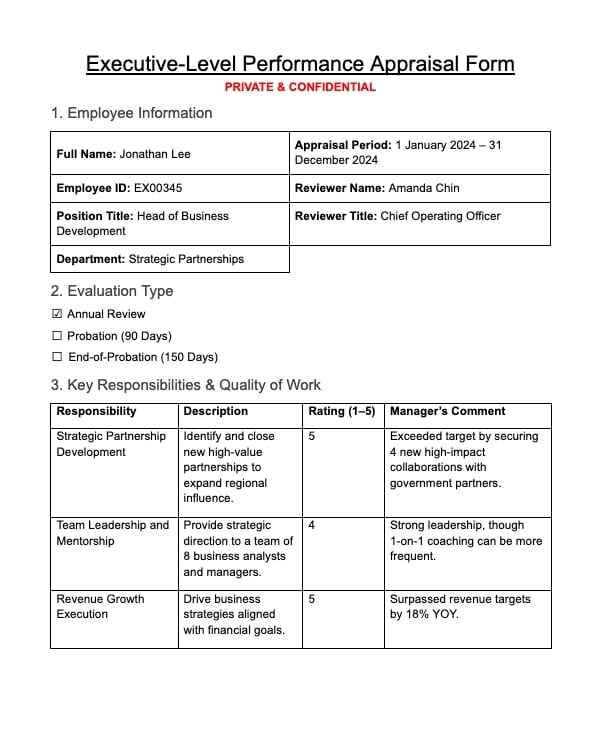
Downloadable Appraisal Form Templates
.png)
.png)
Tips for Conducting Better Appraisals
Good performance reviews don’t just rely on the form. They rely on how you use it. To make the most out of the appraisal process, employers and HR teams can follow these practical tips:
Use clear and objective criteria
Appraisals should be based on measurable performance and observed behaviour, not personal opinions. Clear criteria help ensure consistency and fairness across all departments.
Train managers on giving feedback
Not every supervisor knows how to conduct a productive appraisal meeting. Offering short training or guidelines can help managers deliver feedback in a professional and constructive way.
Prepare all records in advance
Gather relevant data before the meeting, such as previous performance goals, recent achievements, and attendance records. This helps make the discussion more focused and informed.
Encourage two-way communication
Let employees share their own views and self-assessments. This shows respect and often reveals useful insights that supervisors might miss.
Keep documentation complete and organised
Always record the outcome of the appraisal, including comments and next steps. Store the signed form safely as part of the employee’s official HR file.
Create a follow-up action plan
Appraisals should not end with the meeting. Use the results to set new goals, identify training needs, or explore career development paths. This makes the process more meaningful.
Handle difficult conversations with care
If performance is poor, stay factual and supportive. Offer suggestions for improvement and explain how progress will be measured in the next review.
Frequently Asked Questions (FAQ)
What should I include in an appraisal form?
An appraisal form should include:
-
Employee’s name
-
Job title
-
Department
-
Review period
-
Performance rating scale
-
Clearly defined categories (work quality, communication, teamwork, punctuality, etc)
-
Supervisor and employee comments.
-
Overall performance summary
-
Signatures from both the supervisor and employee confirm the discussion took place.
Can I customise the form based on roles or departments?
Yes, you can and should customise appraisal forms to match different roles or departments.
For example, a leadership category may be important for a manager but not necessary for junior staff.
Customisation helps ensure that each employee is evaluated based on responsibilities that are actually relevant to their job. It also makes the feedback more useful and fair for both the employee and the company.
How often should appraisals be done in Malaysia?
A common approach is to have one full-year review and a mid-year check-in. Some companies may also do quarterly reviews for roles that need frequent feedback.
The timing depends on your business needs, but regular appraisals help keep employees aligned with goals and improve communication between managers and staff.
Is it mandatory to conduct appraisals?
No, performance appraisals are not legally required in Malaysia. However, they are considered best practices in human resource management.
Regular appraisals help companies make informed decisions about promotions, salary adjustments, and training needs. They also show employees that their performance is recognised and valued, which can improve morale and retention.
How do I ensure appraisals are fair and unbiased?
Use the same form and criteria for all employees in similar roles. Focus on facts, such as completed tasks, outcomes, and observed behaviour, instead of personal opinions.
Whenever possible, involve more than one reviewer or get input from multiple sources to balance the assessment.
Provide training for managers so they know how to avoid bias and give feedback professionally. Keeping written records helps support transparency and protects against disputes.
Are appraisal results confidential?
Yes, appraisal results should be treated as confidential. They are part of an employee’s personal HR record and should only be shared with the employee, their direct supervisor, and authorised HR personnel.
Keeping the information private helps build trust and protects the integrity of the appraisal process. If results need to be used for broader decisions like promotions or transfers, they should still be handled discreetly and with respect for the employee’s privacy.
Your Next Hire Could be Just a Click Away!

At AJobThing, we connect you with 5+ million jobseekers in Malaysia, ensuring you hire the best while staying compliant with LHDN regulations.
Read More:
- EPF Voluntary Contribution in Malaysia: How It Works & Benefits
- STR 2025 (Sumbangan Tunai Rahmah): Eligibility, Payment Dates & How to Apply
- CP22 Form: Deadline, Free Download Form, How to Fill
- CP204: Deadline, Calculation, & Free Download Form
- How to Use ByrHASiL for Online Tax Payments in Malaysia
- PCB Deduction in Malaysia: Calculation, Rates & Employer Guide
- What is the 182 Days Rule in Malaysia? Tax Residency Explained
- 12 Employment Types You Need to Know: A Guide for Employers
- What is Precarious Employment? Risks, Challenges, and Solution
- New EPF Retirement Savings: Helping Employers Support Financial Well-Being for Employees
- Who Can Look at Employee Personnel Files?
- Why a Clear Signing Off From Work Policy Matters
- What is Work Life Balance? Benefits, Factors, and How to