
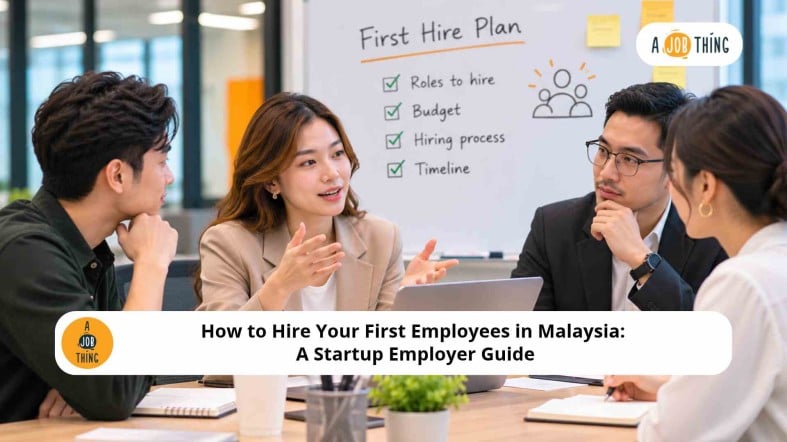
How to Hire Your First Employees in Malaysia: A Startup Employer Guide

Are You Hiring?
Find candidates in 72 Hours with 5+ million talents in Maukerja Malaysia & Ricebowl using Job Ads.
Hire Now
Hiring employees for a startup in Malaysia requires careful planning, especially when the business has limited funds and a small team. Before posting a job vacancy, employers should identify their most urgent business needs, decide which positions to recruit first and calculate the full cost of hiring. A clear recruitment plan helps new businesses build a team that supports growth without unnecessary expenses.
Why Hiring The Right First Employees Matters
For a new business, every employee has an important role in keeping operations running. Unlike established companies with separate departments, startups often operate with smaller teams where employees may handle several responsibilities.
The first few hires can influence how the business manages customers, generates revenue, delivers products and handles daily operations.
Hiring too early can put pressure on cash flow, while hiring too late may cause founders to struggle with workloads and miss business opportunities.
Start by identifying the tasks that are essential to running the business. Then decide whether these responsibilities require a full-time employee, part-time employee, temporary worker or external service provider.
For a better understanding of how to estimate workforce requirements and manage staffing costs, read our guide on Manpower Planning and Budgeting in Malaysia.
Which Positions Should A Startup Hire First?
There is no fixed order for hiring employees in a new business. The right positions depend on the business model, industry, available budget and current workload.
Here are some common positions that startups may consider for their first hires.
| Position | Main Responsibilities | When To Hire |
| Sales or Business Development Executive | Find potential customers, build relationships and generate revenue | When founders need support with sales and customer acquisition |
| Operations Executive | Manage daily activities, suppliers, orders and internal processes | When operational tasks are taking too much time |
| Customer Service Executive | Respond to enquiries, manage complaints and support customers | When customer enquiries and service requests increase |
| Marketing Executive | Manage social media, campaigns, content and brand awareness | When the business needs consistent marketing activities |
| Technical or Product Specialist | Develop, maintain or improve the company's product or technology | When product development or technical support is essential to the business |
These are examples rather than positions every startup needs to recruit immediately.
For example, an e-commerce business may need an operations or customer service employee first to manage orders and customer enquiries. A technology startup may prioritise a software developer or product specialist to build its main product.
The best first hire is the person who can solve the business's biggest operational or commercial problem.
How To Set Hiring Priorities With A Limited Budget
Startups should avoid recruiting several employees simply because they want to establish different departments. Instead, prioritise positions based on their contribution to business operations and growth.
Consider these four areas when deciding which employee to hire first.
Prioritise Work That Generates Revenue
Identify activities that directly support sales and business development. If the founders cannot manage customer acquisition, a sales or business development employee may be a priority.
Identify Operational Bottlenecks
Look for recurring tasks that delay business operations. These may include processing orders, coordinating suppliers, handling documentation or managing customer requests.
Hiring someone to manage these responsibilities can give founders more time to focus on business growth.
Focus On Customer Experience
As the customer base grows, responding to enquiries and resolving issues becomes more important. A customer service employee can help maintain service quality and improve customer satisfaction.
Hire For Skills That Are Difficult To Outsource
Some responsibilities require regular attention or specialised knowledge. If the business depends on technology, product development or technical support, hiring an employee with the necessary skills may be more practical than relying on temporary external support.
For administrative, accounting or occasional creative tasks, outsourcing may be a reasonable starting option.
How To Recruit Employees For A New Business In Malaysia
Once the business has identified its recruitment priorities, employers can follow a structured hiring process.
Define The Job Requirements
Before advertising a vacancy, determine what the employee will be responsible for.
Prepare a job description that includes:
- Job title and department.
- Main duties and responsibilities.
- Required qualifications and experience.
- Essential technical and soft skills.
- Working location and working hours.
- Employment type, such as permanent, contract or part-time.
- Expected salary range.
- Expected starting date.
Keep the requirements realistic. A startup may benefit more from someone with practical skills and the ability to adapt than from a candidate with a long list of qualifications.
A clear job advertisement also helps attract candidates who understand the role. Read our guide on How to Create a Job Posting That Attracts the Right Candidates for tips on preparing an effective vacancy advertisement.
Prepare A Realistic Salary Budget
Research salary expectations for the position and consider what the business can afford.
Do not calculate hiring costs based on monthly salary alone. Include employer statutory contributions, recruitment expenses, onboarding, equipment and any additional benefits.
A realistic budget helps prevent the business from making an employment commitment that it cannot maintain.
You can also refer to our guide on Cost Per Hire in Malaysia: Formula, Examples and How Employers Can Reduce Hiring Costs to understand the expenses involved in recruiting an employee.
Choose Suitable Recruitment Channels
New businesses can advertise vacancies through online job platforms, professional networks, referrals and recruitment services.
Choose channels based on the type of candidate you need. For example, entry-level positions may attract a different candidate pool from specialised technical or management roles.
Startups can also use online recruitment platforms to make job advertising and candidate sourcing more manageable. For example, AJobThing provides access to jobseekers through Maukerja, Ricebowl and Epicareer, allowing employers to explore different candidate audiences when recruiting for their business.
Another option is MYFutureJobs, a recruitment service provided by PERKESO, which allows employers to advertise job opportunities and access local jobseekers.
For more ideas on selecting suitable recruitment channels and attracting applicants, read our guide on Recruitment Strategies: How to Attract and Hire Better Talent.
Screen Candidates Based On Essential Skills
Avoid selecting candidates based only on their educational background or previous job titles.
Review their:
- Relevant work experience.
- Technical and practical skills.
- Communication abilities.
- Problem-solving approach.
- Ability to work in a small team.
- Interest in working in a growing business.
For certain positions, a short practical assessment can help employers understand whether candidates can perform the actual job.
Startups looking for specialised talent can also explore different candidate sourcing methods. Read What Is Candidate Sourcing? to understand how employers can identify and approach potential candidates.
Conduct Structured Interviews
Prepare a consistent set of interview questions for every shortlisted candidate.
Ask questions related to the role, previous experience and how candidates handle work challenges.
For startups, it is also useful to understand whether candidates are comfortable with changing priorities, taking ownership of tasks and working in an environment where processes may still be developing.
You can refer to our Interview Questions to Ask Candidates in Malaysia: By Role With Scoring Guide and Template for ideas when preparing your interview process.
Make A Clear Job Offer
Once the preferred candidate has been selected, provide a written offer or employment contract.
Clearly explain the salary, job responsibilities, employment type, working hours, benefits, probation period and notice requirements.
Make sure both parties understand the employment terms before the employee starts work.
How Much Should A New Business Budget For Hiring?
The cost of hiring an employee involves more than the agreed monthly salary. New business owners should estimate both recruitment expenses and ongoing employment costs.
Consider these expenses when preparing a hiring budget:
| Cost Category | Examples |
| Employee Salary | Basic salary, fixed allowances and contractual bonuses |
| Statutory Contributions | EPF, SOCSO and EIS, where applicable |
| Recruitment Costs | Job advertisements, recruitment services and candidate assessments |
| Equipment | Laptop, software, phone and other work equipment |
| Onboarding | Training, orientation and administrative preparation |
| Employee Benefits | Medical benefits, additional leave and other company-provided benefits |
It is also important to consider how long the business can support the employee's salary and related costs.
A useful approach is to estimate the total monthly employment cost and compare it with the expected business value or operational improvement the employee can deliver.
Employer Responsibilities When Hiring In Malaysia
Hiring an employee also means taking on responsibilities as an employer. New businesses should prepare for the relevant registrations, payroll requirements and employment obligations before their first employee starts work.
Some important areas include:
Employees Provident Fund (EPF)
Employers must register with EPF within seven days from the date they become liable to contribute. Employers are also responsible for registering eligible employees and making the required monthly contributions.
Refer to the EPF employer registration and employee registration guidance for the requirements under Section 41(1) of the Employees Provident Fund Act 1991.
Social Security Organisation (SOCSO) And Employment Insurance System (EIS)
Employers must register with PERKESO and ensure eligible employees are registered for the relevant social security protection and contributions.
The Employees' Social Security Act 1969 and Employment Insurance System Act 2017 provide the relevant legal framework. Check PERKESO's employer registration guidance for registration and contribution responsibilities.
Income Tax And Monthly Tax Deduction (PCB)
Employers must understand their responsibilities to register an employer tax file, make applicable monthly tax deductions and submit the required tax information to LHDN.
Refer to LHDN's Employer Responsibilities for information on PCB, employer tax returns, employee notifications and payroll records.
Employment Contract And Employee Records
Prepare employment documentation that explains the employee's job scope, salary, working hours, benefits and other employment terms. Keep accurate records of employee details, attendance, payroll and statutory contributions.
For employers in Peninsular Malaysia and Labuan, refer to the Employment Act 1955 (Act 265) and the JTKSM Acts and Guidelines page.
The Act covers important employment matters, including working hours, rest days, leave and other employment protections. The general maximum normal working hours under Section 60A is 45 hours per week, subject to the Act's provisions.
Sabah and Sarawak have their own Labour Ordinances. Employers operating in these states should check the applicable state labour requirements rather than relying only on the Employment Act 1955.
HRD Corp Registration
Check whether the business falls under the Pembangunan Sumber Manusia Berhad Act 2001. Registration is compulsory for covered employers with 10 or more Malaysian employees, while employers with five to nine Malaysian employees may register voluntarily, subject to the applicable conditions.
Refer to HRD Corp's employer registration requirements to check eligibility and levy requirements.
Common Hiring Mistakes New Businesses Should Avoid
New employers may face recruitment challenges when they have limited hiring experience. Avoid these common mistakes:
- Hiring Without A Clear Job Scope: Employees may not understand their responsibilities, resulting in duplicated work and operational confusion.
- Recruiting Too Many Employees Too Early: Growing the workforce faster than the business can afford may create unnecessary financial pressure.
- Setting Unrealistic Job Requirements: Requiring too many qualifications or skills can make it harder to attract suitable candidates.
- Ignoring Total Employment Costs: Employers should account for statutory contributions, equipment, onboarding and other expenses, not just basic salary.
- Rushing The Recruitment Process: Hiring without proper screening and interviews can lead to unsuitable appointments and additional recruitment costs.
A good recruitment plan helps a startup avoid these problems and focus on employees who can contribute to its immediate business needs.
Recruiting employees for a new business in Malaysia is not about building a large team as quickly as possible. It is about identifying the most important business needs, hiring people with the right skills and managing employment costs responsibly.
Start with essential positions, set clear job responsibilities and expand the workforce when business demand justifies it. With a well-planned recruitment process and suitable recruitment channels, startups can build a small but capable team that supports sustainable growth.
FAQs
When should a startup hire its first employee?
A startup should consider hiring when its workload exceeds the founders' capacity, important tasks are being delayed or the business needs skills that the existing team does not have.
What are the best first hires for a startup?
Common first hires include sales, operations, customer service, marketing or technical employees. The right choice depends on the business model and its most urgent needs.
How many employees should a new business hire?
There is no fixed number. Start with the positions required to manage essential operations and meet customer demand. Increase headcount as the business grows and its budget allows.
Can a startup hire part-time employees instead of full-time staff?
Yes. Part-time employees can help startups manage workloads that do not require a full-time position. Employers should still check the applicable employment terms, statutory contributions and legal requirements, including the Employment (Part-Time Employees) Regulations 2010 where applicable.
What should a startup prepare before hiring its first employee?
A startup should prepare a job description, salary budget, recruitment plan, employment offer or contract, payroll process and relevant employer registrations such as EPF and PERKESO.
Build Your Startup Team With The Right Talent

Finding your first employees is an important step in growing your business. With AJobThing, you can advertise job vacancies and connect with jobseekers through Maukerja, Ricebowl and Epicareer on one platform.
Whether you are hiring your first employee or expanding your team, AJobThing helps make recruitment easier.
Ready to find your first hire? Start building your team today.
Read More
- SME Hiring Guide: How to Plan, Hire, and Grow Your Team Successfully
- Manpower Planning and Budgeting in Malaysia: Employer's Complete Guide
- Recruitment Strategy: How to Attract and Hire Better Talent
- Cost Per Hire Malaysia: Formula, Examples and How Employers Can Reduce Hiring Costs
- Malaysia Salary Guide 2026: Salary Benchmarks by Industry
- How to Create a Job Posting That Attracts the Right Candidates
- Finding Qualified Candidates: A Comprehensive Guide for Employers in Malaysia
- Candidate Sourcing: Definition, Benefits, and Strategies
- Interview Questions to Ask Candidates in Malaysia: By Role, With Scoring Guide and Template