
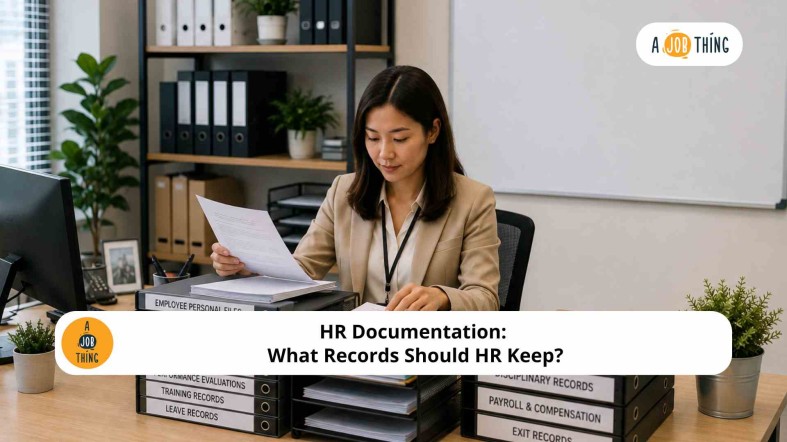
HR Documentation: What Records Should HR Keep?

Are You Hiring?
Find candidates in 72 Hours with 5+ million talents in Maukerja Malaysia & Ricebowl using Job Ads.
Hire Now
Good HR documentation helps companies keep employee information organised, support consistent HR decisions, and maintain important records throughout the employee lifecycle.
From recruitment and onboarding to performance reviews, leave, payroll, and offboarding, HR teams handle a large amount of employee information.
Without a clear documentation process, important records can become difficult to find, incomplete, or inconsistent.
This guide explains the main types of HR records companies should keep, how HR can organise them, and common documentation mistakes to avoid.
What Is HR Documentation?
HR documentation refers to records and information that HR teams create, collect, or maintain throughout an employee's relationship with the company.
These records can cover different stages of employment, including:
-
Recruitment
-
Hiring
-
Employment
-
Performance management
-
Leave and attendance
-
Compensation
-
Training
-
Employee relations
The exact records a company needs to keep depend on its location, industry, workforce, and applicable employment, tax, privacy, and other legal requirements.
Why Is HR Documentation Important?
Keeping accurate HR records can help HR teams manage employees more effectively.
Keeps Employee Information Organised
A structured documentation system makes it easier for HR to find important information when needed.
Instead of searching through emails, spreadsheets, and separate files, HR can keep relevant records in an organised employee file.
Supports HR Decisions
Documentation gives HR and managers a record of important events and decisions.
For example, performance records can provide useful context when reviewing an employee's progress or addressing ongoing performance concerns.
Helps Maintain Consistency
Consistent documentation can help HR apply company policies and processes more consistently across employees.
Supports Compliance
Some employee records may need to be maintained to meet employment, tax, payroll, privacy, or other legal requirements.
HR should understand the specific requirements that apply to the company and avoid assuming that the same retention rules apply to every type of record.
Provides an Organised Record of Employment
Employee documentation creates a record of important events throughout the employment lifecycle, from hiring to departure.
What HR Records Should Companies Keep?
The exact records depend on the organisation, but HR teams commonly maintain the following categories.
Recruitment Records
HR should keep relevant records from the hiring process.
These may include:
-
Job description
-
Job advertisement
-
Candidate application
-
Resume or CV
-
Interview notes
-
Interview scorecards
-
Assessment results
-
Background check records, where applicable
-
Recruitment correspondence
-
Job offer
-
Rejection or withdrawal records
Not every candidate record needs to be kept indefinitely. HR should follow the company's record-retention policy and applicable requirements.
Employee Personal Information
Employee files may contain information needed to manage employment.
Examples include:
-
Full name
-
Contact information
-
Emergency contact
-
Identification information
-
Employment start date
-
Job title
-
Department
-
Work location
-
Employment status
-
Relevant employment documentation
HR should only collect and retain information that is necessary for legitimate business or legal purposes.
Sensitive personal information should receive appropriate protection and access controls.
Employment Records
Important employment documents can include:
-
Offer letter
-
Job description
-
Contract amendments
-
Promotion records
-
Transfer records
-
Changes to employment terms
-
Relevant company policy acknowledgements
HR should make sure employees receive the documents they are entitled to receive and that the company's records remain up to date.
Payroll and Compensation Records
Payroll documentation can include:
-
Salary information
-
Allowances
-
Bonuses
-
Commission records
-
Salary adjustments
-
Payroll records
-
Statutory contribution records
-
Tax-related payroll information
-
Payslips or payroll statements
Payroll records often involve sensitive financial and personal information, so access should be limited to authorised employees.
Leave and Attendance Records
HR may need to maintain records relating to:
-
Other types of leave
-
Leave applications
-
Leave approvals
-
Attendance
-
Overtime
-
Absence records
Accurate records can help HR answer employee questions and identify attendance or leave issues.
Performance Management Records
Performance documentation can help HR and managers track employee development and address performance concerns.
These records may include:
-
Performance goals
-
Manager feedback
-
Employee feedback
-
Progress reviews
-
Recognition records
-
Disciplinary-related performance documentation
Performance records should be factual, relevant, and based on specific observations or outcomes.
Avoid vague statements such as:
"The employee has a bad attitude."
A stronger record would describe the specific behaviour, situation, impact, and action taken.
Training and Development Records
HR may keep records of employee training and development activities, such as:
-
Training courses
-
Training dates
-
Attendance
-
Certifications
-
Skills assessments
-
Professional development programmes
-
Mandatory training completion
These records can help HR understand employee development and identify future training needs.
Employee Relations Records
Employee relations matters may require careful documentation.
Depending on the situation, records can include:
-
Employee complaints
-
Grievances
-
Investigation records
-
Meeting notes
-
Employee responses
-
Management responses
-
Disciplinary actions
-
Warnings
-
Corrective actions
-
Resolution records
These records should be handled carefully because they may contain sensitive information.
HR should document facts rather than assumptions or personal opinions.
Workplace Incident Records
Depending on the organisation and applicable requirements, HR may need records relating to workplace incidents.
These could include:
-
Incident reports
-
Accident records
-
Investigation findings
-
Witness information
-
Corrective actions
-
Follow-up records
The specific documentation required will depend on the type of incident and applicable workplace requirements.
Employee Offboarding Records
When an employee leaves, HR should update the employee's records.
Offboarding documentation may include:
-
Termination documentation
-
Final working date
-
Exit interview
-
Final salary information
-
Leave balance
-
Company property return
-
Access termination
-
Handover records
-
Relevant employment documents
A clear offboarding record helps HR close the employee's employment file properly.
HR Documentation Checklist
A simple checklist can help HR make sure important records are covered.
| HR Record | Should HR Keep It? |
|---|---|
| Job application | Yes |
| Resume/CV | Yes |
| Interview notes | Yes |
| Interview scorecard | Yes |
| Offer letter | Yes |
| Employment contract | Yes |
| Employee personal information | Yes |
| Payroll records | Yes |
| Leave records | Yes |
| Attendance records | Yes |
| Performance reviews | Yes |
| Training records | Yes |
| Disciplinary records, where applicable | Yes |
| Employee complaints, where applicable | Yes |
| Resignation or termination records | Yes |
| Exit interview | Yes |
The exact retention period and whether a specific record must be kept will depend on applicable laws, regulations, and company policy.
How Long Should HR Keep Employee Records?
There is no single retention period that applies to every HR record everywhere.
Different records may have different legal or business requirements.
For example, payroll, tax, employment, health and safety, recruitment, and personal data records may be subject to different rules.
HR should consider:
-
Applicable employment laws
-
Tax requirements
-
Payroll requirements
-
Data protection and privacy rules
-
Industry regulations
-
Contractual obligations
-
Potential disputes or claims
-
Company record-retention policies
HR should create a retention schedule that identifies:
What record → Who owns it → How long it is kept → Where it is stored → When it should be securely deleted
If the applicable requirement is unclear, HR should seek advice from an appropriate legal or compliance professional.
How Should HR Store Employee Records?
HR records can be stored digitally, physically, or through a combination of both.
Digital Records
Digital HR files can make documents easier to organise and retrieve.
HR can use:
-
HR information systems
-
Secure document management systems
-
Access-controlled cloud storage
-
Company databases
Digital systems should use appropriate security controls.
Physical Records
If physical documents are required, HR should store them securely.
Consider:
-
Locked storage
-
Restricted access
-
Clear file naming
-
Document indexing
-
Secure disposal
Physical documents containing personal information should not be left in open or publicly accessible areas.
How HR Can Organise Employee Files
A consistent file structure makes HR documentation easier to manage.
For example:
Employee File
-
Personal Information
-
Recruitment
-
Employment
-
Payroll
-
Leave & Attendance
-
Performance
-
Training
-
Employee Relations
-
Offboarding
HR can also use a consistent naming system for digital documents.
For example:
EmployeeName_DocumentType_Date
A consistent structure can reduce duplicate files and make documents easier to retrieve.
Who Should Have Access to HR Records?
Not every employee should have access to every HR record.
HR should use role-based access based on the sensitivity and purpose of the information.
For example:
|
Record |
Possible Access |
|
Personal information |
HR / authorised personnel |
|
Payroll information |
Payroll / authorised HR |
|
Performance records |
HR + relevant manager |
|
Disciplinary records |
HR + authorised management |
|
Recruitment records |
Recruitment team / relevant hiring team |
|
General policy documents |
Wider employee access |
Access should be limited to people who genuinely need the information for their role.
HR Documentation Best Practices
Document Important Events Promptly
Create records soon after an important event rather than relying on memory later.
Be Factual
Document what happened rather than making assumptions about someone's intentions.
Instead of:
"The employee does not care about their work."
Use:
"The report was submitted two days after the agreed deadline."
The second statement records an observable event rather than an opinion.
Use Consistent Documentation
Use standard forms, templates, and processes where appropriate.
This can make HR records easier to compare and review.
Keep Records Relevant
Do not collect or retain information simply because it might be useful someday.
HR should consider whether the information is necessary for the purpose for which it is being collected or retained.
Protect Sensitive Information
Employee records can contain personal, financial, and other sensitive information.
Use appropriate:
-
Access controls
-
Password protection
-
Secure storage
-
Encryption where appropriate
-
Backup procedures
-
Secure disposal
Keep Records Up to Date
Outdated information can cause problems.
For example, HR should update records when an employee:
-
Changes address
-
Changes job title
-
Transfers departments
-
Receives a salary adjustment
-
Changes employment status
-
Leaves the company
Follow a Retention Schedule
HR should know when records should be reviewed, archived, or securely deleted.
Keeping every document forever can create unnecessary privacy, security, and storage risks.
HR Documentation During the Employee Lifecycle
HR documentation should be viewed as an ongoing process rather than something that only happens when an employee joins or leaves.
A typical employee lifecycle looks like:
Recruitment → Hiring → Onboarding → Employment → Performance → Development → Offboarding
Each stage can generate different HR records.
|
Employee Stage |
Common Records |
|
Recruitment |
Application, CV, interview notes |
|
Hiring |
Offer letter, employment contract |
|
Onboarding |
Policy acknowledgements, onboarding documents |
|
Employment |
Payroll, leave, attendance |
|
Performance |
Reviews, goals, feedback |
|
Development |
Training, certifications |
|
Employee Relations |
Complaints, investigations, disciplinary records |
|
Offboarding |
Resignation, final records, exit interview |
A consistent approach helps HR maintain a complete and organised record throughout the employee lifecycle.
FAQs
What is HR documentation?
HR documentation refers to records created or maintained by HR throughout the employee lifecycle, including recruitment, employment, performance, payroll, leave, employee relations, and offboarding records.
What employee records should HR keep?
Common records include applications, interview notes, employment contracts, payroll information, leave records, attendance records, performance reviews, training records, employee relations documentation, and offboarding records.
How long should HR keep employee records?
There is no universal retention period. The appropriate period depends on the type of record, applicable laws, regulatory requirements, privacy rules, and company policy.
Should HR keep interview notes?
Relevant interview notes can be useful for documenting the recruitment process and supporting consistent hiring decisions. HR should follow its record-retention policy and applicable requirements when deciding how long to keep them.
Who should have access to employee records?
Access should generally be limited to authorised people who need the information for their work. HR should use appropriate access controls based on the sensitivity of each record.
Should HR keep employee records after they leave?
Some records may need to be retained after an employee leaves, depending on legal, regulatory, tax, privacy, contractual, or business requirements. HR should follow its applicable retention schedule.
Build a Better Hiring Process
%20copy.jpg)
Good HR starts with organised processes and the right people. With AJobThing, HR teams can post jobs, reach qualified candidates, and manage applications more efficiently.
Post your job today.
Read More:
-
Panel Interviews: How HR Can Plan, Conduct & Evaluate Candidates
-
Interview-to-Hire Ratio: How to Calculate, Benchmark & Improve It
-
Candidate Experience Survey: Questions, Examples & How to Improve Recruitment
-
How to Reduce Hiring Bias: Common Interview Biases HR Professionals Should Avoid
-
Staff Immediate Resignation in Malaysia: Employer Rights & Responsibilities
-
Late Salary Payment in Malaysia: Can Employers Delay Employee Salaries?
-
Internship vs Apprenticeship in Malaysia: Key Differences for Employers & HR
-
How to Manage Underperforming Employees in Malaysia: Tips for Employers & HR
-
Warning Letter for Poor Performance in Malaysia: How to Write One (With Sample)
-
Can Employers Reject Annual Leave in Malaysia? Rights, Rules & Employee Entitlements
-
Payroll and Attendance Management in Malaysia: Process, Formula & Best Practices for Employers
-
Workplace Conflict Management in Malaysia: Causes, Solutions, and Best Practices
-
Recruitment Process Outsourcing (RPO): What It Is, Benefits & How It Works in Malaysia
-
SME Hiring Guide: How to Plan, Hire, and Grow Your Team Successfully
-
Competency-Based Interviews: Improve Hiring Quality with a Consistent Interview Process
-
Leave Encashment Malaysia: How to Calculate Unused Annual Leave
-
Online Seller Requirements in Malaysia: 10 Business Details You Must Display
-
Performance Bonus in Malaysia: How It Works, Calculation & Employer Guide
-
Cost Per Hire Malaysia: Formula, Examples & How Employers Can Reduce Hiring Costs
-
Letter of Extension of Contract Malaysia: Free Template, Format & Sample
-
Promotion Letter in Malaysia: How to Write One (+ Free Template & Sample)
-
Probation Extension Letter Malaysia: Template, Sample, and What Employers Need to Know
-
Talent Pool: Benefits, Examples & How to Build One for Better Hiring
-
Sales Turnover: What It Is, Formula, Examples & Tips to Increase It
-
Overtime Rates in Malaysia: When Do 1.5x, 2x and 3x Pay Apply?
-
Prorated Salary in Malaysia: How to Calculate an Employee's First Salary
-
Remote Jobs in Malaysia: Most In-Demand Roles, Salaries & Hiring Guide (2026)
-
Effective Ways to Reduce Absenteeism in the Workplace for HR & Employers
-
Medical Benefits for Employees in Malaysia: Types, Legal Requirements & Best Practices
-
Fresh Graduate Salary in Malaysia (2026): How Much Should Employers Pay?
-
Salary Benchmarking in Malaysia: Are You Paying Enough to Attract Candidates?
-
e-Invoicing Malaysia Explained: What Every Employer and Business Needs to Know
-
EOR vs PEO: What's the Difference and Which Is Right for Your Business?
-
Remote Job Offer Letter: What Employers Should Include (+ Example)
-
Job Offer Letter vs. Employment Contract: What's the Difference? (+ Free Templates)
-
Constructive Dismissal Malaysia: Meaning, Examples & What To Do
-
Contract of Service vs Contract for Service Malaysia: How to Classify Workers Correctly
-
Job Offer Letter Templates: Examples, Formats & Best Practices for HR
-
Employee Retention in Malaysia: Meaning, Importance & How to Improve It
-
Employee Turnover in Malaysia: Causes, Warning Signs & How to Reduce It
-
Retrenchment in Malaysia: Meaning, Process & Employee Rights
-
Gmail Templates for HR: Faster Replies for Interviews, Offers & Rejections
-
7 Key Contract Employee Rights in Malaysia Every HR Should Know
-
GLC vs Private Company Malaysia: Salary, Culture & Hiring Differences
-
Types of Payroll Calculation in Malaysia: Adhoc, Prorated Salary & Final Settlement Explained
-
Types of Payroll Cycle in Malaysia: Which One Is Best for Your Business?
-
Types of Insurance in Malaysia and Their Impact on Employee Benefits
-
How to Create a Strong Candidate Shortlist for Better Hiring Decisions
-
How HR in Malaysia Can Offer a Job Over the Phone (with Script)
-
How Notice Period Really Works in Malaysia for Employers and HR
-
How to Create a Job Posting That Attracts the Right Candidates
-
How HR in Malaysia Can Improve Resume Screening and Candidate Shortlisting
-
How HR Can Reject a Candidate the Right Way (with Templates)
-
How to Conduct a Background Check for Employment in Malaysia
-
Onboarding Process Tips: What HR Needs to Know for Better Retention
-
Onboarding Checklist for New Hires (Free Downloadable Template)
-
Performance Evaluation: Description, Types, and How to Conduct
-
Cover Letter Examples Employers Should Know (With Tips to Spot the Best Ones)
-
Step-by-Step Guide to Writing a Great Job Description (Free Templates)