
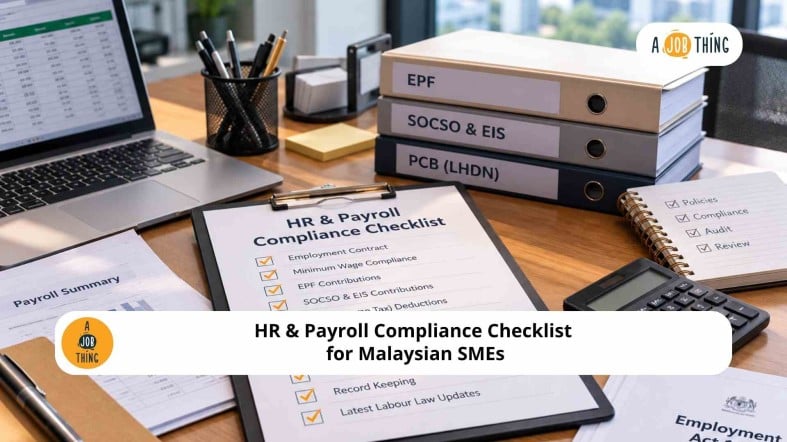
HR & Payroll Compliance Checklist for Malaysian SMEs

Are You Hiring?
Find candidates in 72 Hours with 5+ million talents in Maukerja Malaysia & Ricebowl using Job Ads.
Hire Now
Managing HR compliance can be challenging for small and medium-sized enterprises (SMEs), especially when a business does not have a dedicated HR or payroll team.
Employers need to manage employment contracts, salary payments, statutory contributions, employee records and workplace policies while keeping up with applicable requirements. Missing an important deadline or maintaining incomplete records can lead to payroll errors, employee disputes or compliance issues.
An HR compliance checklist in Malaysia helps employers organise these responsibilities, identify gaps and keep important tasks on track.
Here are 10 areas Malaysian HR teams and business owners should review to maintain better HR and payroll compliance.
Why Is HR Compliance Important for Malaysian SMEs?
HR compliance means ensuring that employment practices, payroll processes and workplace procedures follow the laws and requirements that apply to a business.
For SMEs, this is particularly important because one person may handle several responsibilities, from recruitment and payroll to employee administration and recordkeeping.
A regular compliance review helps employers identify missing documents, check statutory payments, monitor deadlines and prepare for employee queries or regulatory inspections.
However, not every requirement applies to every business in the same way. Some obligations depend on the company's location, industry, workforce size and employee category.
HR and Payroll Compliance Checklist: 10 Things Employers Must Check
1. Employment Contracts and Hiring Documents
Employment terms should be properly documented so that both the employer and employee understand their responsibilities and entitlements.
HR should review whether employment contracts and offer letters accurately reflect the agreed terms, including:
-
Job title, duties and reporting arrangements.
-
Salary, allowances and payment frequency.
-
Working hours, rest days and overtime arrangements.
-
Leave entitlements and employment benefits.
-
Probation, notice periods and termination terms.
Keep signed contracts, offer letters and written amendments in the relevant employee records. For foreign workers, also verify applicable employment authorisations and permit conditions.
Read AJobThing's guide to employment contracts in Malaysia for more information.
2. Minimum Wage, Salary Payments and Payslips
Employers should check that wages meet the applicable minimum wage requirements and that salary payments follow the relevant legal requirements and employment terms.
Review payroll calculations for basic salary, allowances, overtime, bonuses, deductions and take-home pay.
HR and payroll teams should also ensure that wages are paid within the applicable timeframe, employees receive the required wage statements and salary deductions are properly calculated and permitted.
Check the latest minimum wage requirements and any changes scheduled to take effect rather than relying on outdated salary information.
For official guidance, refer to the Department of Labour Peninsular Malaysia (JTKSM).
3. Working Hours, Overtime and Public Holidays
Incorrect working-hour records or overtime calculations can result in employee complaints and payroll disputes.
HR should review attendance records, work schedules, overtime payments, rest days and public holiday arrangements against the rules applicable to each employee.
For employees covered by the relevant working-hour provisions of the Employment Act 1955, the general maximum is 45 working hours per week. Some provisions, including overtime-pay entitlements, have specific eligibility conditions.
Employers should maintain accurate records and ensure that overtime is calculated using the applicable rates and rules.
Read AJobThing's guide to working hours and overtime in Malaysia for further guidance.
4. Annual Leave, Sick Leave and Other Benefits
Leave entitlements should be documented, accurately recorded and administered consistently.
HR should check that company policies comply with applicable statutory requirements and employment contracts, including:
-
Annual leave and sick leave.
-
Maternity and paternity leave.
-
Paid public holidays.
-
Hospitalisation leave, where applicable.
-
Additional contractual or company-provided benefits.
Keep records of leave earned, taken and remaining. Ensure payroll reflects the correct treatment of paid leave, unpaid leave and outstanding leave payments when employment ends.
Employees and managers should also understand the company's leave application and approval procedures.
5. EPF, SOCSO and EIS Contributions
Employers must determine which statutory contributions apply to their employees, calculate the correct amounts and make payments within the applicable deadlines.
| Scheme | What Employers Should Check |
|---|---|
| EPF (KWSP) | Employee registration, applicable contribution rates and monthly payments |
| SOCSO (PERKESO) | Employee coverage, contribution category and payment records |
| EIS | Eligibility, contribution calculations and payments where applicable |
Monthly EPF and PERKESO contributions are generally due by the 15th of the following month. Employers should check the relevant agency's payment guidance for applicable rules and any special deadline arrangements.
Reconcile contribution submissions against payroll records and retain proof of payment. This helps identify missing registrations, incorrect deductions and outstanding contributions.
Use the official KWSP employer guidance and PERKESO contribution information to check current rates and requirements.
6. Monthly Tax Deductions and Annual Employer Reporting
Employers also have tax reporting responsibilities administered by the Inland Revenue Board of Malaysia (HASiL).
Where required, employers must calculate and remit monthly tax deductions, known as PCB or Monthly Tax Deduction (MTD), and prepare the relevant annual employer documents.
Key responsibilities include:
-
Remitting PCB/MTD by the applicable deadline.
-
Preparing employees' annual remuneration statements, Form EA or EC.
-
Submitting Form E and the required CP8D information.
-
Keeping accurate payroll and tax records.
HASiL specifies the 15th of the following month as the standard deadline for monthly PCB/MTD payments. Its published annual reporting deadlines include the last day of February for Form EA/EC and 31 March for Form E with CP8D, subject to applicable filing instructions and exceptions.
Refer to HASiL's official employer responsibilities to confirm current filing requirements.
7. HRD Corp Registration, Levy and Training Claims
Some employers are required to register with the Human Resource Development Corporation (HRD Corp) and pay the applicable training levy.
Registration depends on whether the company's business activities fall under the Pembangunan Sumber Manusia Berhad Act 2001 and the relevant employer categories.
HRD Corp states that covered employers with 10 or more Malaysian employees must register, while registration is optional for covered employers with five to nine Malaysian employees, subject to the applicable conditions.
Employers should check whether registration is required and, if registered, ensure that levy payments and training claims are handled correctly.
Before arranging training, verify the programme's eligibility, approval process, supporting documents and claim deadlines. Not every course or training expense automatically qualifies for reimbursement.
For more information, read AJobThing's step-by-step guide to claiming HRDF through HRD Corp and consult HRD Corp's official employer guidance.
8. Employee Records and Personal Data Protection
Employee records support payroll accuracy, HR administration, employee relations and regulatory compliance.
HR should maintain relevant employment contracts, payroll records, attendance, leave information, performance documentation and other records required for the company's operations and applicable laws.
Employers should also review their personal data protection practices. This includes restricting access to authorised personnel, keeping information secure, establishing appropriate retention periods and disposing of records securely when retention is no longer justified.
Check whether additional obligations, including Data Protection Officer appointment and data-breach notification requirements, apply to the organisation.
Different records may have different statutory retention periods. Employers should not assume that one retention rule applies to every document in an employee's file.
For practical guidance, see AJobThing's HR Document Checklist Excel: Employee Records from Hiring to Offboarding.
9. Workplace Safety and Health
Employers should review workplace safety arrangements as part of their wider HR and operational responsibilities.
The Occupational Safety and Health Act 1994 establishes workplace safety and health duties, including risk assessment and appropriate risk controls.
Depending on the workplace and applicable requirements, HR and management should review:
-
Workplace safety policies and procedures.
-
Hazard identification and risk assessments.
-
Relevant employee training and supervision.
-
Accident reporting and incident investigation.
-
Corrective actions for identified safety concerns.
HR should work with management and the relevant safety personnel to make sure responsibilities are clear and identified issues are followed up.
For practical guidance, see AJobThing's article on workplace safety policies in Malaysia.
10. Employee Complaints, Discipline and Termination
HR compliance also covers how a company handles employee complaints, performance problems, misconduct and the end of employment.
Employers should establish clear procedures for handling grievances, bullying or harassment complaints, investigations and disciplinary action.
When employment ends, HR should check the applicable notice requirements, final salary payments, outstanding leave and any relevant termination benefits.
Businesses considering retrenchment or other workforce reductions should verify whether statutory notification or additional procedures apply before taking action.
Maintain supporting records of complaints, investigations, disciplinary decisions and termination documents. Handle sensitive information appropriately and apply company procedures consistently.
For complex disciplinary, dismissal or retrenchment matters, seek appropriate professional advice before deciding on a course of action.
Download the HR and Payroll Compliance Checklist for Malaysian SMEs
Having a checklist makes it easier to turn compliance responsibilities into routine HR tasks instead of relying on memory.
The downloadable Excel checklist accompanying this article helps Malaysian SMEs track the 10 compliance areas, assign a responsible person, record completion status and review dates, and keep supporting evidence and notes.
Use it to organise your internal review, identify outstanding tasks and follow up on areas that need attention.

Download the HR and Payroll Compliance Checklist for Malaysian SMEs (Excel)
How Often Should Employers Review HR Compliance?
HR compliance should be reviewed regularly rather than only when a problem occurs.
A practical approach is to:
-
Check payroll calculations and statutory payment deadlines every pay cycle.
-
Monitor tax filing and annual reporting dates throughout the year.
-
Periodically review employment documents, employee records and HR policies.
-
Review workplace safety arrangements and follow up on identified risks.
-
Recheck relevant requirements when employment laws, employee categories or business operations change.
The review schedule should reflect the type of obligation, the associated deadline and the risks faced by the business.
Important: The Employment Act 1955 generally applies in Peninsular Malaysia and Labuan, while Sabah and Sarawak have their own labour ordinances. Other requirements may vary by sector, employee category, headcount and business circumstances. Use this checklist as a general working aid and confirm the current rules with the relevant authority.
FAQs
What is an HR compliance checklist?
An HR compliance checklist is a working document used to review employment practices, payroll, statutory contributions, employee records, workplace safety and other employer responsibilities.
What should be included in a Malaysian payroll compliance checklist?
Common items include salary calculations, payslips, permitted deductions, EPF, SOCSO, EIS, monthly tax deductions and annual employer reporting where applicable.
Do small businesses need to follow HR compliance requirements?
Yes. SMEs should identify the employment, payroll and workplace requirements that apply to their business. Some obligations depend on the type of work, employee category, headcount or location.
How often should HR compliance be checked?
Payroll and statutory payments should be monitored every pay cycle. Other areas should be reviewed periodically and whenever relevant laws, employee arrangements or business activities change.
Where can employers verify Malaysian HR compliance requirements?
Employers can consult official guidance from JTKSM, KWSP, PERKESO, HASiL, HRD Corp and the Department of Occupational Safety and Health (DOSH).
Looking for New Staff? Post Your Job Ad Today

Once your HR processes are in place, make your next recruitment effort easier with AJobThing.
Post your job ad to reach potential candidates and find talent for your business.
Read More
-
Malaysia Minimum Wage 2027: RM2,000 From June and PMKS Exemption
-
Leave Entitlements for Employers in Malaysia: A Complete Guide
-
EPF SOCSO EIS Contribution 2026: Latest Rates, Rules & Employer Guide
-
Salary Deduction in Malaysia: Types, Rules, Limits & Employer Guide
-
HR Document Checklist Excel: Employee Records from Hiring to Offboarding
-
Workplace Safety Policies in Malaysia: Definition and How to Implement