
Kenaikan Gaji Penjawat Awam Fasa 2: What It Means for HR Teams and Employers

Are You Hiring?
Find candidates in 72 Hours with 5+ million talents in Maukerja Malaysia & Ricebowl using Job Ads.
Hire Now
With Phase 2 of the gaji penjawat awam adjustment under SSPA taking effect on 1 January 2026 and payment scheduled for 22 January 2026, public sector salary changes are no longer a distant update. They are an immediate market signal that HR teams in the private sector need to pay attention to.
These adjustments influence salary benchmarking, talent movement, and employee expectations, especially as candidates and existing staff begin comparing compensation ahead of the 2026 cycle.
Understanding how the SSPA system works now helps HR teams prepare for tougher salary conversations, adjust workforce planning, and respond with clarity and confidence in the months leading up to 2026.
Overview of Gaji Penjawat Awam in Malaysia
Gaji penjawat awam refers to the salary and remuneration system applied to penjawat awam working under the Malaysian government. These salaries are governed by official government frameworks and periodically reviewed to reflect economic conditions, cost of living, and public service priorities.
Historically, the public sector used the Sistem Saraan Malaysia (SSM). Starting December 2024, this system will be gradually replaced by the Sistem Saraan Perkhidmatan Awam (SSPA), which introduces structural and performance-based improvements.
Introduction to Sistem Saraan Perkhidmatan Awam (SSPA)
SSPA was introduced to modernise how public servants are rewarded and developed.
The government replaced SSM with SSPA to address long-standing concerns around stagnant wages, productivity, and career progression. Under SSPA, salary adjustments are paired with clearer governance, performance recognition, and talent development principles.
Key ideas behind SSPA include performance-based rewards, productivity improvement, stronger leadership pipelines, and better public service delivery. For private sector HR teams, SSPA offers insight into how structured pay systems can align compensation with performance and long-term workforce planning.
Timeline of Gaji Penjawat Awam Adjustment (Fasa 1 & Fasa 2)
The adjustment of gaji penjawat awam under SSPA is implemented in two phases, each with a different timeline and impact.
Fasa 1
Fasa 1 took effect on 1 December 2024. This phase introduced the first round of salary adjustments based on the employee’s last drawn salary, with different increase rates depending on service group.
Fasa 2
Fasa 2 will take effect on 1 January 2026, with payment scheduled on 22 January 2026. The adjustment is calculated based on the employee’s salary as at 31 December 2025, continuing the phased implementation approach under SSPA.
Rate of Gaji Penjawat Awam Increase Under SSPA
The SSPA adjustment represents one of the largest public sector salary revisions in Malaysia’s history.
Under SSPA, the percentage increase differs by service group. Kumpulan Pelaksana and Kumpulan Pengurusan & Profesional receive higher overall adjustments, while Kumpulan Pengurusan Tertinggi receives a more moderate increase. In total, some groups experience cumulative adjustments of up to 15% across both phases.
This signals rising wage competitiveness in the job market and highlights why compensation strategies may need review, even if private companies do not mirror public sector pay structures.
Eligibility for Gaji Penjawat Awam Adjustment
Not all penjawat awam are automatically entitled to the SSPA salary adjustment. Eligibility depends on opt-in status, service timeline, and employment status at specific cut-off dates.
The gaji penjawat awam adjustment under SSPA only applies to penjawat awam who choose to opt into the SSPA system. Employees who do not accept SSPA are excluded from the adjustment.
The implementation is carried out in two phases, each with different timelines.
-
Fasa 1, applies to officers who were appointed before 1 December 2024 and were still in service on that date.
-
Fasa 2, which takes effect on 1 January 2026 with payment on 22 January 2026, applies to officers appointed before 1 January 2026 and still actively serving on that date.
Eligibility is tied closely to active service status. Officers who have left service before the relevant dates, or who reject the SSPA option, are not eligible for the salary adjustment under either phase
This clarification matters for private sector employers because only specific groups of public sector employees are affected. This helps HR teams anticipate which candidate segments may experience salary shifts and how that may influence job movement and compensation expectations.
Impact of Gaji Penjawat Awam Increase on Private Sector Employers
Public sector salary increases often influence how candidates and employees perceive market pay levels.
With the SSPA adjustment, especially Phase 2 effective from 1 January 2026, private employers may face rising salary expectations, particularly from candidates comparing offers with public sector roles. This is more visible in technical, professional, and managerial positions where skills are transferable.
Private companies may also experience increased competition for skilled talent, as improved public sector pay strengthens the overall attractiveness of government roles. As a result, HR teams may feel pressure when planning annual increments, refining retention strategies, and strengthening employer branding.
The key HR takeaway is not to mirror public sector pay structures, but to align compensation strategies realistically, balancing business sustainability with competitive positioning and clear employee communication.
Using Gaji Penjawat Awam as a Salary Benchmark
Public sector salary data can be useful, but it should be used with care and context.
HR teams can refer to gaji penjawat awam figures to understand market sentiment and external wage movements, especially in roles where public and private sectors compete for similar talent. Benchmarking makes the most sense as a reference point, not as a direct comparison.
It is also important to remember that total rewards still matter more than base pay alone. Benefits, flexibility, career growth, learning opportunities, and work environment continue to play a major role in attraction and retention decisions, especially in the private sector.
Calculating Gaji Penjawat Awam Under SSPA
To support transparency, the government provides an official calculator to help penjawat awam estimate their adjusted salaries under SSPA.
The SSPA salary calculator (https://sspa.jpa.gov.my/kiraan/kalkulator.php), provided by Jabatan Perkhidmatan Awam (JPA), allows users to estimate salary changes based on service group, grade, and last drawn salary before the adjustment phases
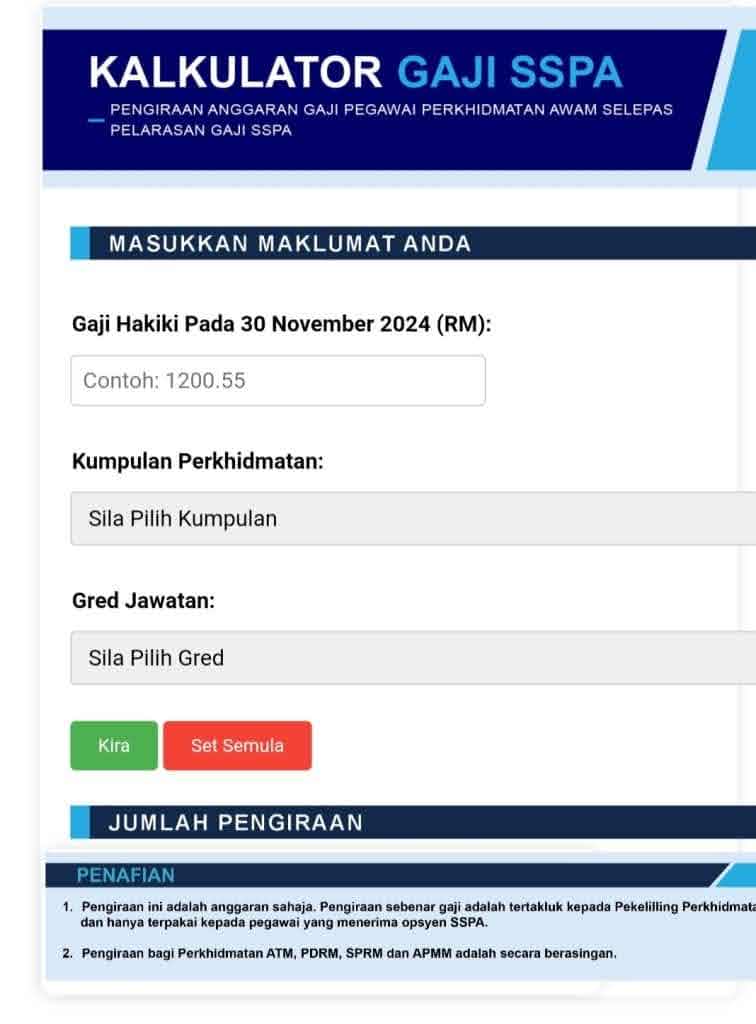
The calculator is useful for understanding how public sector increments are structured, including phased increases and group-based adjustments. However, it should be treated purely as an informational reference, not a model for private sector salary design or payroll decisions.
FAQs
Will gaji penjawat awam increases affect private sector wage trends?
They can influence expectations and market sentiment, but private companies are not required to follow public sector adjustments.
Are private employers required to follow SSPA salary adjustments?
No. SSPA applies only to public sector employees.
How should HR respond when employees compare salaries with penjawat awam?
Provide context on total rewards, career growth, and business realities while acknowledging market developments.
Does a public sector salary increase usually influence job market movement?
Yes, especially during periods of significant adjustment, as candidates reassess job stability, pay, and long-term benefits.
Your Next Hire Could be Just a Click Away!

At AJobThing, we connect you with 5+ million jobseekers in Malaysia, ensuring you hire the best.
Post your job ads today & simplify your hiring process!
Read More:
-
Penamaan KWSP in Malaysia: Legal Implications, Process, and HR’s Role
-
Cara Claim SOCSO Kemalangan: A Complete HR Guide for Work Accident Claims
-
i-Sayang KWSP Guide: Requirements, Benefits & How to Register
-
EPF, SOCSO, EIS, and LHDN Employer Registration Guide for Malaysian Companies
- Cara Kira Potongan KWSP dan SOCSO | How to Calculate EPF and SOCSO Deductions in Malaysia
-
Statutory Contributions in Malaysia Explained for Employers and HR
-
Deadlines & Penalties for SOCSO, EPF, PCB/Form E, and HRD Levy in Malaysia
-
PCB for Foreign Workers in Malaysia: Employer’s Complete Guide
-
EPF Withdrawal for Education: Employer’s Guide to Supporting Staff
-
Akaun Fleksibel (EPF’s New Account Structure): Key Info for Employers
-
KWSP Call Centre for Employers: Contact Numbers, Services, and Support Channels
-
How to Check KWSP/EPF Balance: Online, SMS, Call Center, and More (2025)