
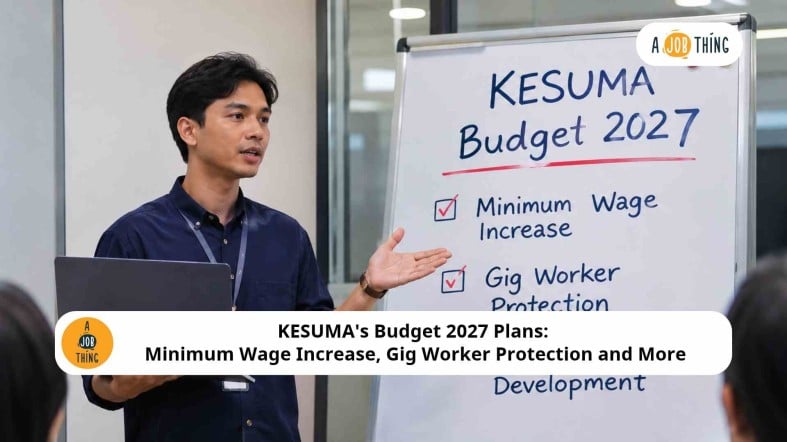
KESUMA's Budget 2027 Plans: Minimum Wage Increase, Gig Worker Protection and More

Are You Hiring?
Find candidates in 72 Hours with 5+ million talents in Maukerja Malaysia & Ricebowl using Job Ads.
Hire Now
Malaysia's Ministry of Human Resources (KESUMA) has announced a series of workforce initiatives under Budget 2027, covering minimum wage adjustments, skills development, gig worker protection and employment opportunities.
The ministry has received RM1.938 billion under Budget 2027 to support workforce development, improve access to quality jobs and strengthen social protection.
During the winding-up of the Supply (Budget) Bill 2027 debate in Parliament on 29 October 2026, Human Resources Minister Datuk Seri R. Ramanan Ramakrishnan outlined KESUMA's priorities for the coming year.
The plans focus on improving workers' income, strengthening technical and vocational education, supporting graduate employability and expanding social protection for gig workers. They also include initiatives to improve employment opportunities for persons with disabilities (PWDs) and support the socio-economic development of the Indian community.
Minimum Wage to Increase to RM2,000 from June 2027
Malaysia's minimum wage will increase from RM1,700 to RM2,000 per month starting June 2027, with more than four million workers expected to benefit.
However, micro, small and medium-sized enterprises (MSMEs) with annual sales revenue below RM50 million will be exempted from implementing the new rate to give businesses more time to adjust to the higher labour costs.
According to KESUMA, the revised minimum wage was determined after considering several economic indicators, including the Poverty Line Income (PGK), median wages, labour productivity, inflation and employers' ability to pay.
The review involved 1,967 employers and 3,197 employees. It was supported by 21 engagement sessions attended by 1,407 employer representatives and 1,189 employee and union representatives.
Apart from the minimum wage increase, the government has also outlined a RM2,500 starting salary framework for graduates and semi-skilled workers. The framework is intended to provide a salary reference based on workers' qualifications and skills.
The Basic Starting Salary Guidelines are based on the Malaysian Occupational Classification Standards (MASCO) and are available through the e-MASCO portal. The guidelines will be reviewed regularly to reflect labour market developments and industry requirements.
The framework will also be supported by the Progressive Wage Policy (DGP) and Productivity-Linked Wage System (PLWS), which encourage salary growth based on employees' skills, experience and productivity.
To strengthen compliance, KESUMA will continue conducting statutory inspections, special enforcement operations, complaint investigations and labour case management.
The ministry is also working on an e-wages module to improve transparency and monitoring of wage payments.
RM8 Billion Allocated for TVET and Three Million Training Opportunities
The government has allocated RM8 billion for Technical and Vocational Education and Training (TVET) programmes across 12 ministries under Budget 2027.
The funding will support skills development, improve workforce productivity and prepare Malaysians for employment opportunities that meet industry requirements.
As part of the allocation, the Human Resources Development Corporation (HRD Corp) will utilise RM3 billion in levy funds to provide three million training opportunities.
This includes more than RM40 million to train 8,000 Malaysians for employment in the elderly care sector.
Meanwhile, RM500 million has been allocated through the Skills Development Fund Corporation (PTPK) to finance skills training at registered public and private training institutions.
KESUMA also highlighted the graduate employability performance of the Department of Manpower (JTM).
According to the TVET Graduate Tracking Study (SKPG) 2026, JTM recorded a graduate employability rate of 98%, with 85.4% of graduates working in fields related to their training.
As of 30 September 2026, a total of 81,982 participants had attended training programmes through JTM's network of 33 campuses and two ADTEC JTM satellite campuses nationwide.
Separately, the MADANI Talent Programme, managed through Talent Corporation Malaysia (TalentCorp), aims to create 30,000 new job opportunities by 2027, including through partnerships with private-sector companies.
KESUMA is also expanding the Malaysian Modular Skills Certificate (MCSC) and Academy in Industry (ADI). These programmes aim to provide more flexible and practical training that aligns with industry needs.
The initiatives will focus on high-growth and high-value sectors, including semiconductors, electronics and artificial intelligence (AI).
Gig Worker Minimum Income Formula Expected by Early 2027
KESUMA is continuing its efforts to strengthen protection for gig workers through the Gig Workers Act 2025 (Act 872), which came into effect on 1 March 2026.
The ministry's priorities include improving income transparency, strengthening occupational safety and health protection, and addressing the welfare needs of gig workers.
Through the Gig Consultative Council (MPGig), KESUMA is working on a formula to calculate minimum income rates and establish minimum protection standards for this group of workers.
The study involved 13 engagement sessions, 14 focus group discussions, 37 in-depth interviews and a survey of 1,962 gig workers. It also included an analysis of 487,805 individual transaction records.
The findings are expected to support the finalisation of the minimum income calculation formula and protection standards by early 2027.
The proposed formula will take several factors into account, including the cost of living, operating expenses, inflation and the actual needs of gig workers.
Budget 2027 also introduced a RM160 million joint financing package between the government and Grab to improve the income and welfare of e-hailing and p-hailing workers.
The package covers assistance for vehicle maintenance, insurance and contributions to the Social Security Organisation (SOCSO).
In addition, KESUMA, through the Department of Occupational Safety and Health (DOSH), will strengthen safety guidance for gig workers. The guidelines will cover hazard identification, risk assessment, safety control measures and emergency procedures.
RM150 Million Allocated for Indian Community Development
Budget 2027 has allocated RM150 million to the Malaysian Indian Community Transformation Unit (MITRA) to support skills development and improve access to higher-income employment opportunities for Indian youth.
The priority areas include industrial automation, technology and aircraft maintenance. These initiatives aim to equip young people with relevant skills and prepare them for employment in higher-value industries.
Another RM150 million has been allocated through TEKUN Nasional and Amanah Ikhtiar Malaysia (AIM) to help small entrepreneurs from the Indian community grow their businesses.
The government has also set aside RM50 million for maintenance and repair works at Tamil National Type Schools (SJKT), particularly those facing infrastructure challenges.
For 2026, MITRA's 12 socio-economic development programmes received RM100 million in funding and benefited 110,541 recipients.
The unit also implemented education intervention programmes covering different learning stages, from preschool to higher education. These programmes received more than RM36.2 million in funding and benefited 24,886 students and undergraduates throughout 2026.
KESUMA said it will continue working with government agencies, educational institutions and industry partners to support initiatives covering education, skills training, entrepreneurship and employment.
SOCSO to Strengthen Social Protection and Employment Support
Beyond wage and skills development initiatives, KESUMA will continue strengthening Malaysia's social protection system through SOCSO.
The focus includes supporting workers who experience job loss, changes in the labour market or career transitions.
Under the LINDUNG Kerjaya Scheme, eligible workers can access several forms of assistance, including:
-
Job Search Allowance: Financial assistance while eligible individuals look for new employment.
-
Shortage Income Allowance: Support for eligible workers who experience a reduction in income.
-
Training Fee Financing: Financial support for approved skills training programmes.
-
Training Allowance: Allowance for eligible individuals participating in training.
Workers can also access job matching services through the MYFutureJobs portal and participate in skills enhancement programmes to improve their chances of returning to employment.
The ministry is also continuing its efforts to improve employment opportunities for persons with disabilities (PWDs).
These initiatives include the Re-Employment Support, Treatment and Rehabilitation Teamwork (RESTART) Programme, Disability Equality Training (DET) and Return To Work Coordinator (RTWC).
Separately, KESUMA is studying ways to strengthen social security protection for students undertaking industrial training.
The review includes examining possible protection mechanisms under the Self-Employment Social Security Act 2017 (Act 789), as well as considering suitable protection schemes for students.
The study will take into account the needs of students, particularly those completing industrial placements in higher-risk sectors. It will also assess the capabilities of relevant stakeholders and the legal and financial implications of introducing these measures.
What Budget 2027 Means for Malaysia's Workforce
Budget 2027 outlines several measures to improve Malaysia's workforce, from higher minimum wages and skills development to gig worker protection and more inclusive employment opportunities.
The RM2,000 minimum wage increase, RM8 billion TVET allocation and planned gig worker income framework are among the key developments to watch in 2027.
As these initiatives move towards implementation, their impact will depend on how effectively the government, businesses, training institutions and industry partners work together to support workers and strengthen employment opportunities across Malaysia.
Official references:
-
KESUMA Prioritises Job Opportunities for Locals, Protects All Workers – Bernama
-
Budget 2027: RM160 Million Package to Boost e-Hailing and p-Hailing Workers' Income – Bernama
This article is based on Budget 2027 announcements and information reported by the Ministry of Human Resources. Programme details and implementation arrangements may be subject to further government updates.
FAQs
What are KESUMA's main priorities under Budget 2027?
KESUMA's priorities include increasing workers' wages, strengthening skills development, improving graduate employability, expanding gig worker protection and enhancing social security coverage.
When will Malaysia's new minimum wage of RM2,000 take effect?
The new minimum wage of RM2,000 per month is scheduled to take effect in June 2027, increasing from the current rate of RM1,700.
How much has KESUMA received under Budget 2027?
KESUMA has received an allocation of RM1.938 billion to support workforce development, improve access to quality employment and strengthen social protection.
What support will gig workers receive under Budget 2027?
The initiatives include work on a minimum income calculation formula, stronger occupational safety guidance and a RM160 million joint financing package between the government and Grab for e-hailing and p-hailing workers.
What initiatives are available to help Malaysians improve their skills?
The government has allocated RM8 billion for TVET programmes across 12 ministries. Other initiatives include HRD Corp training opportunities, PTPK skills training financing, the Malaysian Modular Skills Certificate (MCSC) and Academy in Industry (ADI).
Your Next Great Hire Could Be Just One Click Away

Find the right candidates for your vacancies with AJobThing. Reach more job seekers and make your next recruitment journey easier.
Post a job with AJobThing today.
Read More
-
KESUMA Targets More Job Opportunities for Malaysians and Better Worker Protection
-
Malaysia Budget 2027: Key Highlights on Minimum Wage, Tax and Financial Aid
-
Minimum Wage Malaysia 2027: RM2,000 From June and PMKS Exemption
-
RM2,500 Starting Wage for Graduates and Semi-Skilled Workers Coming Soon, Says HR Minister Ramanan
-
EPF, SOCSO & EIS Contribution for Part-Time, Contract & Foreign Workers in Malaysia
-
Malaysia Budget 2027 to Focus on High-Value Jobs, Better Wages and Cost of Living
-
Government Reviews Malaysia's RM1,700 Minimum Wage as Living Costs Rise