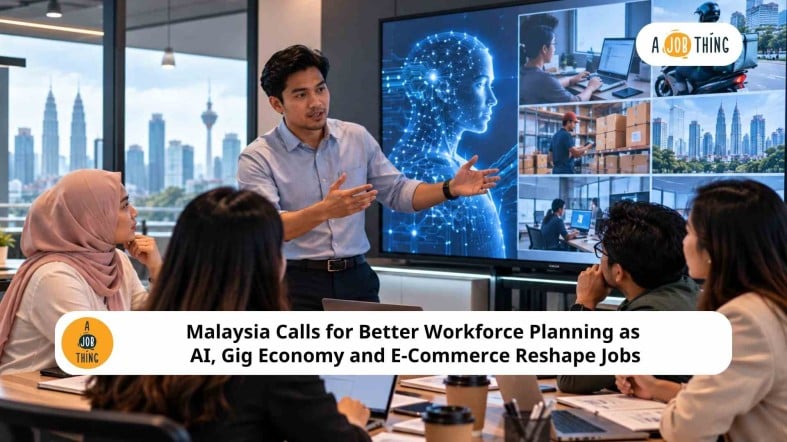
Malaysia Calls for Better Workforce Planning as AI, Gig Economy and E-Commerce Reshape Jobs

Are You Hiring?
Find candidates in 72 Hours with 5+ million talents in Maukerja Malaysia & Ricebowl using Job Ads.
Hire Now
Artificial intelligence (AI), the gig economy and e-commerce are changing how businesses operate and how people work in Malaysia.
As these technologies continue to grow, the government says innovation needs to be balanced with workforce planning and effective regulation to protect workers and prevent negative effects on the local job market.
Communications Minister Fahmi Fadzil said technological development should be encouraged, but not at the expense of workers' welfare, fair wages or the wider business ecosystem.
For employers and HR teams, the message is important: technology adoption is not only about productivity. Companies also need to consider how jobs, skills and workforce requirements will change.
Why Workforce Planning Matters as Technology Changes
AI and digital technologies can help businesses automate tasks, improve productivity and create new ways of working.
At the same time, these changes can affect existing jobs and create demand for different skills.
Fahmi said rapid technological developments need to be managed carefully because unchecked changes could affect workers' welfare and the existing business ecosystem. He also highlighted concerns around people losing jobs or not receiving fair wages if technological disruption is not properly balanced.
This does not mean businesses should stop adopting new technology.
Instead, employers need to consider how technology and workforce planning can move forward together.
HR teams can start by asking:
-
Which roles are likely to change?
-
Which tasks could be automated or supported by AI?
-
Which employees will need new skills?
-
What roles could emerge as technology develops?
-
How should future hiring requirements change?
These questions can help businesses prepare before technology creates a larger skills gap.
Malaysia Launches the Communications and Multimedia Future Skills Framework
The government has launched the Communications and Multimedia Future Skills Framework (C&M FSF) to help prepare Malaysia's communications and multimedia workforce for changing industry needs.
Led by the Malaysian Communications and Multimedia Commission (MCMC), the framework will serve as a strategic reference for talent development over the next five to 10 years. It aims to align industry needs with education, workforce skills and future employment opportunities.
The framework covers sectors under MCMC's purview, particularly:
-
Broadcasting
-
Telecommunications
-
Postal and courier services
The C&M FSF is intended to help government, industry and education providers better coordinate talent development as AI, digitalisation, emerging technologies and the green economy reshape the workplace.
The Framework Is Not a New Employment Law
One important point for employers is that the C&M FSF is not a new employment regulation.
The framework is focused on workforce needs, skills development and assessing how AI adoption may affect specific sectors and their longer-term planning.
For businesses, it should therefore be viewed as a workforce and talent-development reference, rather than a new legal requirement.
How AI Is Changing Jobs
AI is already changing the way some jobs are performed.
AI is affecting areas such as advertising, graphic design and production, including by speeding up processes and taking over certain tasks.
This does not necessarily mean that an entire occupation will disappear.
Instead, employees may spend less time on repetitive tasks and more time on activities that require human judgement, creativity, communication or decision-making.
For example:
-
A recruiter may use AI to organise candidate information while spending more time on interviews and candidate engagement.
-
A marketing employee may use AI for research and content development while focusing more on strategy.
-
A customer service employee may use AI to support routine enquiries while handling more complex customer issues.
-
An HR employee may use AI for administrative tasks while focusing more on workforce planning and employee matters.
This is why employers should assess how tasks and responsibilities are changing, rather than only asking whether AI will replace a particular job.
Future Skills Council Will Support the Framework
To support implementation of the C&M FSF, the government has established the Future Skills Talent Council (FSTC) under the Ministry of Human Resources, working with MCMC and the Ministry of Communications.
The Ministry of Higher Education (MoHE) will also use the framework to strengthen areas such as:
-
Curriculum
-
Micro-credentials
-
Graduate competencies
-
Training and upskilling programmes
The goal is to make education and skills development more responsive to changing technology and industry needs.
This could help create a stronger connection between what employers need and the skills that graduates and existing workers develop.
Technology Can Also Create New Jobs
The government's message is not only about protecting existing jobs.
New technologies can also create new employment opportunities, particularly for university graduates, young people and people coming through Technical and Vocational Education and Training (TVET).
Higher Education Minister Zambry Abd Kadir also highlighted the importance of technical education, with polytechnics and community colleges serving as important pathways for developing technical talent.
For employers, this means future recruitment may involve a wider range of talent pathways, including TVET graduates, technical specialists and workers who develop new digital skills through training.
Skills Mismatch Remains a Workforce Challenge
The need for stronger workforce planning comes as Malaysia continues to deal with skills mismatches.
Deputy Human Resources Minister Khairul Firdaus Akbar Khan said nearly 37% of skilled workers were recorded as not working in the second quarter of 2026.
Factors identified included a lack of job opportunities, skills mismatches and less attractive salaries in some fields.
The figure highlights an important workforce issue: having trained workers does not automatically mean that their skills match the jobs employers actually need.
For HR teams, skills planning and recruitment planning need to work together.
What the C&M FSF Means for Employers
Although the framework focuses on the communications and multimedia sector, its direction offers useful lessons for employers more broadly.
Review Jobs and Tasks
Identify roles that contain repetitive, administrative or digital tasks that could be supported by technology.
Then consider how those roles could change.
The goal should not automatically be to reduce headcount. Instead, employers can assess whether technology allows employees to take on higher-value responsibilities.
Identify Future Skills
Determine which teams will need stronger:
-
AI literacy
-
Digital skills
-
Data skills
-
Analytical skills
-
Problem-solving
-
Adaptability
The right combination will depend on the role and industry.
Reskill Existing Employees
Hiring new talent is not always the only answer.
Existing employees already understand the company, its customers and its processes. With the right training, they may be able to move into changing roles or take on new responsibilities.
Update Job Descriptions
As work changes, job descriptions may also need to change.
Employers can review whether roles require new digital or AI-related capabilities.
However, AI should not automatically become a requirement for every job. Skills should be based on what the position actually requires.
Build Continuous Learning
AI and digital technologies continue to change, so training should not be treated as a one-time activity.
Employers can build ongoing learning opportunities so employees can continue developing relevant skills as their roles evolve.
What HR Should Prepare for the Future
The combination of AI, digitalisation, the gig economy and e-commerce means workforce planning is becoming more important.
HR teams can start with five simple questions:
Which jobs are most likely to change?
Which employees could be reskilled?
What skills will we need when hiring next?
Are our current job descriptions still relevant?
How should training change as technology develops?
Answering these questions can help employers move from reacting to technological change towards actively planning their future workforce.
FAQs
What is the C&M Future Skills Framework?
It is a strategic talent-development framework for Malaysia's communications and multimedia sector covering the next five to 10 years.
Is the C&M FSF a new employment law?
No. It is a workforce and skills-development framework, not a new employment regulation.
Which sectors does the framework cover?
It focuses on communications and multimedia areas including broadcasting, telecommunications, and postal and courier services.
Prepare Your Workforce for a Changing Job Market
%20copy.jpg)
Technology is changing how Malaysian businesses operate. Employers need to ensure their people, skills and workforce planning keep pace with these changes.
As hiring needs continue to evolve, having the right talent in place can make it easier for businesses to adapt. AJobThing can help Malaysian employers connect with suitable talent as they build their workforce for the future.
Read More:
-
Malaysia Faces AI Skills Gap of 500,000+ Workers as PEOPLElogy Targets 5 Million by 2030
-
DEWI 2026: Dana Ekonomi Usahawan Wanita, Financing & How to Apply
-
Malaysia Minimum Wage 2026: Proposed Hike, MSME Exemption & Budget 2027 Update
-
How to Check Your SOCSO (PERKESO) Number in Malaysia: Online & Offline Guide
-
Malaysia Salary & Wage Statistics 2025: Median Monthly Pay Rises to RM2,940
-
Malaysia and Nepal Agree to Streamline Foreign Worker Recruitment, Curb Worker Exploitation
-
PERKESO Includes Gig Workers, Hawkers and Self-Employed Malaysians in Op Kesan 2.0
-
Employee Transfer Letter Malaysia: Sample for Department, Role & Branch Transfer
-
EIS Malaysia: Workers to Receive Enhanced Benefits and Protection From 1 October 2026
-
EIS Malaysia: Workers to Receive Enhanced Benefits and Protection From 1 October 2026
-
LINDUNG 24 Jam Update: 8.5 Million Workers Remain Covered in Malaysia
-
Malaysia Labour Force Hits 17.37 Million in July 2026 as Unemployment Stays at 3.0%
-
Malaysia Budget 2027 To Focus On High-Value Jobs, Better Wages and Cost Of Living
-
Government Reviews Malaysia’s RM1,700 Minimum Wage As Living Costs Rise
-
Malaysia Labour Demand Grew 1.7% in Q2 2026: What Employers Need to Know
-
How to Register PMKS in Malaysia: Requirements & Benefits 2026
-
Pembiayaan TEKUN Online 2026: How to Apply, Eligibility & Required Documents
-
Pembiayaan untuk Usahawan 2026: Business Assistance, Grants, Loans & How to Apply
-
AI Untuk Rakyat 2026: Registration Guide, Eligibility & Free 3-Month AI Software
-
Malaysia Introduces Digital Pension Payments and MyPesara Plus to Support Government Retirees
-
SSM4U Malaysia 2026: Complete Guide to Registration, Login & Business Renewal
-
KESUMA Highlights Over 96,000 Active Job Vacancies to Expand Career Opportunities
-
LINDUNG 24 Jam (SKBBK) Opt-Out: Steps, Deadline, and What You Need to Know
-
Progressive Wage Policy (PWP) Malaysia: Salaries Up 13.8%, RM64 Million Paid Out
-
Foreign Worker Quota Malaysia: Complete Guide to KESUMA's New eQuota System (2026)
-
Government Confirms Umur Bersara Penjawat Awam Remains at 60
-
PERKESO Lindung 24 Jam: Contributions Now Voluntary for Malaysian Workers (2026 Update)
-
Malaysia Digital 2030: AI Vision, 500,000 Digital Jobs & More Online Government Services
-
What Is BAKAT MADANI? Malaysia's New Skills Training Initiative Explained
-
Over 42,000 Malaysians Lost Their Jobs in 2026: Key Insights for Employers
-
Fresh Graduate Salary in Malaysia (2026): How Much Should Employers Pay?
-
Salary Benchmarking in Malaysia: Are You Paying Enough to Attract Candidates?
-
Bangladesh PM Seeks Reopening of Malaysia's Labour Market for Bangladeshi Workers
-
What Is Mutual Separation Scheme (MSS) in Malaysia? Meaning, Compensation & Guide
-
Bantuan Berhenti Kerja Malaysia (2026): Employee Rights & Employer Responsibilities
-
B40, M40 & T20 Malaysia: Latest Household Income Categories and Income Range (2026)
-
MyKad Online: How to Replace Your MyKad Through the JPN Portal
-
Touch n Go MyKad: How to Claim Your Balance After Getting a New MyKad
-
Geran LiKES TalentCorp 2026: RM2,000 Grant & 50% Reimbursement for Intern Hiring
-
Free SSM Registration for B40 & IPT Students Under SPPP 2026
-
Zakat Pendapatan Malaysia: Salary Deduction & Payroll Process for Employers
-
PADURI MADANI Scheme: Financial Assistance for B40 Women Entrepreneurs
-
MyKad Baru June 2026 Released: Do You Need to Change Your IC?
-
Bantuan B40 2026 Ikut Negeri: Full List Malaysia + Eligibility & How to Apply
-
5,900 Workers Affected by March Layoffs, Government Acts to Strengthen Employment Support
-
Malaysia Govt Saves RM678,000 in Fuel in 1 Week After WFH Policy
-
Malaysia Job Loss 2026 Rises 47% to 24,100 Retrenchments in Q1
-
Senarai Barang MyKasih (SARA 2026): What You Can Buy Using Your SARA Credit
-
Senarai Kedai MyKasih 2026: List of Stores That Accept SARA MyKad Assistance
-
Skim Jaminan Kredit Perumahan (SJKP): How Malaysians Can Buy a Home Without a Payslip
-
Semakan SARA 2026: Recipient Categories, Payment Dates and How to Use MyKad
-
SARA 2026 Malaysia Latest Updates and Official Announcements