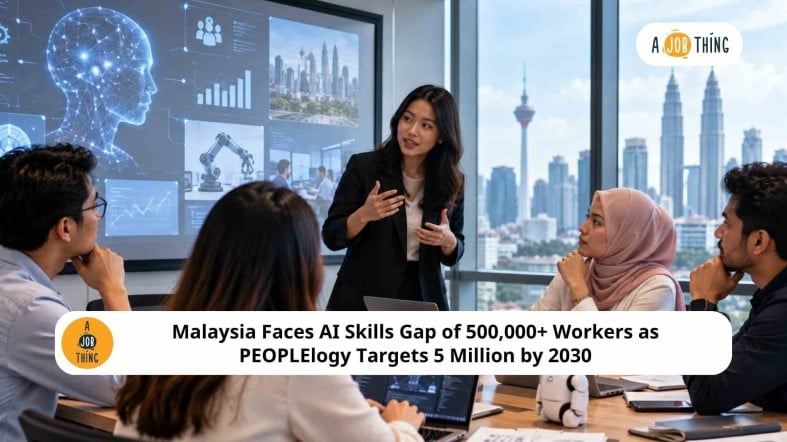
Malaysia Faces AI Skills Gap of 500,000+ Workers as PEOPLElogy Targets 5 Million by 2030

Are You Hiring?
Find candidates in 72 Hours with 5+ million talents in Maukerja Malaysia & Ricebowl using Job Ads.
Hire Now
Artificial intelligence (AI) is changing how businesses work in Malaysia. As companies adopt more AI tools, employees are also expected to adapt to new technologies, workflows and skills.
Malaysia now faces a growing workforce challenge. PEOPLElogy Bhd says the country has a shortage of more than 500,000 AI-skilled workers, while its "I'm AI Ready" movement aims to get 5 million Malaysians to declare their AI readiness by 2030.
For employers and HR teams, the issue goes beyond hiring AI specialists. It also raises questions about reskilling, job roles, workforce planning and future hiring needs.
Malaysia's AI Skills Gap
PEOPLElogy said Malaysia is facing a shortage of more than 500,000 AI-skilled workers as the country works to strengthen its digital talent pipeline.
The company also linked the skills gap to an estimated RM50 billion in economic potential for Malaysia's AI economy by 2030. These figures are PEOPLElogy's estimates and projections, rather than official government labour-market figures.
The skills gap is not limited to people working in highly technical AI roles.
As businesses introduce AI into everyday operations, employees in HR, marketing, finance, recruitment, customer service, content and operations may also need to use AI tools as part of their work.
This creates demand for employees who understand both their professional role and how AI can support their work.
Are Malaysian Workers Ready for AI?
Having enough AI-skilled workers is only part of the challenge. Employers also need existing employees to be ready for changes in their jobs.
PEOPLElogy previously cited findings that 87% of Malaysian workers felt unprepared for AI disruption in their current roles, while only 12% of organisations had a structured AI workforce readiness programme. These figures were reported as part of PEOPLElogy's own AI-readiness initiative.
A separate report by Malay Mail said various workplace studies showed that, depending on the sector, as many as nine in 10 Malaysian employees may feel inadequately trained to work alongside AI. This is a sector-dependent finding from cited workplace studies, not a figure representing every Malaysian employee.
For HR, this means the AI conversation should include both new talent and the existing workforce.
How AI Could Change Jobs
AI does not necessarily mean that an entire job will disappear.
In many cases, AI can change the tasks employees perform within their existing roles.
Examples of how AI could change work
-
A recruiter could use AI to organise candidate information and spend more time on interviews and candidate engagement.
-
A marketing employee could use AI for research and content ideas while focusing more on strategy and brand decisions.
-
A customer service employee could use AI to handle routine questions and focus on more complex cases.
-
An HR employee could use AI to support administrative work and spend more time on workforce and employee matters.
This is why employers should look at how jobs and tasks are changing, rather than focusing only on whether AI will replace a particular job.
What TalentCorp's Workforce Study Shows
The AI skills issue is part of a wider transformation of Malaysia's workforce.
TalentCorp's Impact Study on AI, Digital and Green Economy on the Malaysian Workforce examines 10 key economic sectors and 949 job roles to understand how technology and other changes could affect jobs and skills.
The study estimates that around 620,000 employees could be significantly affected by technological and economic shifts across the sectors analysed. It also identifies around 60 emerging roles, 84 highly impacted roles that may require career transition pathways, and 864 basic and role-specific skills needed to support workforce transitions.
These findings show why reskilling and workforce planning are becoming increasingly important for employers.
What Is the "I'm AI Ready" Movement?
PEOPLElogy launched the "I'm AI Ready" movement in June 2026 as a national initiative focused on improving AI readiness.
According to the latest announcement, the movement is targeting 5 million AI-readiness declarations by 2030.
The initiative focuses on moving people beyond basic awareness towards practical AI skills and workplace readiness.
PEOPLElogy reported that more than 9,100 Malaysians had declared their AI readiness by the end of September, compared with an initial target of 50,000 declarations by the end of 2026. More than 800 delegates had also registered for National AI Readiness Week.
The movement is being carried out in collaboration with MyDIGITAL Corporation.
National AI Readiness Week 2026
As part of the movement, PEOPLElogy will hold National AI Readiness Week 2026 from 12 to 18 November 2026 in the Klang Valley.
The week is designed for different groups, including workers, SMEs, entrepreneurs, students and business leaders.
I'm AI READY Summit
The I'm AI READY Summit, from 12 to 14 November, will focus on SMEs, entrepreneurs, students and the wider workforce.
The programme includes AI-readiness assessments and upskilling support.
Build a Future Team Leaders Conference
The Build a Future Team (BAFT) Leaders Conference will take place on 17 and 18 November.
It is aimed at corporate leaders, HR professionals and government leaders, with a focus on organisational AI readiness and future workforce strategy.
RM3 Million AI Mastery Scholarships
PEOPLElogy is also offering RM3 million in AI Mastery Scholarships to support Malaysians in developing AI skills.
For employers, this highlights an important difference: AI awareness is not the same as AI capability.
An employee may know how AI works or have used an AI tool before, but still need training to apply it effectively and responsibly to their actual job.
What Malaysian Employers Should Prepare
Employers do not need every employee to become an AI specialist.
Instead, HR can start by identifying where AI is most likely to affect the business.
Review Jobs and Tasks
Identify repetitive, administrative or digital tasks that could be assisted or automated by AI.
Then assess how employees' responsibilities could change.
Identify Future Skills
Determine which teams will need stronger AI, digital, data, analytical or problem-solving skills.
The right skills will depend on the role and industry.
Reskill Existing Employees
Employees who already understand the business can be strong candidates for AI upskilling.
This can help companies retain experience while preparing employees for changing responsibilities.
Update Job Descriptions
Where relevant, employers can add AI-related capabilities to job descriptions and competency frameworks.
However, AI should not automatically become a requirement for every position. The requirement should reflect what the actual job needs.
Build Continuous Learning
AI tools are changing quickly, so training should not be treated as a one-time activity.
Employers can provide ongoing training and practical opportunities for employees to build AI capabilities as their roles evolve.
How AI Skills Could Affect Future Hiring
The future workforce will not consist only of AI engineers and technical specialists.
More companies may need AI-enabled professionals who can use technology within their existing roles.
This could include:
-
HR + AI
-
Marketing + AI
-
Finance + AI
-
Sales + AI
-
Operations + AI
-
Customer Service + AI
The exact technical requirements will differ by role, but employees may increasingly need to combine technology skills with human judgement, communication and industry knowledge.
This could also influence how employers assess candidates.
Beyond qualifications and experience, employers may increasingly consider:
-
AI literacy
-
Adaptability
-
Problem-solving
-
Digital skills
-
Willingness to learn
-
Ability to use technology responsibly
What HR Should Do Next
The AI skills gap is unlikely to be solved through recruitment alone.
HR teams can start with a simple workforce review:
Which jobs are most likely to change because of AI?
Which employees could be reskilled?
Which AI skills will we need in future hiring?
Do our current training programmes prepare employees for these changes?
Are our job descriptions still relevant as work changes?
These questions can help HR move from reacting to AI disruption towards actively planning for the future workforce.
FAQs
Is Malaysia short of 500,000 AI-skilled workers?
PEOPLElogy says Malaysia has a shortage of more than 500,000 AI-skilled workers. This is a PEOPLElogy estimate, not an official government labour statistic.
What is the "I'm AI Ready" movement?
It is a PEOPLElogy initiative targeting 5 million AI-readiness declarations by 2030.
When is National AI Readiness Week 2026?
It is scheduled for 12 to 18 November 2026 in the Klang Valley.
Will AI replace Malaysian workers?
Not necessarily. AI can change tasks, automate some work and create new roles. The impact will differ by job and industry.
Build an AI-Ready Workforce
%20copy.jpg)
AI is changing the workplace, but technology alone cannot build an AI-ready business.
Employers also need people with the right skills to use AI effectively.
For Malaysian businesses, preparing for AI means looking beyond new tools. It means preparing your workforce, hiring strategy and skills for the future.
AJobThing helps Malaysian employers find and hire talent more efficiently, so you can build teams ready for a changing workplace.
Read More:
-
DEWI 2026: Dana Ekonomi Usahawan Wanita, Financing & How to Apply
-
Malaysia Minimum Wage 2026: Proposed Hike, MSME Exemption & Budget 2027 Update
-
How to Check Your SOCSO (PERKESO) Number in Malaysia: Online & Offline Guide
-
Malaysia Salary & Wage Statistics 2025: Median Monthly Pay Rises to RM2,940
-
Malaysia and Nepal Agree to Streamline Foreign Worker Recruitment, Curb Worker Exploitation
-
PERKESO Includes Gig Workers, Hawkers and Self-Employed Malaysians in Op Kesan 2.0
-
Employee Transfer Letter Malaysia: Sample for Department, Role & Branch Transfer
-
EIS Malaysia: Workers to Receive Enhanced Benefits and Protection From 1 October 2026
-
EIS Malaysia: Workers to Receive Enhanced Benefits and Protection From 1 October 2026
-
LINDUNG 24 Jam Update: 8.5 Million Workers Remain Covered in Malaysia
-
Malaysia Labour Force Hits 17.37 Million in July 2026 as Unemployment Stays at 3.0%
-
Malaysia Budget 2027 To Focus On High-Value Jobs, Better Wages and Cost Of Living
-
Government Reviews Malaysia’s RM1,700 Minimum Wage As Living Costs Rise
-
Malaysia Labour Demand Grew 1.7% in Q2 2026: What Employers Need to Know
-
How to Register PMKS in Malaysia: Requirements & Benefits 2026
-
Pembiayaan TEKUN Online 2026: How to Apply, Eligibility & Required Documents
-
Pembiayaan untuk Usahawan 2026: Business Assistance, Grants, Loans & How to Apply
-
AI Untuk Rakyat 2026: Registration Guide, Eligibility & Free 3-Month AI Software
-
Malaysia Introduces Digital Pension Payments and MyPesara Plus to Support Government Retirees
-
SSM4U Malaysia 2026: Complete Guide to Registration, Login & Business Renewal
-
KESUMA Highlights Over 96,000 Active Job Vacancies to Expand Career Opportunities
-
LINDUNG 24 Jam (SKBBK) Opt-Out: Steps, Deadline, and What You Need to Know
-
Progressive Wage Policy (PWP) Malaysia: Salaries Up 13.8%, RM64 Million Paid Out
-
Foreign Worker Quota Malaysia: Complete Guide to KESUMA's New eQuota System (2026)
-
Government Confirms Umur Bersara Penjawat Awam Remains at 60
-
PERKESO Lindung 24 Jam: Contributions Now Voluntary for Malaysian Workers (2026 Update)
-
Malaysia Digital 2030: AI Vision, 500,000 Digital Jobs & More Online Government Services
-
What Is BAKAT MADANI? Malaysia's New Skills Training Initiative Explained
-
Over 42,000 Malaysians Lost Their Jobs in 2026: Key Insights for Employers
-
Fresh Graduate Salary in Malaysia (2026): How Much Should Employers Pay?
-
Salary Benchmarking in Malaysia: Are You Paying Enough to Attract Candidates?
-
Bangladesh PM Seeks Reopening of Malaysia's Labour Market for Bangladeshi Workers
-
What Is Mutual Separation Scheme (MSS) in Malaysia? Meaning, Compensation & Guide
-
Bantuan Berhenti Kerja Malaysia (2026): Employee Rights & Employer Responsibilities
-
B40, M40 & T20 Malaysia: Latest Household Income Categories and Income Range (2026)
-
MyKad Online: How to Replace Your MyKad Through the JPN Portal
-
Touch n Go MyKad: How to Claim Your Balance After Getting a New MyKad
-
Geran LiKES TalentCorp 2026: RM2,000 Grant & 50% Reimbursement for Intern Hiring
-
Free SSM Registration for B40 & IPT Students Under SPPP 2026
-
Zakat Pendapatan Malaysia: Salary Deduction & Payroll Process for Employers
-
PADURI MADANI Scheme: Financial Assistance for B40 Women Entrepreneurs
-
MyKad Baru June 2026 Released: Do You Need to Change Your IC?
-
Bantuan B40 2026 Ikut Negeri: Full List Malaysia + Eligibility & How to Apply
-
5,900 Workers Affected by March Layoffs, Government Acts to Strengthen Employment Support
-
Malaysia Govt Saves RM678,000 in Fuel in 1 Week After WFH Policy
-
Malaysia Job Loss 2026 Rises 47% to 24,100 Retrenchments in Q1
-
Senarai Barang MyKasih (SARA 2026): What You Can Buy Using Your SARA Credit
-
Senarai Kedai MyKasih 2026: List of Stores That Accept SARA MyKad Assistance
-
Skim Jaminan Kredit Perumahan (SJKP): How Malaysians Can Buy a Home Without a Payslip
-
Semakan SARA 2026: Recipient Categories, Payment Dates and How to Use MyKad
-
SARA 2026 Malaysia Latest Updates and Official Announcements