
Malaysia Job Loss 2026 Rises 47% to 24,100 Retrenchments in Q1

Are You Hiring?
Find candidates in 72 Hours with 5+ million talents in Maukerja Malaysia & Ricebowl using Job Ads.
Hire Now
Layoffs peaked in January and remain concentrated in manufacturing and the Klang Valley.
Malaysia saw a strong increase in job losses in the first quarter of 2026, with 24,100 workers retrenched, a 47% increase compared to the same period last year.
Data from the Social Security Organisation, analysed by Hong Leong Investment Bank (HLIB), showed layoffs rose to 10,700 in January, before dropping to 7,500 in February and 5,900 in March.
Most of the increase happened at the start of the year, when many companies began restructuring and adjusting their workforce.
While layoffs have slowed after January, the total number is still much higher than in 2025, when around 16,500 workers were retrenched in the same period.
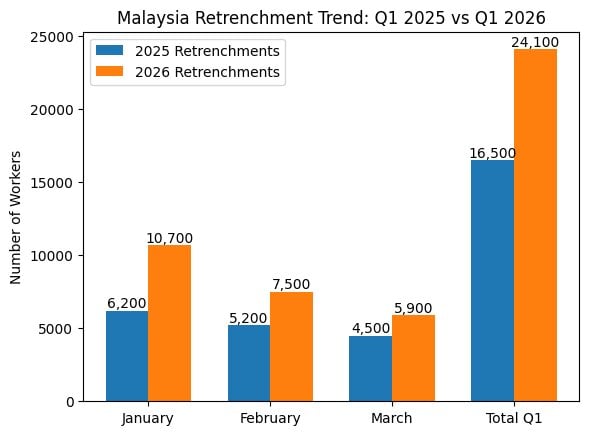
Source: SOCSO / HLIB Research / SAYS.com
For employers, this shows that many businesses are becoming more careful with hiring and cost planning in 2026.
Manufacturing Remains the Most Affected Sector
HLIB said the manufacturing sector is the most affected by job cuts.
This is because it depends heavily on:
-
Global trade
-
External demand
Layoffs were also seen in:
-
Wholesale and retail
-
Logistics-related sectors
The bank described manufacturing as the “weakest link” in the labour market right now, especially with global uncertainty and geopolitical issues.
For employers in these sectors, it may be important to review workforce size and focus on efficiency to manage costs better.
Klang Valley Accounts for Most Layoffs
Job losses are still mainly happening in Malaysia’s key business areas.
In March:
-
Selangor: 29.3% of total layoffs
-
Kuala Lumpur: 25.6%
This means the Klang Valley made up more than half of all retrenchments this year.
Earlier in February, Kuala Lumpur alone reached 38%, showing that big cities are usually affected first during restructuring.
HLIB noted that these areas are often hit first because they have a higher number of businesses.
Outside Klang Valley:
-
Penang remains at risk due to the electrical and electronics (E&E) sector
-
Johor is affected by trade changes and its link to Singapore
For employers in these areas, it is important to monitor business trends and prepare for possible changes.
Job Market Still Stable Despite Higher Layoffs
Even with the increase in retrenchment, Malaysia’s job market is still stable.
According to the OpenDOSM Labour Market Dashboard:
-
Unemployment rate: 2.9% (stable for four months)
HLIB also highlighted that job vacancies increased to around 107,000 in March, showing that hiring is still happening.
Sectors still hiring include:
-
Services
-
Construction
This means while some companies are reducing staff, others are still growing.
For employers, this is a good time to hire experienced workers who are available in the market.
Clear Difference Compared to 2025
In the first quarter of 2025, job losses were much lower.
This was supported by:
-
Strong manufacturing activity
-
High demand in the semiconductor industry
HLIB said the current situation shows a period of adjustment as global conditions become more uncertain.
While layoffs have eased after January, risks are still present due to the changing global environment.
What Employers Should Watch
Export-driven sectors, especially manufacturing, are expected to remain sensitive to:
-
Global demand changes
-
Trade disruptions
-
Economic uncertainty
For employers, this is a good time to:
-
Plan hiring carefully
-
Manage workforce costs
-
Stay flexible with business decisions
FAQs
Why are layoffs increasing in Malaysia in 2026?
Layoffs are increasing due to global economic uncertainty, slower export demand, and rising business costs. Many companies are restructuring to stay competitive.
Which industry has the highest job loss in Malaysia?
The manufacturing sector has the highest job loss, followed by retail and logistics. These sectors depend heavily on global demand.
Which area has the most retrenchment in Malaysia?
Most retrenchment cases happen in Klang Valley, especially Selangor and Kuala Lumpur, where many businesses are located.
Is the Malaysia job market still stable in 2026?
Yes. The unemployment rate is around 2.9%, and there are still job vacancies, especially in services and construction.
What should employers do during this period?
Employers should plan hiring carefully, control costs, keep key employees, and take the opportunity to hire experienced talent available in the market.
Malaysia’s job loss trend in early 2026 shows that companies are adjusting to a more uncertain environment.
Although layoffs are slowing, the overall numbers are still high.
For employers, focusing on smart hiring and better workforce planning will be important in the months ahead.
Hire Smarter with AJobThing
%20copy.jpg)
Reach the right candidates and build a stronger team, even during uncertain times.
Start posting your job ads today and stay ahead of your competitors.
Read More:
-
Tax Filing for Social Media Influencers in Malaysia: Income, Expenses & LHDNM Rules
-
How to Register MyTax Malaysia: Step-by-Step Guide for Employees & Employers
-
EPF Employer Responsibilities in Malaysia: Rules, Contributions & Compliance Guide
-
EPF Death Assistance Malaysia: Eligibility, Claims Process & HR Guide
-
EPF, SOCSO & EIS Contribution for Part-Time, Contract & Foreign Workers in Malaysia
-
ASB (Amanah Saham Bumiputera): What It Is and How It Works in Malaysia
-
ASNB (Amanah Saham Nasional Berhad): Complete Beginner’s Guide to Investing in Malaysia
-
GLC vs Private Company Malaysia: Salary, Culture & Hiring Differences
-
BDR (Bekerja Dari Rumah) Starts 15 April 2026: Updates for Employers & HR in Malaysia
-
Rising Oil Prices Issue: Which Industries and Jobs Are at Risk?
-
PM Anwar Announces WFH Policy for Penjawat Awam as Oil Supply Disruptions Continue