
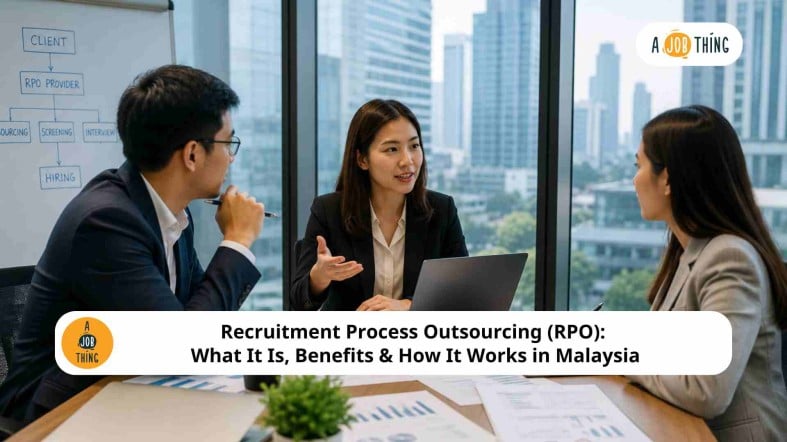
Recruitment Process Outsourcing (RPO): What It Is, Benefits & How It Works in Malaysia

Are You Hiring?
Find candidates in 72 Hours with 5+ million talents in Maukerja Malaysia & Ricebowl using Job Ads.
Hire Now
Hiring the right employees takes time, effort, and resources. For many businesses, especially those hiring regularly or at scale, managing recruitment internally can become challenging.
This is where Recruitment Process Outsourcing (RPO) comes in.
RPO allows businesses to outsource part or all of their recruitment process to a specialist recruitment provider. Instead of only helping to fill one vacancy, an RPO provider works closely with your company to manage recruitment more efficiently.
In this guide, we'll explain what Recruitment Process Outsourcing is, how it works, its benefits, and whether it's the right solution for your business.
What Is Recruitment Process Outsourcing (RPO)?
Recruitment Process Outsourcing (RPO) is when a company outsources some or all of its recruitment activities to an external recruitment partner.
An RPO provider acts as an extension of your HR or recruitment team. Depending on your business needs, they can manage the entire hiring process or only specific stages.
Common RPO services include:
-
Creating job advertisements
-
Conducting initial interviews
-
Coordinating interviews with hiring managers
-
Managing job offers
-
Supporting onboarding
-
Providing recruitment reports and hiring insights
Unlike a traditional recruitment agency that focuses on filling individual vacancies, an RPO provider helps improve your overall recruitment process.
How Does Recruitment Process Outsourcing Work?
Although every provider works differently, the process usually follows these steps.
Understand Your Hiring Needs
The RPO provider works with your company to understand:
-
Business goals
-
Hiring targets
-
Required skills
-
Company culture
-
Recruitment timeline
Develop a Recruitment Strategy
Based on your hiring needs, the provider creates a recruitment plan, including sourcing channels, screening methods, interview stages, and hiring timelines.
Source Candidates
Candidates may be sourced through:
-
Talent databases
-
Social media
-
Employee referrals
-
Professional networks
-
Campus recruitment
Screen and Shortlist Candidates
The RPO provider reviews applications, screens candidates, and prepares a shortlist for your hiring managers.
Coordinate Interviews
The provider arranges interviews, communicates with candidates, and keeps the recruitment process moving smoothly.
Support Hiring and Onboarding
After a candidate accepts the offer, the RPO provider may also assist with documentation, onboarding, and recruitment reporting.
Types of Recruitment Process Outsourcing
End-to-End RPO
The provider manages the complete recruitment process from workforce planning to onboarding.
This is suitable for businesses with continuous hiring needs.
Project RPO
Designed for temporary hiring projects, such as opening a new branch, launching a new factory, or seasonal recruitment.
Hybrid RPO
The employer keeps control of certain recruitment activities while outsourcing selected tasks such as sourcing or resume screening.
On-Demand RPO
Recruitment support is provided only when needed, making it suitable for businesses with occasional hiring requirements.
Benefits of Recruitment Process Outsourcing
Faster Hiring
RPO providers already have recruitment processes, technology, and candidate networks in place, helping reduce time-to-hire.
Access to More Qualified Candidates
RPO providers use multiple sourcing channels to reach both active and passive job seekers.
Lower Recruitment Costs
Businesses can reduce recruitment advertising costs, agency fees, and the internal resources needed to manage recruitment.
Better Candidate Experience
Candidates receive timely communication and a smoother hiring experience, which can strengthen your employer brand.
Scalable Recruitment
Whether you're hiring five employees or 500, RPO services can scale based on your recruitment needs.
Reduced Workload for HR Teams
Your HR team can focus on employee engagement, training, compliance, and other strategic responsibilities instead of spending most of their time recruiting.
Signs Your Business May Need Recruitment Process Outsourcing
RPO is not necessary for every business. However, it may be worth considering if you experience any of these challenges:
-
You regularly hire large numbers of employees.
-
Your HR team is overwhelmed with recruitment tasks.
-
Vacant positions remain open for long periods.
-
You're expanding into new locations.
-
You're opening a new department or business unit.
-
You're struggling to attract qualified candidates.
-
Recruitment costs continue to increase.
-
Your hiring process lacks consistency.
If several of these situations sound familiar, an RPO solution may help improve your recruitment process.
Recruitment Process Outsourcing vs Recruitment Agency
Although both help employers hire employees, there are important differences.
|
Recruitment Process Outsourcing |
Recruitment Agency |
|
Manages part or all of the recruitment process |
Focuses on filling specific vacancies |
|
Long-term recruitment partner |
Usually hired for individual roles |
|
Works closely with your HR team |
Operates independently |
|
Helps improve recruitment strategy |
Primarily provides candidates |
|
Provides recruitment reporting and analytics |
Limited reporting |
Companies with ongoing recruitment needs often benefit more from RPO, while businesses hiring occasionally may only require a recruitment agency.
Recruitment Process Outsourcing vs Job Portal
Many employers also wonder whether they need RPO or simply a job portal.
|
Recruitment Process Outsourcing |
Job Portal |
|
Manages the recruitment process |
Employers manage recruitment themselves |
|
Screens candidates |
Employers review all applications |
|
Coordinates interviews |
Employers arrange interviews |
|
Provides recruitment expertise |
Provides job advertising platform |
|
Suitable for large-scale or ongoing hiring |
Suitable for businesses managing recruitment internally |
A job portal works well if your HR team has enough time and resources to manage recruitment. RPO is more suitable if you want expert support throughout the hiring process.
Recruitment Process Outsourcing vs In-House Recruitment
|
RPO |
In-House Recruitment |
|
Flexible and scalable |
Limited by internal resources |
|
Access to experienced recruiters |
Depends on internal HR expertise |
|
Faster hiring during peak periods |
May take longer when hiring demand increases |
|
Uses specialist recruitment technology |
Company manages its own recruitment tools |
Which Businesses Should Consider RPO?
Recruitment Process Outsourcing can be suitable for:
-
Manufacturing companies
-
Retail businesses
-
Logistics companies
-
Healthcare providers
-
Hospitality businesses
-
Technology companies
-
Customer service and BPO companies
-
Fast-growing SMEs
-
Large organisations hiring regularly
Businesses with high-volume recruitment usually gain the greatest value from RPO services.
Example of Recruitment Process Outsourcing
Imagine a manufacturing company in Johor needs to hire 150 production operators within three months.
Instead of asking its HR team to manage hundreds of applications while handling daily HR responsibilities, the company partners with an RPO provider.
The provider advertises the vacancies, sources candidates, screens resumes, arranges interviews, manages candidate communication, and supports onboarding.
The HR team remains involved in final hiring decisions while saving significant time and resources.
How Much Does Recruitment Process Outsourcing Cost?
There is no fixed pricing because every business has different hiring requirements.
Common pricing models include:
-
Monthly retainer
-
Cost per hire
-
Project-based pricing
-
Hybrid pricing
The total cost depends on factors such as:
-
Number of vacancies
-
Type of roles
-
Recruitment timeline
-
Hiring locations
-
Level of recruitment support required
When comparing providers, consider the overall value rather than choosing based on price alone.
How to Choose an RPO Provider
Before selecting an RPO provider, consider:
-
Experience in your industry
-
Knowledge of the Malaysian job market
-
Access to qualified candidates
-
Recruitment technology
-
Reporting capabilities
-
Flexible service options
-
Transparent pricing
-
Customer support
Choosing the right recruitment partner can improve both hiring quality and efficiency.
Is Recruitment Process Outsourcing Suitable for SMEs?
Yes, but it depends on your hiring needs.
If you're a small business hiring one or two employees occasionally, posting jobs yourself may be enough.
However, if you're expanding quickly, opening multiple locations, or hiring regularly, RPO can help reduce your HR team's workload and improve hiring efficiency.
Many growing SMEs use RPO to access experienced recruiters without building a large internal recruitment team.
FAQs
What is Recruitment Process Outsourcing (RPO)?
Recruitment Process Outsourcing is when a company outsources part or all of its recruitment process to a specialist provider.
Is RPO the same as a recruitment agency?
No. An RPO provider manages recruitment as an ongoing partnership, while a recruitment agency usually focuses on filling individual job vacancies.
Is Recruitment Process Outsourcing suitable for SMEs?
Yes. SMEs with regular or high-volume hiring needs can benefit from RPO services.
What industries commonly use RPO?
Manufacturing, retail, logistics, healthcare, hospitality, technology, customer service, BPO, and FMCG commonly use RPO.
Can I outsource only part of my recruitment process?
Yes. Many providers offer flexible services, allowing businesses to outsource only candidate sourcing, resume screening, interview coordination, or other selected recruitment activities.
Is RPO more expensive than a recruitment agency?
Not always. For companies with ongoing recruitment needs, RPO can be more cost-effective because it streamlines the entire recruitment process rather than charging for individual placements.
Looking to Hire Employees?
%20copy.jpg)
If your company is hiring, AJobThing can help you reach millions of job seekers across Malaysia.
Whether you're hiring one employee or building an entire team, our recruitment solutions make it easier to attract qualified candidates and hire faster.
Post your job with AJobThing today and find the right talent for your business.
Read more:
-
SSM4U Malaysia 2026: Complete Guide to Registration, Login & Business Renewal
-
SME Hiring Guide: How to Plan, Hire, and Grow Your Team Successfully
-
Competency-Based Interviews: Improve Hiring Quality with a Consistent Interview Process
-
Leave Encashment Malaysia: How to Calculate Unused Annual Leave
-
Online Seller Requirements in Malaysia: 10 Business Details You Must Display
-
Performance Bonus in Malaysia: How It Works, Calculation & Employer Guide
-
Cost Per Hire Malaysia: Formula, Examples & How Employers Can Reduce Hiring Costs
-
Letter of Extension of Contract Malaysia: Free Template, Format & Sample
-
Promotion Letter in Malaysia: How to Write One (+ Free Template & Sample)
-
Probation Extension Letter Malaysia: Template, Sample, and What Employers Need to Know
-
Talent Pool: Benefits, Examples & How to Build One for Better Hiring
-
Sales Turnover: What It Is, Formula, Examples & Tips to Increase It
-
Overtime Rates in Malaysia: When Do 1.5x, 2x and 3x Pay Apply?
-
Prorated Salary in Malaysia: How to Calculate an Employee's First Salary
-
Remote Jobs in Malaysia: Most In-Demand Roles, Salaries & Hiring Guide (2026)
-
Effective Ways to Reduce Absenteeism in the Workplace for HR & Employers
-
Medical Benefits for Employees in Malaysia: Types, Legal Requirements & Best Practices
-
Fresh Graduate Salary in Malaysia (2026): How Much Should Employers Pay?
-
Salary Benchmarking in Malaysia: Are You Paying Enough to Attract Candidates?
-
e-Invoicing Malaysia Explained: What Every Employer and Business Needs to Know
-
EOR vs PEO: What's the Difference and Which Is Right for Your Business?
-
Remote Job Offer Letter: What Employers Should Include (+ Example)
-
Job Offer Letter vs. Employment Contract: What's the Difference? (+ Free Templates)
-
Constructive Dismissal Malaysia: Meaning, Examples & What To Do
-
Contract of Service vs Contract for Service Malaysia: How to Classify Workers Correctly
-
Job Offer Letter Templates: Examples, Formats & Best Practices for HR
-
Employee Retention in Malaysia: Meaning, Importance & How to Improve It
-
Employee Turnover in Malaysia: Causes, Warning Signs & How to Reduce It
-
Retrenchment in Malaysia: Meaning, Process & Employee Rights
-
Gmail Templates for HR: Faster Replies for Interviews, Offers & Rejections
-
7 Key Contract Employee Rights in Malaysia Every HR Should Know
-
GLC vs Private Company Malaysia: Salary, Culture & Hiring Differences
-
Types of Payroll Calculation in Malaysia: Adhoc, Prorated Salary & Final Settlement Explained
-
Types of Payroll Cycle in Malaysia: Which One Is Best for Your Business?
-
Types of Insurance in Malaysia and Their Impact on Employee Benefits
-
How to Create a Strong Candidate Shortlist for Better Hiring Decisions
-
How HR in Malaysia Can Offer a Job Over the Phone (with Script)
-
How Notice Period Really Works in Malaysia for Employers and HR
-
How to Create a Job Posting That Attracts the Right Candidates
-
How HR in Malaysia Can Improve Resume Screening and Candidate Shortlisting
-
How HR Can Reject a Candidate the Right Way (with Templates)
-
How to Conduct a Background Check for Employment in Malaysia
-
Onboarding Process Tips: What HR Needs to Know for Better Retention
-
Onboarding Checklist for New Hires (Free Downloadable Template)
-
Performance Evaluation: Description, Types, and How to Conduct
-
Cover Letter Examples Employers Should Know (With Tips to Spot the Best Ones)
-
Step-by-Step Guide to Writing a Great Job Description (Free Templates)