

Salary Increment Strategies to Make Fair and Smart Pay Decisions for Staff

Are You Hiring?
Find candidates in 72 Hours with 5+ million talents in Maukerja Malaysia & Ricebowl using Job Ads.
Hire Now
A well-planned salary increment can boost morale, build loyalty, and help retain top talent. In Malaysia’s competitive job market, regular and fair salary reviews show that your company values employee growth and contribution.
However, salary increments shouldn’t be given without a clear reason. They must be backed by clear performance data, market benchmarks, and company budget realities to stay sustainable and compliant.
Understanding Salary Increments in Malaysia
A salary increment is a permanent increase in an employee’s base pay, usually following a performance review, promotion, or market adjustment.
The common triggers for salary increments are:
-
Annual Performance Review: Based on employee appraisal results and KPIs.
-
Promotion or Role Expansion: Reflecting added responsibilities.
-
Market Adjustment: To remain competitive with industry pay or inflation trends.
According to the WTW Malaysia Salary Budget Report 2024, average increments in Malaysia range between 4% and 6%, depending on industry and performance level.
Legal & Market Context in Malaysia
Salary increments are not legally mandatory, but they are a vital part of fair employment practices and employee retention.
What Employers Must Consider
-
Minimum Wages Order 2022: All salary increases must still comply with minimum wage thresholds.
-
Progressive Wage Policy (PWP): Encourages structured wage growth, especially for low- and mid-income earners.
-
EPF, SOCSO, and EIS Contributions: Any salary increase must be reflected in these statutory contributions.
While the law doesn’t set increment amounts, companies must ensure equitable and consistent salary practices to prevent discrimination claims or pay disparity.
Key Factors to Consider Before Increasing Salary
Before deciding on a pay raise, employers should look beyond performance alone. So, what are the main factors that should be evaluated to ensure salary increments are fair, strategic, and sustainable?
Employee Performance
The base increments for objective performance metrics and appraisal scores should be implemented. Top performers should be rewarded with higher percentages (e.g., 6%-8%), while average performers receive standard increases (3%-5%). Both individual achievements and team contributions should be recognized.
Market Salary Benchmark
Utilize industry salary guides or compensation surveys to compare pay rates. Remaining competitive is essential to prevent employee turnover to rival companies that offer higher salaries.
Company Financial Health
Review overall payroll impact and ensure increments fit within the annual HR budget. Avoid overcommitting to pay rises that may not be sustainable during slow business periods.
Cost of Living & Inflation
Adjust salaries periodically to account for Malaysia’s inflation rate, ensuring real income growth for employees. Consider modest cost-of-living adjustments (COLA) for long-serving employees.
Length of Service & Loyalty
Reward tenure through long-service increments or recognition bonuses. Loyal employees bring institutional knowledge and reduce rehiring costs.
Internal Pay Equity
Ensure fair and transparent pay distribution among employees in similar roles. Avoid bias or inconsistency in increment percentages across departments.
How to Decide: Step-by-Step Salary Review Process
Salary reviews work best when done systematically, not emotionally. Follow this structured process to align salary increments with company goals, budgets, and employee performance data.
-
Review business budget & salary data. Start with financial projections and HR cost analysis.
-
Evaluate employee performance scores. Gather appraisal data and feedback.
-
Compare against market benchmarks. Align pay scales with market standards.
-
Set increment percentage ranges. Define structured bands, e.g.:
-
Top performers: 6%-8%
-
Average performers: 3%-5%
-
Below average: 0%-2% or bonus-based
-
-
Get management approval. Secure sign-off from finance and leadership.
-
Communicate the salary adjustment clearly. Send official letters and explain the rationale to the employee.
-
Update payroll & contributions. Reflect new salaries in EPF, SOCSO, and EIS systems.
To make this process more accurate and efficient, HR teams can use a salary calculator to quickly break down salary components, deductions, and net pay before finalising any increment decisions.
Sample Salary Increment Criteria Table
Having a clear salary increment framework helps HR make consistent decisions across departments. Use this table as a simple reference to match performance levels with suitable increment percentages.
|
Category |
Criteria |
Increment Range |
|
Outstanding Performer |
Exceeds KPIs and shows strong leadership or innovation |
6%-8% |
|
Above Average Performer |
Consistently meets and occasionally exceeds KPIs |
4%-6% |
|
Average Performer |
Meets job expectations |
3%-4% |
|
Below Average Performer |
Meets minimum standards; improvement needed |
0%-2% |
|
New or Promoted Employee |
Change in role or grade |
Based on new role range |
Keep written documentation of all increments. It helps maintain transparency and supports future salary audits.
Communicating the Salary Increase
How you communicate a raise matters just as much as the raise itself. Deliver the message professionally and personally to reinforce trust and appreciation.
Best Practices
-
Schedule a short one-on-one or HR meeting.
-
Start by acknowledging the employee’s achievements.
-
Clearly explain the reason for the increment and its effective date.
-
Hand over the official salary increment letter (see sample below).
-
Maintain confidentiality. Avoid announcing increments publicly to prevent comparison issues.
Common Mistakes Employers Should Avoid
Even with good intentions, salary increments can go wrong if not managed carefully. Avoid these common pitfalls to keep your pay strategy fair, compliant, and sustainable.
-
Giving unequal or arbitrary raises without performance justification.
-
Ignoring internal pay equity and creating unintentional pay gaps.
-
Failing to document the increment properly in payroll or HR records.
-
Overpromising future increases without budget approval.
-
Forgetting to update statutory contribution records post-increment.
Sample Resources to Include
Here’s a sample salary increment letter you can adapt for your company’s HR use in Malaysia.
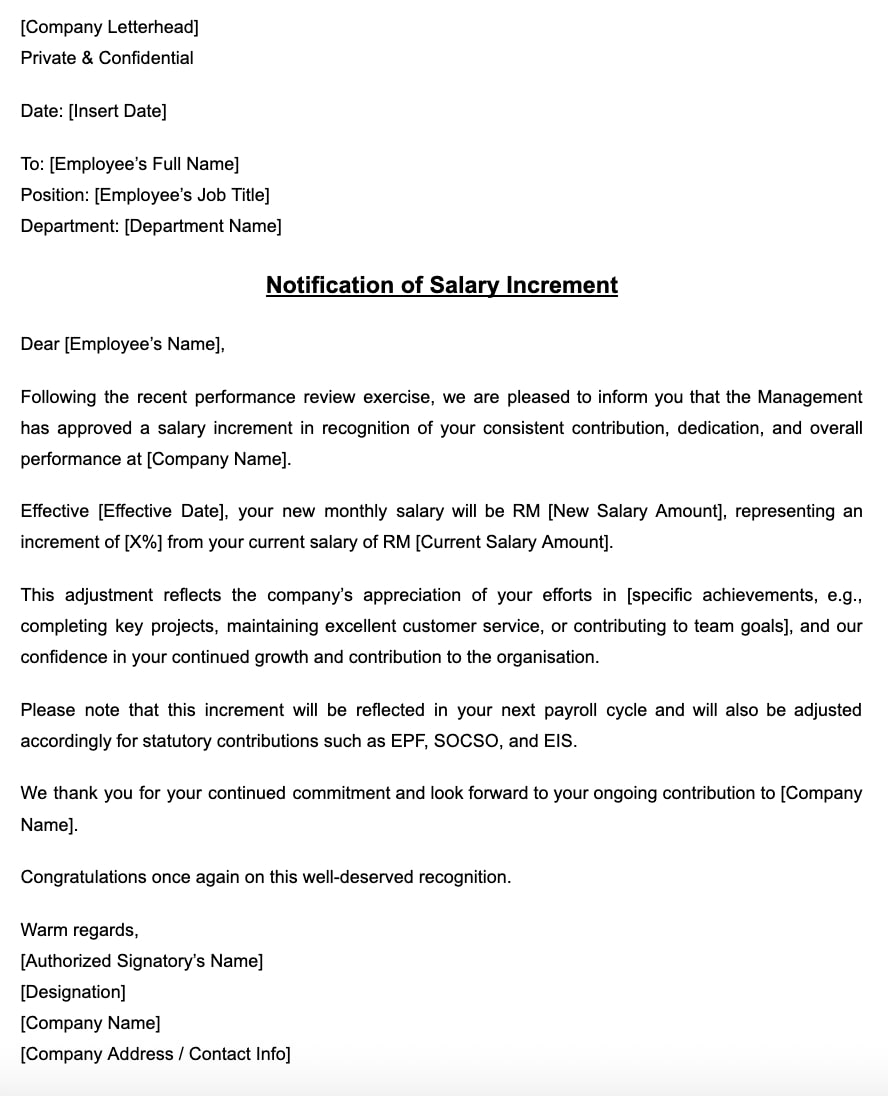
Free Download Salary Increment Letter Template (Malaysia)
FAQ
How often should salary increments be given?
Usually once a year, after performance reviews. Some companies also give increments after promotions or role changes.
What is the average salary increment in Malaysia?
Most employees get around 4% to 6%, depending on performance and industry.
Is it compulsory to give a salary increment every year?
No, it’s not required by law. But regular reviews help keep employees happy and reduce turnover.
How can employers decide the right increment amount?
Look at performance, company budget, market salary rates, and fairness among staff.
Does a salary increment affect EPF, SOCSO, and EIS?
Yes. Once the salary increases, employers must update all these contributions to match the new pay.
Ready to Build Your Future Team?

With AJobThing, finding the right talent is simple and fast.
Post your job ads today and reach candidates on Maukerja, Ricebowl, and Epicareer!
Read More:
-
Financial Year End in Malaysia Explained: Deadlines, Forms, and Payroll Duties
-
Payroll Checklist Malaysia 2025: Deadlines, Penalties, and Best Practices for Employers
-
Manpower Planning & Budgeting in Malaysia Employer’s Complete Guide
-
Hiring Qualified Freelancers in Malaysia? Make Sure You Do It Right
-
Hiring Part-Time in Malaysia? Here's How to Find the Right People
-
Part-Timers vs Casual Employees in Malaysia, Which Suits Your Company Best?
-
How to Write A Good Internship Offer Letter (With Free Templates)