

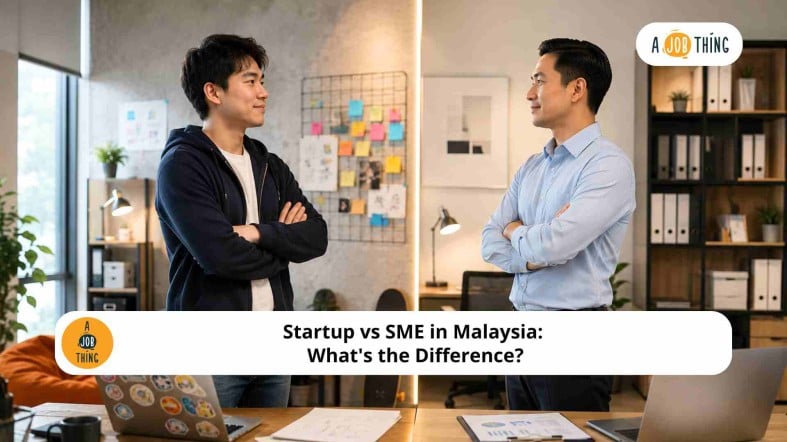
Startup vs SME in Malaysia: What's the Difference?

Many people use the terms startup and SME interchangeably, but they are not the same.
Understanding the difference is important for employers, HR professionals and business owners. Whether you're planning your hiring strategy, growing your workforce or improving your recruitment process, knowing how startups and SMEs operate can help you make better hiring decisions.
In this guide, we'll explain the key differences between startups and SMEs, how their hiring approaches differ, and what employers should consider when building their teams.
What is a Startup?
A startup is a newly established business that aims to solve a problem through an innovative product, service or business model. Unlike traditional businesses, startups are usually built with the goal of growing quickly and expanding into larger markets.
Many startups operate in industries such as technology, fintech, healthcare, e-commerce and Artificial Intelligence (AI), although startups can exist in almost any industry.
Some common characteristics of a startup include:
-
Focus on innovation
-
High growth potential
-
Small and agile teams
-
Flexible work environment
-
May seek funding from angel investors or venture capital firms
Because startups often have smaller teams, employees may take on multiple responsibilities and work closely with founders or management.
What is an SME?
SME stands for Small and Medium Enterprise. In Malaysia, SMEs are officially defined by SME Corp. Malaysia based on annual sales turnover and the number of full-time employees. A business only needs to meet one of the qualifying criteria (sales turnover or employee count, whichever is lower) to be classified as an SME.
For example:
-
Manufacturing sector: Sales turnover not exceeding RM50 million or not more than 200 full-time employees.
-
Services and other sectors: Sales turnover not exceeding RM20 million or not more than 75 full-time employees.
Unlike startups, SMEs generally focus on stable operations, sustainable growth and long-term business success.
SMEs operate across many industries, including retail, manufacturing, logistics, food and beverage, healthcare and professional services.
Startup vs SME: Key Differences
|
Area |
Startup |
SME |
|
Main objective |
Rapid growth and scalability |
Stable and sustainable growth |
|
Business focus |
Innovation and new ideas |
Established products or services |
|
Funding |
Investors, venture capital, angel funding |
Business revenue, bank loans or grants |
|
Risk level |
Higher |
Lower |
|
Organisation |
Flexible and less structured |
More structured operations |
|
Employee roles |
Multiple responsibilities |
Clearly defined responsibilities |
Hiring Differences Between Startups and SMEs
Although both startups and SMEs need talented employees, their hiring priorities are often different.
Startup Hiring
Startups usually look for candidates who are flexible, proactive and comfortable working in a fast-changing environment.
Employers often look for:
-
Adaptability
-
Problem-solving skills
-
Initiative
-
Willingness to learn
-
Strong cultural fit
Hiring decisions are often made quickly because startups need to fill important roles as the business grows.
SME Hiring
SMEs usually have more structured recruitment processes and clearly defined job roles.
Employers often prioritise:
-
Relevant work experience
-
Technical and job-specific skills
-
Long-term commitment
-
Teamwork
-
Industry knowledge
SMEs may also have dedicated HR personnel to manage recruitment, onboarding and employee development.
HR Challenges for Startups
As startups grow, employers often face challenges such as:
-
Hiring with limited budgets
-
Competing with larger companies for skilled talent
-
Building a strong company culture
-
Creating HR policies and processes
-
Retaining employees as the business expands
Since teams are usually small, every new hire can have a significant impact on business performance.
HR Challenges for SMEs
SMEs also face their own recruitment challenges, including:
-
Retaining experienced employees
-
Upskilling and reskilling staff
-
Managing payroll and employment compliance
-
Adapting to digital transformation
Many SMEs also compete with startups and multinational companies (MNCs) when recruiting skilled professionals.
Recruitment Tips for Startups and SMEs
Whether you're hiring for a startup or an SME, following good recruitment practices can help you attract better candidates.
Here are a few tips:
-
Write clear and accurate job descriptions.
-
Highlight your company culture and employee benefits.
-
Offer opportunities for learning and career growth.
-
Respond to candidates promptly throughout the hiring process.
-
Build a positive employer brand.
-
Use trusted recruitment platforms to reach qualified job seekers.
Hiring the right employees can improve productivity, strengthen your company culture and support long-term business growth.
FAQs
What is the difference between a startup and an SME?
A startup focuses on innovation, scalability and rapid growth, while an SME focuses on stable operations and sustainable business growth.
Is every startup an SME?
Not necessarily. Some startups meet Malaysia's SME definition based on their sales turnover or number of full-time employees, while others may grow beyond the SME category.
How is an SME defined in Malaysia?
According to SME Corp. Malaysia, SMEs are classified based on annual sales turnover and the number of full-time employees, with different thresholds for manufacturing and services sectors.
Do startups and SMEs use different hiring strategies?
Yes. Startups usually prioritise adaptability, learning ability and cultural fit, while SMEs often focus on relevant experience, technical skills and long-term employee retention.
Can a startup become an SME?
Yes. If a startup meets Malaysia's SME definition based on its sales turnover or number of full-time employees, it can be classified as an SME. As the business continues to grow, it may eventually exceed the SME thresholds.
Looking to Hire for Your Startup or SME?
%20copy.jpg)
Whether you're building your first team or growing your business, AJobThing helps you reach millions of job seekers across Malaysia and hire qualified candidates faster.
Post your job with AJobThing today and find the right talent for your business.
Read more:
-
Malaysia Digital 2030: AI Vision, 500,000 Digital Jobs & More Online Government Services
-
Overtime Rates in Malaysia: When Do 1.5x, 2x and 3x Pay Apply?
-
Prorated Salary in Malaysia: How to Calculate an Employee's First Salary
-
Remote Jobs in Malaysia: Most In-Demand Roles, Salaries & Hiring Guide (2026)
-
Effective Ways to Reduce Absenteeism in the Workplace for HR & Employers
-
Medical Benefits for Employees in Malaysia: Types, Legal Requirements & Best Practices
-
Fresh Graduate Salary in Malaysia (2026): How Much Should Employers Pay?
-
Salary Benchmarking in Malaysia: Are You Paying Enough to Attract Candidates?
-
e-Invoicing Malaysia Explained: What Every Employer and Business Needs to Know
-
EOR vs PEO: What's the Difference and Which Is Right for Your Business?
-
Remote Job Offer Letter: What Employers Should Include (+ Example)
-
Job Offer Letter vs. Employment Contract: What's the Difference? (+ Free Templates)
-
Constructive Dismissal Malaysia: Meaning, Examples & What To Do
-
Contract of Service vs Contract for Service Malaysia: How to Classify Workers Correctly
-
Job Offer Letter Templates: Examples, Formats & Best Practices for HR
-
Employee Retention in Malaysia: Meaning, Importance & How to Improve It
-
Employee Turnover in Malaysia: Causes, Warning Signs & How to Reduce It
-
Retrenchment in Malaysia: Meaning, Process & Employee Rights
-
Gmail Templates for HR: Faster Replies for Interviews, Offers & Rejections
-
7 Key Contract Employee Rights in Malaysia Every HR Should Know
-
GLC vs Private Company Malaysia: Salary, Culture & Hiring Differences
-
Types of Payroll Calculation in Malaysia: Adhoc, Prorated Salary & Final Settlement Explained
-
Types of Payroll Cycle in Malaysia: Which One Is Best for Your Business?
-
Types of Insurance in Malaysia and Their Impact on Employee Benefits
-
How to Create a Strong Candidate Shortlist for Better Hiring Decisions
-
How HR in Malaysia Can Offer a Job Over the Phone (with Script)
-
How Notice Period Really Works in Malaysia for Employers and HR
-
How to Create a Job Posting That Attracts the Right Candidates
-
How HR in Malaysia Can Improve Resume Screening and Candidate Shortlisting
-
How HR Can Reject a Candidate the Right Way (with Templates)
-
How to Conduct a Background Check for Employment in Malaysia
-
Onboarding Process Tips: What HR Needs to Know for Better Retention
-
Onboarding Checklist for New Hires (Free Downloadable Template)
-
Performance Evaluation: Description, Types, and How to Conduct
-
Cover Letter Examples Employers Should Know (With Tips to Spot the Best Ones)
-
Step-by-Step Guide to Writing a Great Job Description (Free Templates)