
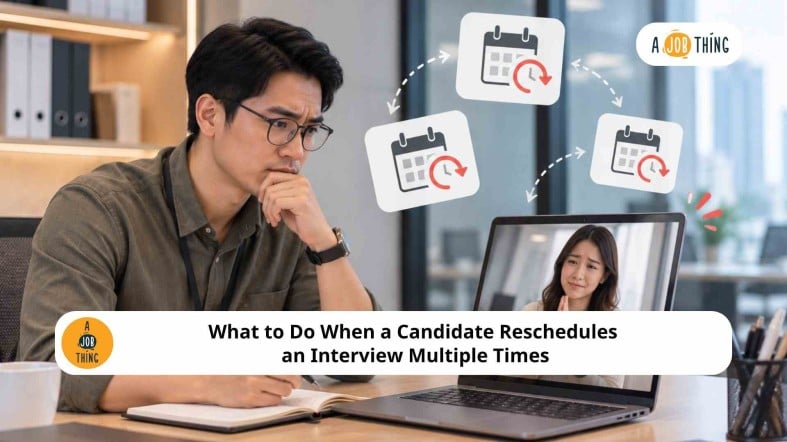
What to Do When a Candidate Reschedules an Interview Multiple Times

Are You Hiring?
Find candidates in 72 Hours with 5+ million talents in Maukerja Malaysia & Ricebowl using Job Ads.
Hire Now
Scheduling an interview takes time.
HR needs to find a suitable time, coordinate with the hiring manager and make sure everyone is prepared. But what happens when a candidate keeps asking to reschedule?
One schedule change is usually not a big problem. People can have unexpected work or personal commitments.
However, repeated rescheduling may be a sign that the candidate is no longer interested, has another offer, or is having difficulty committing to the interview.
For HR and employers in Malaysia, the key is to understand the situation, set reasonable boundaries and avoid spending too much time on a candidate who may not continue.
Why Do Candidates Reschedule Interviews?
There can be many reasons, and not all of them are negative.
They Have Work Commitments
Candidates who are currently employed may find it difficult to attend an interview during working hours.
They may need to change the interview time because of meetings, work schedules or other responsibilities.
Something Unexpected Happened
An emergency, illness or personal matter can happen at any time.
One rescheduling request should not automatically be treated as a red flag.
They Are Interviewing With Other Companies
Candidates may be managing several interviews at the same time.
Their schedule can change when another company moves its interview or hiring process.
They Are Losing Interest
Repeated rescheduling without a clear reason may indicate that the candidate is becoming less interested in the role.
They may also have concerns about the salary, job responsibilities, location or working arrangement.
They Are Not Prioritising the Interview
If a candidate repeatedly cancels at the last minute, gives little explanation and does not suggest another suitable time, HR may need to reconsider how much time to continue investing in the candidate.
How Many Times Should HR Reschedule?
There is no fixed number that applies to every hiring situation.
The reason and communication matter more than the number alone.
For example:
One reschedule with a genuine reason
Usually not a concern.
Two reschedules with clear communication
HR can still consider the candidate, especially if they remain interested.
Repeated rescheduling with little communication
This may indicate that the candidate is not prioritising the opportunity.
Repeated last-minute cancellations or no-shows
HR may need to reconsider whether the candidate should remain in the process.
The hiring team should also consider how difficult the role is to fill. A strong candidate for a hard-to-fill role may be worth accommodating more than a candidate who has shown little commitment.
What Should HR Do After the First Reschedule?
Stay professional and flexible.
You can reply:
Thanks for letting us know. We understand that schedules can change. Please share a few suitable times, and we'll do our best to arrange the interview.
This keeps the conversation positive while asking the candidate to take responsibility for the new schedule.
What If the Candidate Reschedules Again?
If a candidate asks to change the time again, HR can be more direct.
For example:
We understand that your schedule can change. As we have already rescheduled the interview once, please confirm a time that you are confident you can attend.
This sets a clear expectation without being unnecessarily harsh.
What If the Candidate Keeps Rescheduling?
At this stage, HR should stop repeatedly rearranging the calendar without understanding the situation.
Send a clear message:
We understand that your schedule may be busy. We are happy to continue with your application, but we need a confirmed interview time. Please let us know a suitable time by [date].
This gives the candidate a reasonable opportunity to confirm their interest.
What If the Candidate Cancels at the Last Minute?
Last-minute cancellations should be handled based on the reason.
If the candidate has a genuine emergency, HR can consider rescheduling.
If the candidate repeatedly cancels shortly before the interview, HR should consider whether continuing to schedule them is worth the time involved.
You can say:
We understand that unexpected situations can happen. As the interview has been rescheduled several times, please confirm your availability before we arrange another session.
This keeps the communication professional while making the expectation clear.
What If the Candidate Does Not Suggest Another Time?
This can be a warning sign.
For example:
Sorry, I can't make it tomorrow.
Without suggesting another date or showing interest in continuing.
HR can ask:
No problem. Are you still interested in the position? If so, please share two or three suitable times for an interview.
This gives the candidate a simple way to confirm whether they still want to continue.
Should HR Ask Why They Keep Rescheduling?
Yes, but keep the question simple.
For example:
May I check if there is anything affecting your availability for the interview?
This gives the candidate an opportunity to explain.
They may reveal that:
- The interview time conflicts with work
- They need more information about the role
- They have another commitment
- They prefer a video interview
- They are no longer actively looking
Understanding the reason can help HR decide what to do next.
Give Candidates Flexible Interview Options
One way to reduce rescheduling is to give candidates several time options.
Instead of:
Are you available Tuesday at 10 a.m.?
Try:
We are available Tuesday at 10 a.m., Wednesday at 2 p.m. or Thursday at 4 p.m. Which time works best for you?
For candidates who are currently employed, consider offering interview times outside normal working hours where practical.
For suitable roles, video interviews can also make scheduling easier.
Confirm the Interview Beforehand
A simple confirmation message can reduce unnecessary cancellations.
For example:
Hi [Candidate Name], just confirming your interview for the [Job Title] position on [date] at [time]. Please let us know as soon as possible if you need to make any changes.
For online interviews, include the meeting link and any instructions the candidate needs before the interview.
Make the Interview Details Clear
Some candidates may reschedule because they are unsure about the interview.
Include:
- Date
- Time
- Interview format
- Location or meeting link
- Expected duration
- Interviewer
- Anything they need to prepare
Clear information makes it easier for candidates to prepare and attend.
What Should HR Avoid?
Do Not Immediately Reject the Candidate
One reschedule does not tell you enough about a candidate's reliability.
Look at the reason and communication.
Do Not Keep Rescheduling Without a Limit
Repeated changes can waste time for HR and hiring managers.
Set a reasonable process for handling repeated requests.
Do Not Shame the Candidate
Avoid messages such as:
You clearly don't respect our time.
Keep communication professional, even when you decide not to continue.
Do Not Assume the Worst
A candidate may have a genuine reason for changing the schedule.
Give them an opportunity to explain before making a decision.
Do Not Put the Role on Hold
Even when a candidate looks promising, continue considering other suitable applicants until the hiring decision is confirmed.
When Should HR Move On?
HR may decide to stop pursuing a candidate when there is a repeated pattern of:
- Last-minute cancellations
- Multiple rescheduling requests
- No response after follow-ups
- No effort to suggest another time
- Lack of interest in the role
- Repeated missed appointments
The exact decision should depend on the company's recruitment process and the circumstances.
For hard-to-fill positions, HR may decide to keep communication open while continuing to look for other candidates.
A Simple Interview Rescheduling Process
HR can use this approach:
First Reschedule
Be flexible and offer new times.
Second Reschedule
Confirm the candidate is still interested and ask them to choose a time they can commit to.
Repeated Rescheduling
Set a clear deadline for the candidate to confirm their availability.
No Response
Follow the company's process for closing or pausing the application.
This gives both HR and candidates a clear process.
Track Interview Rescheduling
If many candidates are rescheduling interviews, the problem may not always be the candidates.
HR can track:
|
Information |
What to Check |
|
Number of reschedules |
Are cancellations increasing? |
|
Interview stage |
When do candidates reschedule? |
|
Reason |
Work, personal, other offer, etc. |
|
Notice given |
Early notice or last minute? |
|
Candidate outcome |
Continued or withdrew? |
This can help HR identify patterns in the recruitment process.
For example, if many candidates cancel after learning the working hours, the job advertisement or initial screening process may need to explain the schedule more clearly.
FAQs
Is it a red flag when a candidate reschedules an interview?
Not necessarily. One reschedule can happen for many genuine reasons. Repeated cancellations or poor communication may be more concerning.
How many times should HR allow a candidate to reschedule?
There is no fixed number. HR should consider the reason, communication and importance of the role rather than using a strict number for every candidate.
Should HR ask why a candidate keeps rescheduling?
Yes. A simple question can help HR understand whether the issue is their work schedule, personal circumstances or a lack of interest in the role.
What should HR do if a candidate keeps cancelling?
Ask the candidate to confirm whether they are still interested and request a time they can commit to. If there is still no commitment, HR can move forward with other candidates.
Should HR reject a candidate who reschedules twice?
Not automatically. Look at the overall situation, including the reason, notice given and how the candidate communicates.
Ready to Find Your Next Candidate?
%20copy.jpg)
A smooth interview process starts with having the right candidates to choose from. AJobThing helps employers post job vacancies and connect with candidates across Malaysia.
Whether you’re hiring for full-time, part-time, internship or other positions, reach more candidates and manage your hiring needs with AJobThing.
Post your job today and start connecting with candidates.
Read More:
-
Malaysia Labour Force Hits 17.37 Million in July 2026 as Unemployment Stays at 3.0%
-
Probation Performance Review in Malaysia: How HR Can Evaluate Employees
-
Final Interview Tips for HR: How to Assess Candidates Effectively
-
Candidate Withdrawal During the Hiring Process: How HR Can Reduce Drop-Off
-
How to Keep Candidates Interested During a Long Hiring Process
-
Candidates Stop Responding After an Interview? What HR Should Do
-
Management Trainee Programme In Malaysia: How Employers Can Build A Graduate Pipeline That Retains
-
Job Requisition: What It Is, What to Include & How HR Can Create One
-
Panel Interviews: How HR Can Plan, Conduct & Evaluate Candidates
-
Interview-to-Hire Ratio: How to Calculate, Benchmark & Improve It
-
Candidate Experience Survey: Questions, Examples & How to Improve Recruitment
-
How to Reduce Hiring Bias: Common Interview Biases HR Professionals Should Avoid
-
Staff Immediate Resignation in Malaysia: Employer Rights & Responsibilities
-
Late Salary Payment in Malaysia: Can Employers Delay Employee Salaries?
-
Internship vs Apprenticeship in Malaysia: Key Differences for Employers & HR
-
How to Manage Underperforming Employees in Malaysia: Tips for Employers & HR
-
Warning Letter for Poor Performance in Malaysia: How to Write One (With Sample)
-
Can Employers Reject Annual Leave in Malaysia? Rights, Rules & Employee Entitlements
-
Payroll and Attendance Management in Malaysia: Process, Formula & Best Practices for Employers
-
Workplace Conflict Management in Malaysia: Causes, Solutions, and Best Practices
-
Recruitment Process Outsourcing (RPO): What It Is, Benefits & How It Works in Malaysia
-
Competency-Based Interviews: Improve Hiring Quality with a Consistent Interview Process
-
Leave Encashment Malaysia: How to Calculate Unused Annual Leave
-
Online Seller Requirements in Malaysia: 10 Business Details You Must Display
-
Performance Bonus in Malaysia: How It Works, Calculation & Employer Guide
-
Cost Per Hire Malaysia: Formula, Examples & How Employers Can Reduce Hiring Costs
-
Letter of Extension of Contract Malaysia: Free Template, Format & Sample
-
Promotion Letter in Malaysia: How to Write One (+ Free Template & Sample)
-
Probation Extension Letter Malaysia: Template, Sample, and What Employers Need to Know
-
Talent Pool: Benefits, Examples & How to Build One for Better Hiring
-
Sales Turnover: What It Is, Formula, Examples & Tips to Increase It
-
Overtime Rates in Malaysia: When Do 1.5x, 2x and 3x Pay Apply?
-
Prorated Salary in Malaysia: How to Calculate an Employee's First Salary
-
Remote Jobs in Malaysia: Most In-Demand Roles, Salaries & Hiring Guide (2026)
-
Effective Ways to Reduce Absenteeism in the Workplace for HR & Employers
-
Medical Benefits for Employees in Malaysia: Types, Legal Requirements & Best Practices
-
Fresh Graduate Salary in Malaysia (2026): How Much Should Employers Pay?
-
Salary Benchmarking in Malaysia: Are You Paying Enough to Attract Candidates?
-
e-Invoicing Malaysia Explained: What Every Employer and Business Needs to Know
-
EOR vs PEO: What's the Difference and Which Is Right for Your Business?
-
Remote Job Offer Letter: What Employers Should Include (+ Example)
-
Job Offer Letter vs. Employment Contract: What's the Difference? (+ Free Templates)
-
Constructive Dismissal Malaysia: Meaning, Examples & What To Do
-
Contract of Service vs Contract for Service Malaysia: How to Classify Workers Correctly
-
Job Offer Letter Templates: Examples, Formats & Best Practices for HR
-
Employee Retention in Malaysia: Meaning, Importance & How to Improve It
-
Employee Turnover in Malaysia: Causes, Warning Signs & How to Reduce It
-
Retrenchment in Malaysia: Meaning, Process & Employee Rights
-
Gmail Templates for HR: Faster Replies for Interviews, Offers & Rejections
-
7 Key Contract Employee Rights in Malaysia Every HR Should Know
-
GLC vs Private Company Malaysia: Salary, Culture & Hiring Differences
-
Types of Payroll Calculation in Malaysia: Adhoc, Prorated Salary & Final Settlement Explained
-
Types of Payroll Cycle in Malaysia: Which One Is Best for Your Business?
-
Types of Insurance in Malaysia and Their Impact on Employee Benefits
-
How to Create a Strong Candidate Shortlist for Better Hiring Decisions
-
How HR in Malaysia Can Offer a Job Over the Phone (with Script)
-
How Notice Period Really Works in Malaysia for Employers and HR
-
How to Create a Job Posting That Attracts the Right Candidates
-
How HR in Malaysia Can Improve Resume Screening and Candidate Shortlisting
-
How HR Can Reject a Candidate the Right Way (with Templates)
-
How to Conduct a Background Check for Employment in Malaysia
-
Onboarding Process Tips: What HR Needs to Know for Better Retention
-
Onboarding Checklist for New Hires (Free Downloadable Template)
-
Performance Evaluation: Description, Types, and How to Conduct
-
Cover Letter Examples Employers Should Know (With Tips to Spot the Best Ones)
-
Step-by-Step Guide to Writing a Great Job Description (Free Templates)