
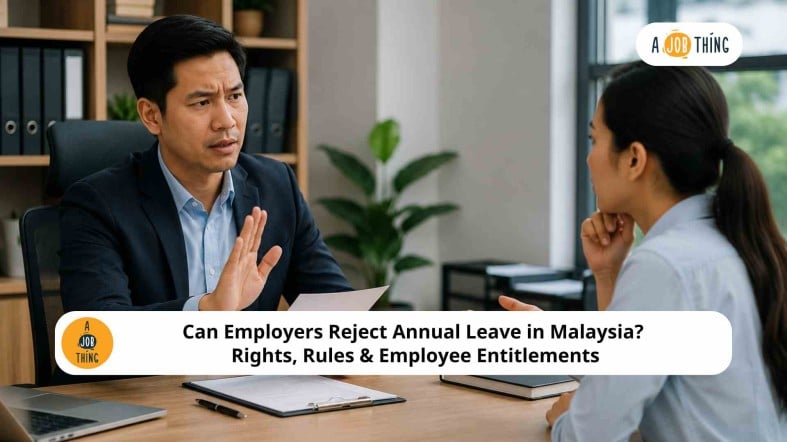
Can Employers Reject Annual Leave in Malaysia? Rights, Rules & Employee Entitlements

Are You Hiring?
Find candidates in 72 Hours with 5+ million talents in Maukerja Malaysia & Ricebowl using Job Ads.
Hire Now
Annual leave is one of the most important employee benefits in Malaysia. However, many employers and employees still wonder:
Can an employer reject an employee's annual leave request?
The answer is yes, but not without reason.
Under Malaysia's Employment Act 1955, eligible employees are entitled to paid annual leave based on their length of service. However, having annual leave entitlement does not automatically mean employees can take leave on any date they choose. Employers have the right to manage leave applications to ensure business operations continue smoothly, provided employees are still given a reasonable opportunity to enjoy their statutory annual leave.
In this guide, we'll explain what Malaysian employment law says, when employers can reject annual leave, employee rights, and best practices for managing leave fairly.
What Does the Employment Act 1955 Say About Annual Leave?
Section 60E of the Employment Act 1955 provides eligible employees with paid annual leave based on their completed years of service.
The minimum annual leave entitlement is:
| Length of Service | Minimum Annual Leave |
|---|---|
| Less than 2 years | 8 days |
| 2 years to less than 5 years | 12 days |
| 5 years or more | 16 days |
These are the minimum statutory entitlements. Employers may provide additional annual leave through employment contracts, company policies, or collective agreements.
Annual leave should generally be taken within 12 months after the end of the period in which it is earned. Employers should also ensure employees have a reasonable opportunity to use their statutory leave entitlement.
When Can Employers Reject Annual Leave Requests?
Employers may reject or ask employees to reschedule annual leave if there is a genuine business or operational reason.
This is because employers are responsible for ensuring the business has enough staff to continue operating efficiently.
Examples include:
-
Too many employees have already applied for leave during the same period.
-
The requested dates fall during the company's busiest season.
-
The employee is needed for an important project or client deadline.
-
There are insufficient staff to maintain daily operations.
-
The employee did not follow the company's leave application process.
Rejecting one leave request does not mean employers can permanently prevent employees from using their annual leave.
Instead, employers should work with employees to arrange another suitable period whenever possible.
Common Reasons for Rejecting Annual Leave
Employers should only reject annual leave when there is a legitimate business reason.
Some common examples include:
Peak business periods
Retail businesses may experience higher customer demand during festive seasons such as Hari Raya, Chinese New Year, Deepavali, or Christmas. Employers may limit leave during these periods to maintain sufficient staffing.
Major business projects
Employees may be required to remain at work during important product launches, audits, system migrations, or major client projects.
Staff shortages
If multiple employees from the same department apply for leave on the same dates, employers may need to stagger approvals to ensure business continuity.
Failure to follow company procedures
Employers may reject leave applications that do not comply with company policies, such as late submissions or incomplete leave requests.
Employer Responsibilities When Managing Annual Leave
While employers have the right to approve or reject leave requests, they also have important responsibilities.
Employers should:
-
Apply leave policies consistently to all employees.
-
Process leave applications within a reasonable timeframe.
-
Maintain accurate leave records.
-
Explain why a leave request is rejected whenever possible.
-
Discuss alternative leave dates with employees.
-
Ensure employees have a reasonable opportunity to use their statutory annual leave.
Applying leave policies fairly helps reduce disputes and improves employee trust.
Cancelling Approved Annual Leave
Sometimes unexpected situations arise after leave has already been approved.
Examples include:
-
Emergency operational issues
-
Unexpected staff shortages
-
Major equipment failures
-
Critical customer commitments
-
Business continuity emergencies
Although employers may request employees to postpone approved leave where genuinely necessary, this should only happen in exceptional circumstances.
If cancelling approved leave causes employees to suffer financial losses, such as non-refundable flight tickets or accommodation, employers are encouraged to discuss a fair solution with the employee. Open communication helps maintain positive employee relations.
Requiring Employees to Take Annual Leave
There may also be situations where employers require employees to use annual leave.
Examples include:
-
Company-wide shutdowns
-
Factory maintenance periods
-
Office renovations
-
Seasonal business closures
-
Temporary reductions in business activity
Before requiring employees to use annual leave, employers should ensure the arrangement is consistent with:
-
Company leave policies
-
Collective agreements (if applicable)
-
Applicable employment laws
Providing reasonable notice is considered good HR practice.
What Happens If an Employee Takes Leave Without Approval?
Employees should obtain approval before taking annual leave.
If an employee is absent without approval, the employer may treat the absence as unauthorised.
Depending on the circumstances, this could lead to disciplinary action.
However, employers should first determine whether the employee has a reasonable explanation, such as:
-
A medical emergency
-
A family emergency
-
Bereavement
-
Other unexpected circumstances beyond the employee's control
Each case should be assessed fairly before disciplinary action is taken.
Best Practices for Employers
A well-managed leave process benefits both employers and employees.
To manage annual leave effectively, employers should:
-
Create a clear annual leave policy.
-
Explain how leave applications should be submitted.
-
Encourage employees to plan leave early.
-
Apply leave rules consistently.
-
Approve or reject leave requests promptly.
-
Keep accurate leave records.
-
Plan staffing levels during peak leave periods.
-
Discuss alternative dates instead of simply rejecting leave.
-
Ensure employees can enjoy their statutory annual leave entitlement.
Consistency is essential. Approving similar leave requests for some employees while rejecting others without a legitimate operational reason may create perceptions of unfair treatment and affect workplace morale.
Not sure how much annual leave your employees are entitled to? Use this free Annual Leave Calculator helps you calculate leave entitlement quickly and accurately.
FAQs
Can annual leave be rejected because the company is busy?
Yes. Employers may reject or postpone leave if there is a genuine business or operational need.
How many times can employers reject annual leave requests?
Employers may reject specific requests, but they should still allow employees to use their statutory annual leave.
Who decides when annual leave is taken?
Employees request leave, but employers generally decide whether to approve it based on operational needs.
What happens if approved annual leave is cancelled?
Employers should inform employees as soon as possible and discuss alternative arrangements where appropriate.
When can employers require employees to take annual leave?
This may happen during company shutdowns, temporary closures, or other situations allowed by company policy and applicable laws.
Can unused annual leave be carried forward?
It depends on the employment contract or company policy, provided it complies with applicable laws.
Can annual leave be paid instead of taken?
Generally, annual leave is meant to be taken as time off. Payment in lieu usually applies when employment ends or where permitted by law.
What happens if an employee takes annual leave without approval?
The absence may be treated as unauthorised and could lead to disciplinary action, depending on the circumstances.
Looking to Grow Your Team?
%20copy.jpg)
Post your job on AJobThing and connect with qualified candidates across Malaysia.
Read more:
-
What Is KWAP? Functions, Roles & Who It Applies To in Malaysia
-
Payroll and Attendance Management in Malaysia: Process, Formula & Best Practices for Employers
-
Workplace Conflict Management in Malaysia: Causes, Solutions, and Best Practices
-
Recruitment Process Outsourcing (RPO): What It Is, Benefits & How It Works in Malaysia
-
SME Hiring Guide: How to Plan, Hire, and Grow Your Team Successfully
-
Competency-Based Interviews: Improve Hiring Quality with a Consistent Interview Process
-
Leave Encashment Malaysia: How to Calculate Unused Annual Leave
-
Online Seller Requirements in Malaysia: 10 Business Details You Must Display
-
Performance Bonus in Malaysia: How It Works, Calculation & Employer Guide
-
Cost Per Hire Malaysia: Formula, Examples & How Employers Can Reduce Hiring Costs
-
Letter of Extension of Contract Malaysia: Free Template, Format & Sample
-
Promotion Letter in Malaysia: How to Write One (+ Free Template & Sample)
-
Probation Extension Letter Malaysia: Template, Sample, and What Employers Need to Know
-
Talent Pool: Benefits, Examples & How to Build One for Better Hiring
-
Sales Turnover: What It Is, Formula, Examples & Tips to Increase It
-
Overtime Rates in Malaysia: When Do 1.5x, 2x and 3x Pay Apply?
-
Prorated Salary in Malaysia: How to Calculate an Employee's First Salary
-
Remote Jobs in Malaysia: Most In-Demand Roles, Salaries & Hiring Guide (2026)
-
Effective Ways to Reduce Absenteeism in the Workplace for HR & Employers
-
Medical Benefits for Employees in Malaysia: Types, Legal Requirements & Best Practices
-
Fresh Graduate Salary in Malaysia (2026): How Much Should Employers Pay?
-
Salary Benchmarking in Malaysia: Are You Paying Enough to Attract Candidates?
-
e-Invoicing Malaysia Explained: What Every Employer and Business Needs to Know
-
EOR vs PEO: What's the Difference and Which Is Right for Your Business?
-
Remote Job Offer Letter: What Employers Should Include (+ Example)
-
Job Offer Letter vs. Employment Contract: What's the Difference? (+ Free Templates)
-
Constructive Dismissal Malaysia: Meaning, Examples & What To Do
-
Contract of Service vs Contract for Service Malaysia: How to Classify Workers Correctly
-
Job Offer Letter Templates: Examples, Formats & Best Practices for HR
-
Employee Retention in Malaysia: Meaning, Importance & How to Improve It
-
Employee Turnover in Malaysia: Causes, Warning Signs & How to Reduce It
-
Retrenchment in Malaysia: Meaning, Process & Employee Rights
-
Gmail Templates for HR: Faster Replies for Interviews, Offers & Rejections
-
7 Key Contract Employee Rights in Malaysia Every HR Should Know
-
GLC vs Private Company Malaysia: Salary, Culture & Hiring Differences
-
Types of Payroll Calculation in Malaysia: Adhoc, Prorated Salary & Final Settlement Explained
-
Types of Payroll Cycle in Malaysia: Which One Is Best for Your Business?
-
Types of Insurance in Malaysia and Their Impact on Employee Benefits
-
How to Create a Strong Candidate Shortlist for Better Hiring Decisions
-
How HR in Malaysia Can Offer a Job Over the Phone (with Script)
-
How Notice Period Really Works in Malaysia for Employers and HR
-
How to Create a Job Posting That Attracts the Right Candidates
-
How HR in Malaysia Can Improve Resume Screening and Candidate Shortlisting
-
How HR Can Reject a Candidate the Right Way (with Templates)
-
How to Conduct a Background Check for Employment in Malaysia
-
Onboarding Process Tips: What HR Needs to Know for Better Retention
-
Onboarding Checklist for New Hires (Free Downloadable Template)
-
Performance Evaluation: Description, Types, and How to Conduct
-
Cover Letter Examples Employers Should Know (With Tips to Spot the Best Ones)
-
Step-by-Step Guide to Writing a Great Job Description (Free Templates)