
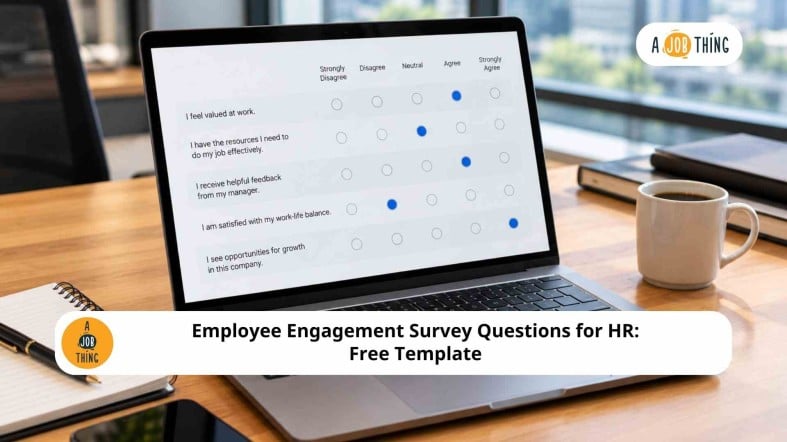
Employee Engagement Survey Questions for HR: Free Template

Are You Hiring?
Find candidates in 72 Hours with 5+ million talents in Maukerja Malaysia & Ricebowl using Job Ads.
Hire Now
Employee engagement surveys help HR teams understand how employees feel about their work, managers, workplace culture and career opportunities. The feedback can help employers identify workplace issues, improve employee satisfaction and create a better working environment.
For Malaysian employers, employee engagement surveys are also a practical way to understand employees' needs, including workload, communication, recognition and work-life balance.
This guide covers 20 employee engagement survey questions, staff satisfaction survey examples and a free employee feedback survey template that HR teams can copy and customise.
What Is an Employee Engagement Survey?
An employee engagement survey is a questionnaire used to measure how connected, motivated and committed employees feel towards their work and organisation.
HR teams use survey responses to understand what employees value, what challenges they face and what changes could improve their working experience.
Common areas covered by an employee engagement survey include:
-
Job satisfaction and motivation
-
Management support and leadership
-
Communication and teamwork
-
Recognition and career development
-
Workload and work-life balance
-
Workplace culture and employee retention
HR teams can conduct a full survey annually or twice a year, with shorter pulse surveys between periods when feedback is needed on a specific issue.
20 Employee Engagement Survey Questions for HR
The following employee engagement survey questions can help HR teams assess different aspects of the employee experience. Select the questions that match your survey objectives rather than asking every question at once.
1. Job Satisfaction and Motivation
These questions help HR understand whether employees feel satisfied with their roles and motivated to perform well.
-
I am satisfied with my current role and responsibilities.
-
I understand how my work contributes to the company's goals.
-
I feel motivated to do my best at work.
-
I have the tools and resources needed to perform my job well.
2. Leadership and Management
Manager behaviour can influence how employees experience their workplace. These questions assess communication, trust and support.
-
My manager communicates work expectations clearly.
-
My manager provides useful feedback to help me improve.
-
I feel comfortable discussing work-related concerns with my manager.
-
My manager listens to my ideas and suggestions.
3. Communication and Teamwork
Clear communication helps employees understand priorities and work effectively with colleagues.
-
I receive the information I need to do my job well.
-
My team works well together to achieve shared goals.
-
I feel comfortable sharing my opinions at work.
-
Communication between departments is effective.
4. Recognition and Career Development
Employees need to understand how their contributions are valued and what opportunities are available for professional growth.
-
My contributions are recognised and appreciated.
-
I am treated fairly at work.
-
I have opportunities to develop new skills.
-
I understand the career growth opportunities available to me.
5. Work-Life Balance and Retention
These questions help HR identify possible concerns about workload, wellbeing and employees' intention to stay.
-
My workload is manageable.
-
I can maintain a healthy balance between work and personal life.
-
I feel respected by my colleagues.
-
I can see myself continuing to work for this company over the next year.
HR tip: Use a mix of rating questions and open-ended questions. Ratings help identify patterns, while written feedback gives employees an opportunity to explain their experiences.
Free Employee Engagement Survey Template
HR teams can copy the template below into Google Forms, Microsoft Forms or another survey platform.
Employee Engagement Survey
Survey introduction
We want to understand your experience at work and identify opportunities to improve our workplace. Please answer the questions honestly based on your current experience.
Your feedback will help us understand what is working well and where improvements may be needed. Responses will be handled according to the company's stated privacy practices.
Section A: Employee Information (Optional)
-
Department: ____________________
-
Length of service: ____________________
-
Work arrangement: Office / Hybrid / Remote
Collect only information that is relevant to the survey. If anonymity is promised, avoid collecting identifying details or reporting results in ways that could reveal individual employees.
Section B: Employee Engagement Questions
For each statement, select the response that best reflects your experience.
| Rating | Response |
|---|---|
| 1 | Strongly disagree |
| 2 | Disagree |
| 3 | Neither agree nor disagree |
| 4 | Agree |
| 5 | Strongly agree |
| No. | Survey statement | Rating |
|---|---|---|
| 1 | I am satisfied with my current role. | 1 to 5 |
| 2 | I understand the company's goals and priorities. | 1 to 5 |
| 3 | My manager gives me the support I need. | 1 to 5 |
| 4 | I receive recognition for my contributions. | 1 to 5 |
| 5 | I have opportunities to develop my skills. | 1 to 5 |
| 6 | Communication within the company is effective. | 1 to 5 |
| 7 | My workload is manageable. | 1 to 5 |
| 8 | I feel respected by my colleagues. | 1 to 5 |
| 9 | I feel comfortable sharing feedback at work. | 1 to 5 |
| 10 | I see a future for myself at this company. | 1 to 5 |
Section C: Open-Ended Feedback
-
What do you enjoy most about working here?
-
What is one thing the company could improve?
-
What additional support would help you perform better at work?
Closing message
Thank you for sharing your feedback. Your responses will help us identify practical ways to improve the employee experience.
Employee Engagement vs Employee Satisfaction
Employee engagement and employee satisfaction are related, but they measure different aspects of the workplace.
| Employee engagement | Employee satisfaction |
|---|---|
| Measures employees' connection to their work and organisation. | Measures how satisfied employees are with their work experience. |
| Focuses on motivation, involvement and commitment. | Focuses on factors such as salary, benefits, workload and working conditions. |
| Helps HR understand how employees relate to company goals. | Helps HR identify areas where employees may be unhappy or dissatisfied. |
For example, an employee may be satisfied with their salary and working hours but may not feel motivated or connected to the company's goals.
Using both employee engagement survey questions and staff satisfaction survey questions gives HR a more complete view of the employee experience.
How to Analyse Employee Engagement Survey Results
After collecting responses, HR teams should review the scores and comments to identify recurring patterns and possible areas for improvement.
Calculate the Average Survey Score
For questions using a five-point rating scale, HR can calculate the average score using this formula:
Average score = Total ratings ÷ Number of responses
For example, if 20 employees give a combined total of 76 points for a question:
76 ÷ 20 = 3.8 out of 5
The average helps HR compare responses across questions or survey periods. It should be interpreted alongside written feedback and other relevant information.
Identify Areas That Need Attention
Review results by topic instead of focusing only on one overall score.
For example:
-
Low management support scores: Review how managers communicate expectations, provide feedback and support their teams.
-
Low career development scores: Consider clearer career pathways, relevant training or regular career discussions.
-
Low workload scores: Review staffing levels, priorities and how work is distributed across teams.
-
Low recognition scores: Assess whether employees receive useful feedback and appropriate recognition for their contributions.
These results indicate areas to investigate, not definite causes. Discuss the findings with relevant stakeholders before deciding on corrective actions.
Create an Action Plan
Choose a small number of priority issues and assign an owner and target date to each action.
For example, if employees report unclear communication, HR could work with department managers to introduce regular team updates and clearer communication channels.
Share the planned actions with employees so they understand how their feedback will be used. Follow up later to assess whether the changes have helped.
Best Practices for Conducting an Employee Feedback Survey
To collect useful and honest feedback, HR teams should follow these practices:
-
Keep questions clear: Avoid complicated wording and questions that ask about several issues at once.
-
Keep the survey manageable: Start with 10 to 20 relevant rating questions and a few open-ended questions.
-
Explain confidentiality: Tell employees who can access responses, how the data will be used and whether the survey is anonymous.
-
Choose the right timing: Allow employees enough time to respond and avoid unnecessary survey fatigue.
-
Communicate the results: Share the main findings and explain which improvements the company plans to make.
-
Follow up on actions: Review progress and collect feedback again when appropriate.
Employees may be less willing to participate in future surveys when their feedback is repeatedly collected without visible action. Closing the feedback loop is therefore an important part of the process.
FAQs
What are the best employee engagement survey questions?
The best questions assess job satisfaction, management support, communication, recognition, career development, workload and employees' intention to stay. Select questions that match your company's objectives.
How many questions should an employee engagement survey have?
Around 10 to 20 focused rating questions, supported by a few open-ended questions, is a practical starting point. The appropriate number depends on the survey's purpose and the time employees need to complete it.
Should employee engagement surveys be anonymous?
Anonymous surveys can encourage employees to share honest feedback, particularly about sensitive workplace issues. HR should ensure the survey design and reporting process support any anonymity commitments made to employees.
How often should HR conduct employee engagement surveys?
Many organisations conduct a full survey annually or twice a year. Shorter pulse surveys can be used between full surveys when HR needs feedback on a particular workplace issue.
What should HR do after an employee engagement survey?
HR should review the results, identify priority issues, develop an action plan, communicate the planned changes and monitor progress. Employees should understand how their feedback contributes to workplace improvements.
Build a Better Employee Experience with AJobThing

Improving employee engagement starts with understanding what employees need to perform well and feel supported at work. Regular feedback can help HR teams identify workplace concerns, improve communication and make more informed people-management decisions.
A strong employee experience also begins with hiring suitable candidates for the right roles.
Looking to improve your recruitment process? Explore AJobThing's recruitment solutions.
Read More
-
Employee Retention in Malaysia: Meaning, Importance & How to Improve It
-
Employee Turnover in Malaysia: Causes, Warning Signs & How to Reduce It
-
Effective Employee Recognition Programs: Ideas and Strategies
-
Performance Evaluation: Description, Types, and How to Conduct
-
How to Create and Use an Appraisal Form in Malaysia (With Templates)
-
Performance Review: Definition, Benefits, and How to Conduct
-
How Malaysian Employers Can Support Mental Health at the Workplace
-
How to Manage Underperforming Employees in Malaysia: Tips for Employers & HR