
EPF (KWSP) Contribution Rates 2026: How Much Do Employees and Employers Contribute?

Are You Hiring?
Find candidates in 72 Hours with 5+ million talents in Maukerja Malaysia & Ricebowl using Job Ads.
Hire Now
EPF (KWSP) contributions are mandatory monthly contributions made by both employers and employees in Malaysia.
The contribution consists of the employer's share and the employee's share and helps employees build retirement savings throughout their working years.
This requirement is stated under Section 43(1) of the EPF Act 1991, where both employers and employees are responsible for making monthly contributions based on the rates set out in the Third Schedule of the Act.
Since 1 October 2025, EPF contributions have also become mandatory for foreign workers in Malaysia.
In this guide, we'll explain who needs to contribute, the latest EPF contribution rates, how contributions are allocated, and what employees can do if their employer fails to contribute.
What Is an EPF (KWSP) Contribution?
An EPF contribution is a mandatory deduction that includes:
-
Employee contribution
-
Employer contribution
Employers must calculate and submit contributions according to the contribution rates stated under the EPF Act 1991.
Monthly contributions must be paid on or before the 15th of the following month.
For example, EPF contributions for May salaries must be paid by 15 June.
Who Must Contribute to EPF?
EPF contributions are compulsory for individuals employed under a Contract of Service or Apprenticeship.
This includes:
-
Permanent employees
-
Contract employees
-
Temporary employees
-
Employees on probation
-
Company directors who receive wages or remuneration
-
Employees who returned to work after recovering from disability
-
Employees who continue working after making Age Withdrawal
-
Pensioners who work for private sector employers
-
Employees who return to work after retirement
-
Foreign workers holding valid immigration passes and employed legally in Malaysia
EPF contributions must be made regardless of whether wages are paid monthly, weekly, or daily.
Who Is Considered an Employer?
An employer refers to any individual or entity that has a contract of service or apprenticeship with an employee.
This includes:
-
Business owners
-
Companies
-
Government agencies
-
Statutory bodies
-
Local authorities
-
Any person responsible for paying wages
Who Is Considered an Employee?
An employee is a person employed under a Contract of Service or Apprenticeship as defined under the EPF Act 1991.
A contract may be:
-
Written or verbal
-
Express or implied
The minimum working age is subject to the Children and Young Persons (Employment) Act 1966.
The maximum age for mandatory EPF contributions is 75 years old.
How Are EPF Contributions Allocated?
EPF contributions are credited into three accounts:
| Account | Allocation |
|---|---|
| Akaun Persaraan | 75% |
| Akaun Sejahtera | 15% |
| Akaun Fleksibel | 10% |
EPF Accounts After Age 55
Once a member reaches age 55, two accounts will exist:
Akaun 55
-
Combines Akaun Persaraan, Akaun Sejahtera, and Akaun Fleksibel.
-
Funds can be withdrawn at any time after age 55.
-
Created when a member reaches age 55.
-
Any contributions received after age 55 will be credited here.
-
Funds can only be withdrawn after age 60.
EPF Contribution Rates 2026
Category 1: Malaysian Citizens (Senior Citizens)
For Malaysian employees aged 60 and above:
| Contributor | Rate |
|---|---|
| Employee | 0% |
| Employer | 4% |
The employee's salary is not deducted. Only the employer contributes.
Category 2: Malaysian Citizens, Permanent Residents, and Foreign Workers Registered Before 1 August 1998
Monthly Salary RM5,000 and Below
| Age | Employee | Employer |
|---|---|---|
| Below 60 | 11% | 13% |
| 60 and Above | 5.5% | 6.5% |
Monthly Salary Above RM5,000
| Age | Employee | Employer |
|---|---|---|
| Below 60 | 11% | 12% |
| 60 and Above | 5.5% | 6% |
Category 3: Foreign Workers Registered From 1 August 1998
For all foreign employees regardless of salary or age:
| Contributor | Rate |
|---|---|
| Employee | 2% |
| Employer | 2% |
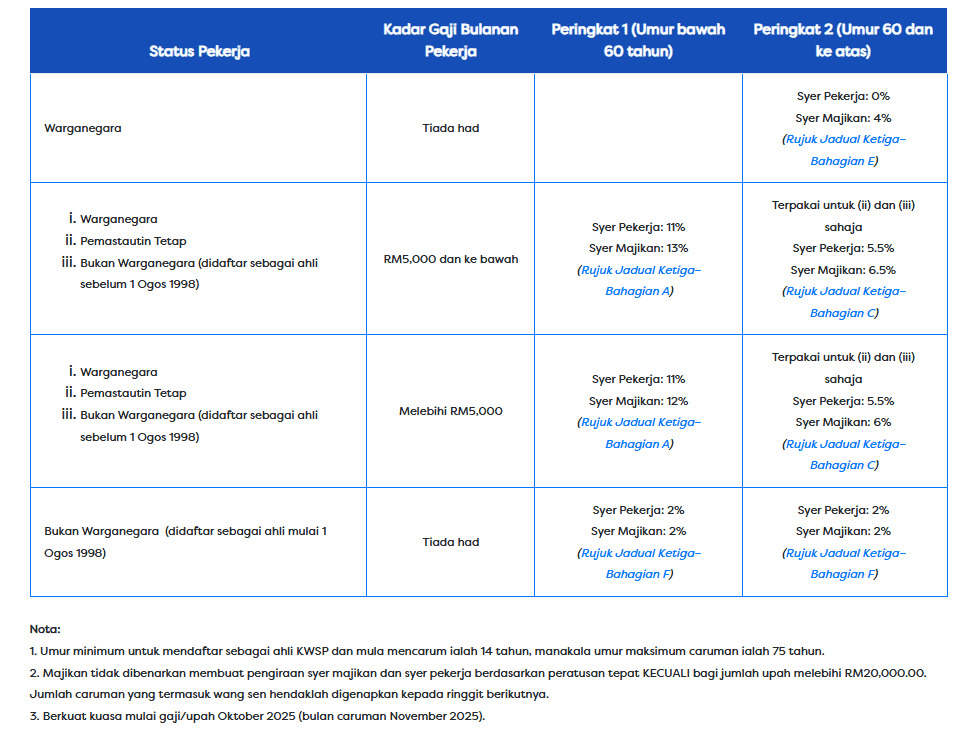
Image source: KWSP
Need to Calculate EPF Contributions?
Use EPF Calculator to quickly calculate employee and employer EPF contributions based on salary.
Is EPF Calculated Based on Basic Salary Only?
No.
EPF contributions are calculated based on "wages", which include most cash payments made to employees.
Payments Subject to EPF Contributions
-
Salary
-
Bonus
-
Allowances
-
Commission
-
Incentives
-
Salary arrears
-
Maternity leave wages
-
Study leave wages
-
Unused annual leave and sick leave payments
-
Half-pay leave wages
-
Other payments under a contract of service
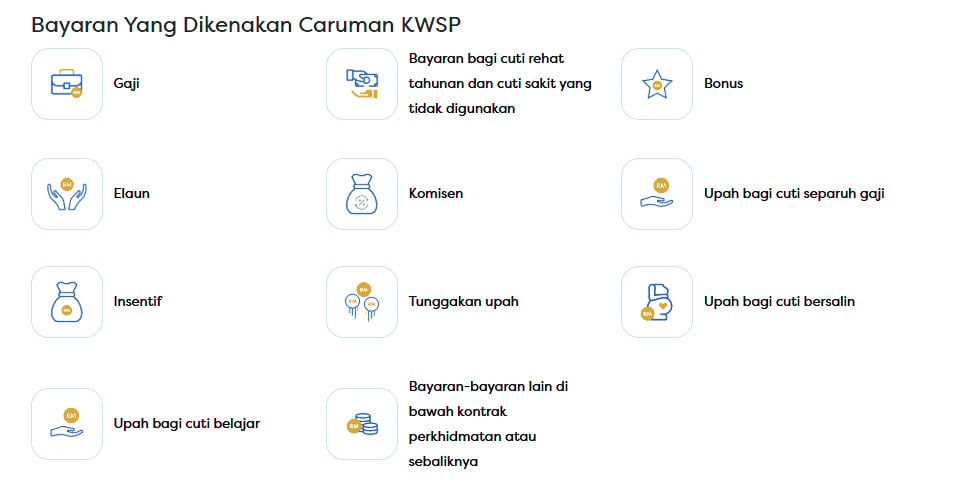
Image source: KWSP
Payments Not Subject to EPF Contributions
-
Service charges
-
Overtime payments
-
Gratuity
-
Retirement benefits
-
Retrenchment benefits
-
Temporary layoff benefits
-
Travel allowances
-
Travel concessions
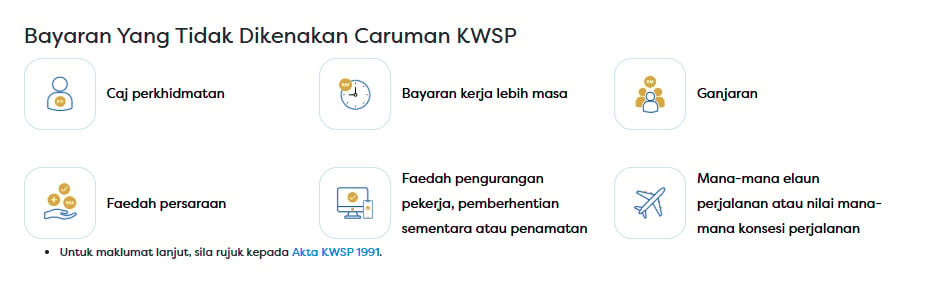
Image source: KWSP
Can an Employer Refuse to Contribute EPF?
No.
Employers are legally required to make EPF contributions for eligible employees.
Failure to do so is a criminal offence under the EPF Act 1991.
Some offences and penalties include:
| Offence | Penalty |
|---|---|
| Failure to register as an employer | Up to 3 years imprisonment or RM10,000 fine or both |
| Failure to pay EPF contributions on time | Up to 3 years imprisonment or RM10,000 fine or both |
| Providing false information | Up to 3 years imprisonment or RM10,000 fine or both |
| Deducting employee contributions but failing to pay EPF | Up to 6 years imprisonment or RM20,000 fine or both |
| Deducting employer contribution from employee wages | Up to 6 years imprisonment or RM20,000 fine or both |
EPF may also take enforcement actions such as:
-
Bankruptcy proceedings
-
Asset seizure and sale
-
Travel restrictions
-
Court action
How to Check Whether Your Employer Has Paid EPF
You can verify your EPF contributions through:
EPF i-Akaun
Log in to your i-Akaun and review your contribution records.
My Statement
Download your EPF statement through the i-Akaun portal to view monthly contribution transactions.
EPF Branches and Kiosks
You can also visit an EPF branch or selected kiosks to print your contribution statement.
Always compare the employee contribution amount shown on your payslip with the amount credited into your EPF account.
What Should You Do If Your Employer Does Not Contribute EPF?
If your employer deducts EPF from your salary but does not pay it to EPF, you should file a complaint immediately.
You may submit a report to any EPF office together with supporting documents such as:
-
Personal details
-
Employer details
-
Employment contract (if available)
-
Employment period
-
Salary records
-
Payslips showing EPF deductions
-
EPF Form 1879 (Employer Non-Contribution Complaint Form)
-
Other supporting documents
You should make a complaint if:
-
EPF deductions were not made
-
Employer contributions were not paid
-
Employee contributions were deducted but not submitted
-
Incorrect contribution amounts were paid
-
Wrong contribution rates were used
-
Contributions were paid late
More Information
For the latest information and updates on EPF (KWSP) contributions, please refer to:
-
EPF Contact Centre: 03-8922 6000
FAQs
Are probation employees entitled to EPF contributions?
Yes. Employees on probation are still entitled to EPF contributions under the EPF Act 1991.
Can employees contribute more than the standard 11%?
Yes. Employees may choose to contribute more than the statutory rate by submitting Form KWSP 17A (Special).
What is the maximum age for mandatory EPF contributions?
75 years old.
Can freelancers contribute to EPF?
Yes. Freelancers can contribute voluntarily through the i-Saraan programme.
How can I check my EPF contributions?
You can check your contributions through:
-
EPF statements
-
The EPF member portal
When is the deadline for employers to pay EPF contributions?
Employers must pay contributions by the 15th of the following month.
Are foreign workers required to contribute to EPF?
Yes. Foreign workers who are legally employed in Malaysia are required to contribute at the prescribed rates.
Ready to Hire?
%20copy.jpg)
Now that you understand EPF contribution requirements, start building your workforce with confidence.
Post your job on AJobThing and reach qualified candidates across Malaysia faster.
Read More:
-
Gig Workers Act 2025 Malaysia: What Employers Need to Know in 2026
-
PERKESO Lindung 24 Jam: How Much Will Be Deducted From Your Salary?
-
SOCSO "Lindung 24 Jam": New Employee Contribution Scheme Effective 1 June 2026
-
9 Types of Skim KWSP in 2026: Which One Fits Your Retirement Goals?
-
EIS PERKESO Login: How to Claim SIP & Elaun Kehilangan Pekerjaan
-
KWSP untuk Ansuran Rumah (2026): How It Works & Who Can Apply
-
EPF Account Restructuring Guide: Akaun Fleksibel, Sejahtera & Persaraan
-
How to Calculate EPF (KWSP) in Malaysia: Contribution Rates, Payment & Rules
-
EPF Employer Responsibilities in Malaysia: Rules, Contributions & Compliance Guide
-
EPF Death Assistance Malaysia: Eligibility, Claims Process & HR Guide
-
EPF, SOCSO & EIS Contribution for Part-Time, Contract & Foreign Workers in Malaysia
-
KWSP Akaun Emas Rules and Withdrawal After Age 55 in Malaysia
-
i-Saraan Plus: Employer Guide to EPF Incentives for E-Hailing & P-Hailing Drivers in Malaysia
-
i-Suri KWSP 2026 Malaysia: Benefits, Eligibility & How It Works
-
e-Filing 2026 Malaysia: Opening Date, Deadlines & Complete Guide
-
EPF Dividends Remain Tax-Free, Says LHDN Amid 2% Dividend Tax Confusion
-
Akaun Persaraan KWSP: How It Works & Why It’s Important for Retirement Savings
-
Akaun Sejahtera KWSP: What It Is, How It Works & What You Need to Know
-
EPF SOCSO EIS Contribution 2026: Latest Rates, Rules & Employer Guide in Malaysia
-
How EPF Withdrawal Works When an Employee Leaves Malaysia Permanently
-
Simpanan Shariah KWSP: What It Is, How It Works & What Employers Should Know
-
e-Filing 2026 Malaysia: Opening Date, Deadlines & What Employers Must Know
-
Pinjaman PTPTN: How to Pay Using KWSP (EPF) Account 2 in 2026
-
Pengeluaran KWSP Untuk Haji 2026: How to Apply & Who Is Eligible
-
EPF i-Lindung Malaysia: Eligibility, Coverage, and How It Works
-
EPF (KWSP) New Updates in January 2026 for Employers & HR in Malaysia
-
Penamaan KWSP in Malaysia: Legal Implications, Process, and HR’s Role
-
Penyata KWSP: How to Check, Download & Understand Your EPF Statement
-
i-Topup KWSP: Contribution Rules & Guide for Employers in Malaysia
-
i-Simpan EPF (KWSP): How It Works & How Employees Can Contribute
-
i-Sayang KWSP Guide: Requirements, Benefits & How to Register
-
EPF, SOCSO, EIS, and LHDN Employer Registration Guide for Malaysian Companies
- Cara Kira Potongan KWSP dan SOCSO | How to Calculate EPF and SOCSO Deductions in Malaysia
-
Deadlines & Penalties for SOCSO, EPF, PCB/Form E, and HRD Levy in Malaysia
-
EPF Withdrawal for Education: Employer’s Guide to Supporting Staff
-
Akaun Fleksibel (EPF’s New Account Structure): Key Info for Employers
-
KWSP Call Centre for Employers: Contact Numbers, Services, and Support Channels