
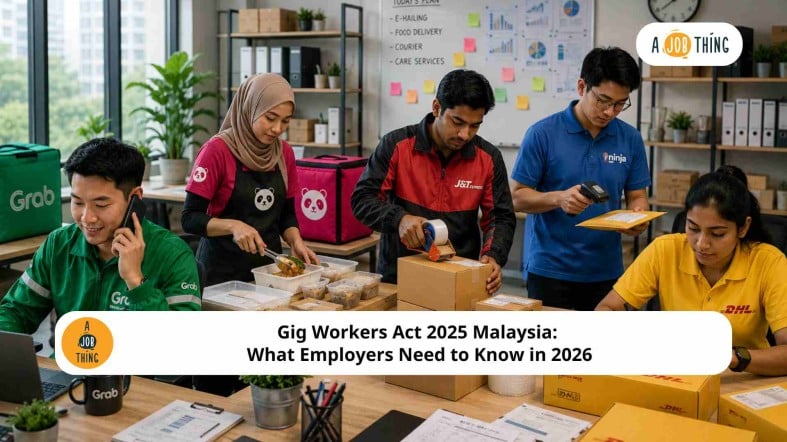
Gig Workers Act 2025 Malaysia: What Employers Need to Know in 2026

Are You Hiring?
Find candidates in 72 Hours with 5+ million talents in Maukerja Malaysia & Ricebowl using Job Ads.
Hire Now
Malaysia's gig economy has entered a new era with the implementation of the Gig Workers Act 2025 (Act 872).
Officially coming into force on 31 March 2026, the Act provides legal protection for more than 1.6 million gig workers across Malaysia while introducing new compliance requirements for platform providers and contracting entities.
For employers, HR teams, and businesses that engage gig workers, understanding the new rules is essential to avoid compliance risks and prepare for future regulatory changes.
In this guide, we'll explain what the Gig Workers Act 2025 is, who it applies to, employer responsibilities, worker rights, SOCSO contribution requirements, dispute resolution procedures, and what businesses should do next.
Gig Workers Act 2025 at a Glance
| Key Information | Details |
|---|---|
| Act Name | Gig Workers Act 2025 (Act 872) |
| Effective Date | 31 March 2026 |
| Workers Covered | More than 1.6 million gig workers |
| SOCSO Contribution Rate | 1.25% |
| Dispute Resolution Body | Gig Workers Tribunal |
| Advisory Body | Malaysian Gig Economy Council (MyGiG) |
What Is the Gig Workers Act 2025 (Act 872)?
The Gig Workers Act 2025 (Act 872) is Malaysia's first dedicated legislation governing gig work arrangements.
The Act was introduced to:
-
Protect the rights of gig workers
-
Regulate service agreements
-
Define responsibilities of contracting entities
-
Improve social security protection
-
Strengthen occupational safety standards
-
Establish dispute resolution mechanisms
-
Create the Gig Workers Tribunal
Unlike traditional employees who are protected under the Employment Act 1955, gig workers now operate under their own dedicated legal framework.
This allows Malaysia to regulate the growing gig economy while maintaining flexibility for both workers and businesses.
Gig Workers vs Employees in Malaysia
| Factor | Gig Worker | Employee |
|---|---|---|
| Governing Law | Gig Workers Act 2025 (Act 872) | Employment Act 1955 |
| Working Arrangement | Service Agreement | Employment Contract |
| Flexibility | High | Employer-controlled |
| Working Hours | Usually flexible | Usually fixed |
| EPF Contributions | Not mandatory under Act 872 | Mandatory |
| SOCSO Coverage | Self-Employment Social Security Scheme | Employer contributions required |
| Annual Leave | Not automatically provided | Statutory entitlement |
| Sick Leave | Not automatically provided | Statutory entitlement |
| Employment Status | Independent gig worker | Employee |
While gig workers enjoy greater flexibility, employers should understand that the Gig Workers Act introduces specific protections and compliance obligations that did not previously exist.
Why Was the Gig Workers Act Introduced?
Malaysia's gig economy has expanded significantly over the past decade.
Millions of Malaysians now earn income through:
-
Food delivery platforms
-
Courier services
-
Freelance marketplaces
-
Creative services
-
Care services
-
Media and content-related work
Before Act 872, there was no dedicated legislation specifically governing gig workers.
The new law addresses concerns relating to:
-
Income protection
-
Social security coverage
-
Unfair deactivation
-
Workplace safety
-
Dispute resolution
-
Transparency in platform operations
The goal is to create a more sustainable and secure gig economy while preserving flexibility for both workers and businesses.
Who Is Considered a Gig Worker?
Under the Act, a gig worker is a Malaysian citizen or permanent resident who:
-
Enters into a service agreement with a contracting entity
-
Performs services in exchange for earnings
-
Provides services through a platform provider or approved gig arrangement
Examples include:
-
Grab drivers
-
Food delivery riders
-
Freelance designers
-
Content creators
-
Care workers
-
Media professionals
Who Is Covered Under the Gig Workers Act?
| Category | Coverage Status |
|---|---|
| E-hailing drivers (e.g. Grab) | Covered |
| Food delivery riders | Covered |
| Parcel and courier delivery workers | Covered |
| Freelance creatives | Covered |
| Media professionals | Covered |
| Care service providers | Covered |
| Traditional employees under the Employment Act 1955 | Not Covered |
| Permanent employees | Not Covered |
The Gig Workers Act creates a separate legal framework for gig workers. This means gig workers are not automatically classified as employees and are governed by different rights and obligations compared to traditional employment arrangements.
Who Is a Contracting Entity?
A contracting entity refers to:
-
An individual
-
A company
-
An organisation
-
A platform provider
That engages a gig worker under a service agreement in exchange for payment.
Businesses that hire gig workers directly or through digital platforms may fall within this definition.
What Is a Platform Provider?
A platform provider is a digital intermediary system that connects gig workers with customers or service users.
Examples include:
-
E-hailing platforms
-
Delivery applications
-
Freelance marketplaces
-
Service booking platforms
Platform providers are subject to additional obligations under the Act.
What Must Be Included in a Service Agreement?
One of the most important requirements under the Act is the use of a proper service agreement.
Every service agreement should clearly state:
-
Parties involved
-
Duration of the agreement
-
Services to be provided
-
Obligations of each party
-
Earnings and payment rates
-
Payment methods
-
Benefits (if applicable)
-
Tips and gratuities (if applicable)
Any contractual term that is less favourable than the minimum protections provided under the Act may be void and replaced by the statutory provisions.
What Rights Do Gig Workers Have?
The Act introduces several important rights for gig workers.
Right to Information
Workers must be informed about:
-
Services to be performed
-
Payment rates
-
Payment methods
-
Contract terms
before accepting work.
Right to Timely Payment
Workers must receive earnings within the agreed payment period.
Right to Be Consulted
Gig workers should be informed and consulted regarding significant changes to service agreements.
Freedom of Association
Gig workers have the right to:
-
Join gig worker associations
-
Participate in association activities
-
Establish their own associations
Protection Against Discrimination
Contracting entities cannot discriminate against workers regarding working conditions, assignment of tasks, or earnings.
Protection Against Unfair Termination
Workers should not have their service terminated without just cause or excuse.
New Rules on Platform Algorithms and Automated Decisions
Platform providers must inform workers about:
-
Automated monitoring systems
-
Automated evaluation systems
-
Automated decision-making processes
Workers must also have access to a human review process when automated systems affect their work opportunities or conditions.
This increases transparency in how platform algorithms operate.
Can Platform Providers Suspend or Deactivate Workers?
Yes, but strict rules now apply.
A platform provider may suspend or deactivate a worker if:
-
The action complies with the service agreement; or
-
Misconduct has occurred.
Workers must generally receive:
-
Notice of the issue
-
An opportunity to be heard
-
Written explanations of decisions
Compensation During Investigations
If a worker is suspended while an investigation is conducted and the platform later determines there are no valid grounds for deactivation, the worker may be entitled to receive 50% of their average daily earnings during the suspension period.
Gig Worker SOCSO Contributions Under the Gig Workers Act
The Gig Workers (Social Security) Regulations 2026 introduce mandatory social security contribution requirements.
Platform providers must:
-
Register gig workers under the Self-Employment Social Security Scheme
-
Submit worker information to PERKESO
-
Implement contribution deduction mechanisms
-
Facilitate contributions on behalf of workers
What Is the Contribution Rate?
The contribution rate is set at 1.25%.
Platform providers are responsible for implementing the deduction process according to PERKESO requirements.
Is the Platform Paying Additional Employer Contributions?
Currently, the Act requires platform providers to facilitate deductions and contributions on behalf of workers.
It does not impose traditional employer-style social security contribution obligations similar to those applicable to employees.
Need to estimate workforce costs? Use SOCSO Calculator to estimate contributions and better understand hiring-related expenses.
Occupational Safety and Health Responsibilities
The Act extends occupational safety responsibilities into the gig economy.
Contracting entities must:
-
Conduct risk assessments
-
Implement risk control measures
-
Provide safety-related guidance
-
Ensure safe working conditions
-
Establish emergency procedures
-
Report occupational accidents and diseases
How Are Disputes Resolved?
The Act introduces a structured dispute resolution process.
Step 1: Internal Grievance Process
Workers may submit a written complaint to the contracting entity.
The contracting entity is generally expected to resolve the dispute within 30 days.
Step 2: Conciliation
If the issue remains unresolved, the matter may proceed to conciliation through the Ministry of Human Resources.
Step 3: Gig Workers Tribunal
If conciliation fails, the dispute can be referred to the Gig Workers Tribunal.
The Tribunal may order:
-
Recovery of earnings
-
Compensation
-
Compliance with service agreements
-
Refunds
-
Restoration of platform access
-
Other appropriate remedies
Tribunal decisions are legally binding.
How Can Gig Workers File a Complaint?
Workers experiencing issues such as:
-
Unpaid earnings
-
Contract disputes
-
Unfair deactivation
-
Service agreement violations
can take the following steps:
Internal Complaint
Submit a written complaint through the contracting entity's grievance mechanism.
e-Aduan System
If the issue remains unresolved, workers can submit a complaint through the Ministry of Human Resources' e-Aduan System.
Visit a Labour Office
Workers may also file complaints directly with relevant agencies under the Ministry of Human Resources.
Tribunal Proceedings
Where necessary, disputes may proceed to the Gig Workers Tribunal.
What Is the Malaysian Gig Economy Council (MyGiG)?
The Act establishes the Malaysian Gig Economy Council (MyGiG), a consultative body comprising representatives from government agencies, contracting entities, and gig workers.
Its responsibilities include advising the government on:
-
Minimum earnings rates
-
Industry standards
-
Regional differences
-
Future gig economy policies
This allows regulations to evolve alongside Malaysia's growing gig economy.
Gig Workers Act Compliance Checklist for Employers
Businesses that engage gig workers should:
Review Service Agreements
Ensure agreements contain all mandatory information required under the Act.
Review Worker Management Processes
Update onboarding, payment, suspension, and grievance procedures.
Prepare for PERKESO Compliance
Confirm systems can support contribution deductions and reporting obligations.
Train HR and Operations Teams
Managers responsible for gig workers should understand the new requirements.
Monitor Future Developments
Additional guidance may be issued through PERKESO, KESUMA, and MyGiG recommendations.
FAQs
Has the Gig Workers Act 2025 come into force?
Yes. The Act officially came into force on 31 March 2026.
Does the Act apply to all businesses?
The Act applies to contracting entities and platform providers that engage gig workers through service agreements.
What is the SOCSO contribution rate for gig workers?
The Gig Workers (Social Security) Regulations 2026 set the contribution rate at 1.25%.
Can a platform deactivate a worker without explanation?
No. The Act requires procedural safeguards, including notice, an opportunity to be heard, and written explanations.
What is MyGiG?
MyGiG is the Malaysian Gig Economy Council established under the Act to advise the government on gig economy matters.
Need to Hire Employees?
%20copy.jpg)
Post your job on AJobThing and reach qualified candidates across Malaysia faster.
Read More:
-
EOR vs PEO: What's the Difference and Which Is Right for Your Business?
-
Remote Job Offer Letter: What Employers Should Include (+ Example)
-
Job Offer Letter vs. Employment Contract: What's the Difference? (+ Free Templates)
-
Constructive Dismissal Malaysia: Meaning, Examples & What To Do
-
Contract of Service vs Contract for Service Malaysia: How to Classify Workers Correctly
-
Job Offer Letter Templates: Examples, Formats & Best Practices for HR
-
Employee Retention in Malaysia: Meaning, Importance & How to Improve It
-
Employee Turnover in Malaysia: Causes, Warning Signs & How to Reduce It
-
Retrenchment in Malaysia: Meaning, Process & Employee Rights
-
Gmail Templates for HR: Faster Replies for Interviews, Offers & Rejections
-
7 Key Contract Employee Rights in Malaysia Every HR Should Know
-
GLC vs Private Company Malaysia: Salary, Culture & Hiring Differences
-
Types of Payroll Calculation in Malaysia: Adhoc, Prorated Salary & Final Settlement Explained
-
Types of Payroll Cycle in Malaysia: Which One Is Best for Your Business?
-
Types of Insurance in Malaysia and Their Impact on Employee Benefits
-
How to Create a Strong Candidate Shortlist for Better Hiring Decisions
-
How HR in Malaysia Can Offer a Job Over the Phone (with Script)
-
How Notice Period Really Works in Malaysia for Employers and HR
-
How to Create a Job Posting That Attracts the Right Candidates
-
How HR in Malaysia Can Improve Resume Screening and Candidate Shortlisting
-
How HR Can Reject a Candidate the Right Way (with Templates)
-
How to Conduct a Background Check for Employment in Malaysia
-
Onboarding Process Tips: What HR Needs to Know for Better Retention
-
Onboarding Checklist for New Hires (Free Downloadable Template)
-
Performance Evaluation: Description, Types, and How to Conduct
-
Cover Letter Examples Employers Should Know (With Tips to Spot the Best Ones)
-
Step-by-Step Guide to Writing a Great Job Description (Free Templates)