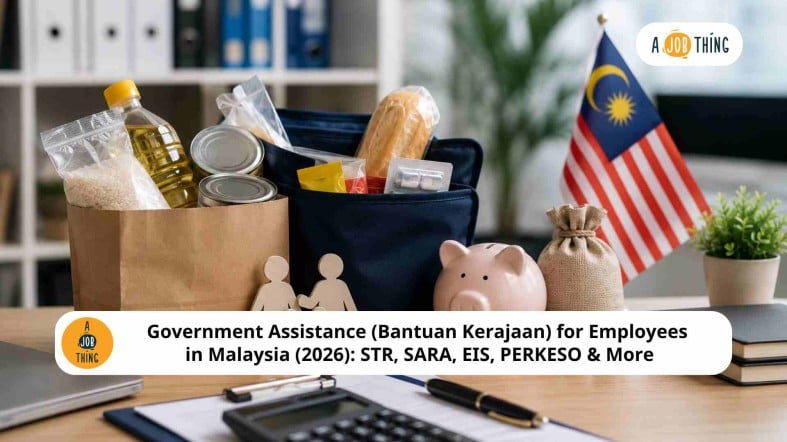
Government Assistance (Bantuan Kerajaan) for Employees in Malaysia (2026): STR, SARA, EIS, PERKESO & More

Are You Hiring?
Find candidates in 72 Hours with 5+ million talents in Maukerja Malaysia & Ricebowl using Job Ads.
Hire Now
Many employees struggle with rising living costs, financial stress, and unexpected emergencies. While salary is important, several government assistance and support programmes are available to help employees manage living costs, retirement planning, and unexpected situations such as job loss or workplace injuries.
For employers and HR teams, understanding these programmes can help:
-
Support employee wellbeing
-
Answer common employee questions
-
Improve financial literacy in the workplace
-
Direct employees to the right assistance programmes
-
Strengthen employee retention and engagement
This guide explains the key government assistance and support programmes that employees in Malaysia may qualify for in 2026.
Important: Employees must apply for most programmes individually. Employers cannot apply on their behalf. However, HR teams play a critical role in ensuring employees are informed and have the right documentation ready.
Quick Overview: Government Assistance Programmes 2026
|
Programme |
What You Get |
Who Qualifies |
How to Access |
|
STR |
Cash assistance — amount varies by category |
Eligible households and individuals based on income requirements |
Apply or update information via the STR Portal (bantuantunai.hasil.gov.my) |
|
SARA |
Assistance for purchasing essential goods |
Eligible STR recipients and Malaysians under SARA Untuk Semua |
Automatically credited via MyKad |
|
EIS |
Temporary financial support after job loss |
Employees who meet EIS contribution and eligibility requirements |
Claim via PERKESO ASSIST portal (assist.perkeso.gov.my) |
|
PERKESO |
Social protection and financial assistance |
Eligible employees covered under PERKESO schemes |
Claim via PERKESO portal or panel clinic |
|
i-Saraan |
Government incentive for voluntary EPF savings |
Self-employed individuals and gig workers |
Register via EPF (kwsp.gov.my or i-Akaun app) |
|
i-Suri |
Government contribution to EPF savings |
Eligible housewives registered under programme requirements |
Register via EPF (kwsp.gov.my or i-Akaun app) |
|
MyFutureJobs |
Job matching, reskilling, and career support |
Job seekers and retrenched workers |
Register at myfuturejobs.gov.my |
Sumbangan Tunai Rahmah (STR)
STR provides cash assistance to eligible Malaysians based on household income and family circumstances. Payments are typically distributed in tranches throughout the year following the annual federal budget announcement.
How Much Does STR Pay?
Payment amounts vary by recipient category and are announced annually by the government. The general breakdown is:
|
Category |
Payment Level |
|
Married couple with children (lower income household) |
Higher amount |
|
Married couple with children (middle income household) |
Moderate amount |
|
Single / bujang (aged 21+) |
Lower amount |
|
Senior citizen (aged 60+) |
Lower amount |
Note: Payment amounts are set annually and may change based on the federal budget. Always refer to the official STR portal at bantuantunai.hasil.gov.my for the latest confirmed amounts.
Who Qualifies for STR?
Eligibility is determined by the government based on factors such as:
-
Malaysian citizenship
-
Household income category
-
Marital status
-
Number of children
-
Information available in government databases and applications submitted through the STR portal
Because eligibility criteria and payment amounts may change from year to year, applicants should always refer to the official STR portal for the latest information.
How to Apply for STR
-
Check eligibility at bantuantunai.hasil.gov.my
-
If not automatically registered, apply via the portal with MyKad details
-
Ensure bank account details are updated in the system for payment crediting
-
Track payment status and announcement dates via the same portal
What HR Can Do
-
Share the STR portal link (bantuantunai.hasil.gov.my) with employees during Q1 when applications typically open
-
Assist employees in obtaining salary slips or employment confirmation letters as supporting documents
-
Remind employees to update their bank account details before each payment period
Sumbangan Asas Rahmah (SARA)
SARA provides assistance for purchasing essential goods using MyKad at participating stores. The amount of assistance and eligible items may vary depending on the recipient category and government announcements.
What Does SARA Provide?
Examples of approved items may include:
-
Rice
-
Bread
-
Eggs
-
Cooking oil
-
Milk
-
Flour
-
Other essential household items
Applicants should refer to the official SARA portal for the latest list of participating stores and eligible products.
Who Qualifies?
-
Eligibility for SARA depends on the requirements announced by the government. Certain STR recipients and eligible Malaysians may qualify for the programme.
-
SARA Untuk Semua extends the programme to a broader group of eligible Malaysians
-
No separate application is usually needed, assistance is automatically credited to eligible recipients via MyKad
-
Employees can check their status via the STR portal or at a participating store
What HR Can Do
-
Inform employees that SARA assistance is typically automatic for STR recipients
-
Share information on participating stores available at the official SARA portal
-
Remind lower-income employees to verify their MyKad balance at a participating outlet
Employment Insurance System (EIS)
EIS provides temporary financial support and reemployment assistance for workers who lose their jobs through retrenchment, redundancy, or company closure. It is one of the most important and most misunderstood employee protections in Malaysia.
Critical: EIS does NOT cover employees who resign voluntarily or are dismissed for misconduct. Only genuine retrenchment, redundancy, or company closure qualifies.
How Much Does EIS Pay?
The Job Search Allowance (JSA) is the main EIS benefit, paid for up to 6 months:
|
Month |
Job Search Allowance Rate |
Notes |
|
Month 1 |
80% of daily wages |
Highest payment |
|
Month 2 |
80% of daily wages |
|
|
Month 3 |
60% of daily wages |
|
|
Month 4 |
50% of daily wages |
|
|
Month 5 |
40% of daily wages |
|
|
Month 6 |
30% of daily wages |
Lowest payment |
Who Qualifies for EIS?
-
Malaysian citizens and permanent residents in the private sector
-
Must meet the contribution and eligibility requirements determined by PERKESO.
-
Job loss must be due to retrenchment, redundancy, or company closure — not resignation or misconduct
-
Must be actively seeking employment to continue receiving the allowance
How to Claim EIS
-
File a claim at assist.perkeso.gov.my within 60 days of the last working day
-
Submit supporting documents: termination letter, last payslip, MyKad copy
-
Attend career counselling at a PERKESO career centre if required
-
Receive monthly JSA payments for up to 6 months
-
Report job search activities monthly to continue receiving payments
60-day deadline: Employees who miss the 60-day claim window forfeit their EIS benefits. HR should inform retrenched employees of this deadline on their last working day.
What HR Must Do
-
Notify PERKESO via the ASSIST portal when retrenching employees, this speeds up claim processing
-
Issue a termination letter clearly stating the reason as 'redundancy' or 'retrenchment'
-
Provide retrenched employees with their last payslip and EA form promptly
-
Inform employees of the 60-day EIS claim deadline on their last working day
-
Ensure all EIS contributions are paid up to date, gaps can delay or affect the employee's claim
PERKESO Benefits
PERKESO provides social protection through several schemes for private sector employees. These are funded by SOCSO contributions deducted from monthly salaries. Many employees only discover their entitlements after an incident occurs.
The Five PERKESO Schemes Explained
|
Scheme |
What It Covers |
How to Access |
|
Employment Injury Scheme |
Covers medical costs and lost wages for injuries at work or while commuting. Includes permanent disablement benefits. |
Seek treatment at PERKESO panel clinic; report within 48 hours |
|
Invalidity Scheme |
Monthly pension for employees permanently unable to work due to illness or disability (not work-related), subject to contribution record. |
Apply via PERKESO ASSIST portal with medical documentation |
|
Medical Benefits |
Treatment costs at PERKESO panel clinics and hospitals for work-related injuries. |
Present PERKESO card at panel clinic |
|
Dependants' Benefits |
Monthly payments to spouse and children of employee who dies from a work-related accident. |
Family applies via PERKESO ASSIST portal or nearest PERKESO office |
|
Rehabilitation Support |
Physical and vocational rehabilitation to help injured workers return to employment. |
Referred by PERKESO after injury claim is approved |
Who Is Covered?
Most Malaysian and permanent resident employees in the private sector are covered under PERKESO schemes.
Certain PERKESO schemes also apply to foreign workers, depending on the specific scheme and applicable regulations. Employers should always refer to the latest PERKESO guidelines regarding foreign worker coverage.
How to Access PERKESO Benefits
-
Work-related injuries: seek treatment at a PERKESO panel clinic immediately and report within 48 hours
-
Invalidity claims: apply via the ASSIST PERKESO portal with medical documentation
-
Dependants' claims: family members apply at the nearest PERKESO office or via the portal
Full list of PERKESO panel clinics and scheme details: perkeso.gov.my
What HR Should Do
-
Display the PERKESO panel clinic list at the workplace
-
Train line managers to report workplace injuries within 48 hours late reporting may affect claim eligibility
-
Educate new employees during onboarding on what SOCSO deductions provide
-
Ensure SOCSO contributions are paid on time, gaps may affect invalidity scheme eligibility
i-Saraan — For Self-Employed and Gig Workers
i-Saraan is a voluntary EPF contribution programme for self-employed individuals and workers without fixed income, designed to support long-term retirement savings.
What Does i-Saraan Provide?
Under the latest programme:
-
The government provides an incentive equal to 20% of annual contributions
-
Maximum incentive: RM500 per year
-
Lifetime incentive limit: RM5,000
Participants may also enjoy:
-
Annual EPF dividends
-
Long-term retirement savings growth
-
Flexible voluntary contribution amounts — no minimum required
Who Qualifies?
-
Malaysian citizens aged 18 to 55
-
Self-employed, freelancers, gig workers, or anyone without a formal employer making EPF deductions
-
No minimum monthly contribution amount required
How to Register
-
Download the KWSP i-Akaun app or visit any KWSP branch
-
Register as a self-employed contributor under i-Saraan
-
Make voluntary contributions via the app, online banking, or at a KWSP counter
-
Government incentive is credited to the EPF account — check latest rates at kwsp.gov.my
What HR Can Do
-
Recommend i-Saraan to employees transitioning to freelance or gig work when leaving the company
-
Include i-Saraan information in offboarding packs for employees moving to self-employment
i-Suri — For Housewives
i-Suri is an EPF programme that helps eligible housewives build retirement savings, with contributions supported by the government.
What Does i-Suri Provide?
-
Government contribution credited directly to the housewife's EPF Account 1
-
The contribution amount and terms are set by EPF and the government — refer to kwsp.gov.my for the latest figures
-
Additional voluntary contributions can be made by the housewife at any time
Who Qualifies?
Eligibility requirements may change from time to time, but generally include:
-
Malaysian citizen
-
Registered with eKasih
-
Meets the eligibility requirements set by EPF and the government.
Applicants should always check the latest requirements directly with EPF at kwsp.gov.my or via the i-Akaun app.
How to Register
-
Housewife registers via the KWSP i-Akaun app or at any KWSP branch
-
Provide MyKad for verification
-
Once approved, government contribution is credited according to the programme schedule
What HR Can Do
-
Inform married employees that their non-working spouses may be eligible for i-Suri
-
Include i-Suri information in employee financial literacy sessions
MyFutureJobs — Employment and Reskilling Platform
MyFutureJobs (myfuturejobs.gov.my) is a free government job matching and career support platform run by the Ministry of Human Resources (MOHR).
What Does MyFutureJobs Offer?
-
Free job matching between job seekers and employers
-
Access to approved training and reskilling programmes
-
Career counselling and advisory services
-
Connection to PERKESO career support for retrenched workers
Who Can Use MyFutureJobs?
-
Job seekers — anyone actively looking for employment
-
Retrenched workers — directed here as part of the EIS claim and support process
-
Employers — can register and access various hiring and talent services through MyFutureJobs.
How to Register
-
Visit myfuturejobs.gov.my
-
Register as a job seeker or employer using MyKad or SSM number
-
Complete the skills profile for better job matching
What HR Can Do
-
Register your company on MyFutureJobs, free access to a broad candidate pool including retrenched workers
-
Refer retrenched employees to MyFutureJobs as part of responsible retrenchment practice
-
Include MyFutureJobs information in retrenchment exit packs alongside EIS claim instructions
What Documents HR May Need to Provide
When employees apply for government assistance, they may require documentation from their employer. Having these ready reduces delays and helps employees access support faster.
|
Programme |
Documents That May Be Required |
|
STR |
Salary slips, employment confirmation letter |
|
EIS |
Termination letter, last payslip, employment records |
|
PERKESO |
Accident report, medical documents, employment information |
|
MyFutureJobs |
Employment details and retrenchment information |
|
i-Saraan / i-Suri |
Usually applied directly by the individual — employer documents generally not required |
Tip: Preparing a standard set of HR documents (latest payslip, employment confirmation letter, termination letter template) in advance means you can respond quickly when an employee needs assistance.
How Employers Can Support Employees
Government assistance programmes should not replace employee benefits — but they can complement an employer's wellbeing strategy. Here is a practical action plan for HR teams:
|
Action |
Why It Helps |
What to Include |
|
Financial Wellbeing Guide |
Compile key programmes, eligibility criteria, and application links in one internal document |
Include: STR portal, EIS claim steps, PERKESO clinic list, i-Saraan for gig workers |
|
Annual Reminders |
Many employees miss deadlines because no one told them |
STR opens Q1; EIS claims within 60 days of job loss; EA forms by 28 February |
|
Onboarding |
New employees often don't know what their deductions are for |
Explain EPF, SOCSO, EIS purposes and what happens if they are retrenched |
|
Retrenchment Support |
Retrenched employees have a 60-day window to claim EIS — many miss it |
Notify PERKESO via ASSIST portal; issue termination letter stating 'redundancy'; release EA form promptly |
|
Financial Literacy Sessions |
Employees who understand their benefits experience less financial stress |
Cover STR eligibility, EIS claims, PERKESO protection, EPF account types |
Key point: The most impactful thing HR can do is ensure employees know these programmes exist and how to access them. Most employees who miss out on EIS, STR, or PERKESO benefits do so because no one informed them in time.
Which Government Assistance Programmes May Your Employees Qualify For?
Most government assistance programmes use household income as one of their eligibility criteria. The B40/M40/T20 classification helps identify which programmes an employee may be eligible for.
|
Household Income |
Income Category |
Examples of Assistance |
|
RM5,906 and below |
B40 |
STR, SARA, selected welfare programmes |
|
RM5,906 – RM12,567 |
M40 |
Certain assistance programmes depending on eligibility |
|
RM12,567 and above |
T20 |
Social protection schemes such as EIS and PERKESO |
Important: EIS and PERKESO benefits are generally available regardless of household income, provided contribution and eligibility requirements are met.
Sources
-
STR Portal: https://bantuantunai.hasil.gov.my/
-
SARA Portal: https://sara.gov.my/
-
PERKESO: https://perkeso.gov.my/
-
EPF (KWSP): https://www.kwsp.gov.my/en/
-
MyFutureJobs: https://myfuturejobs.gov.my/
FAQs
How do I check if I am eligible for STR?
You can check your STR eligibility and application status through the official STR portal using your MyKad number. If required, your employer may assist by providing supporting documents such as salary slips or employment confirmation letters.
How do employees claim EIS after retrenchment?
Employees should submit their EIS claim through the PERKESO ASSIST portal within 60 days of their last working day. Required documents generally include the termination letter, last payslip, and MyKad copy. Late submissions may affect eligibility for EIS benefits.
What is the difference between EIS and SOCSO / PERKESO?
SOCSO (through PERKESO) provides protection for work-related injuries, invalidity, and dependants' benefits. EIS specifically provides temporary financial support and employment assistance to eligible employees who lose their jobs. Although both are administered by PERKESO, they are separate schemes with different benefits and eligibility requirements.
Can part-time workers claim EIS?
Yes, provided they are Malaysian citizens or permanent residents working in the private sector and EIS contributions have been made on their behalf. Employees must also meet the eligibility requirements determined by PERKESO.
Is EIS considered government assistance?
No. EIS is a social protection scheme administered by PERKESO that provides temporary financial support to eligible employees who lose their jobs. It is funded through statutory contributions rather than direct government cash assistance.
Build a Stronger Workforce with AJobThing
%20copy.jpg)
Supporting employees goes beyond government assistance and payroll compliance. Hiring the right people is equally important to building a productive and engaged workforce.
At AJobThing, we connect employers with millions of job seekers across Malaysia, helping you find the right talent faster and hire with confidence.
Read More:
-
B40, M40 & T20 Malaysia: Latest Household Income Categories and Income Range (2026)
-
MyKad Online: How to Replace Your MyKad Through the JPN Portal
-
Touch n Go MyKad: How to Claim Your Balance After Getting a New MyKad
-
Geran LiKES TalentCorp 2026: RM2,000 Grant & 50% Reimbursement for Intern Hiring
-
Free SSM Registration for B40 & IPT Students Under SPPP 2026
-
Zakat Pendapatan Malaysia: Salary Deduction & Payroll Process for Employers
-
PADURI MADANI Scheme: Financial Assistance for B40 Women Entrepreneurs
-
MyKad Baru June 2026 Released: Do You Need to Change Your IC?
-
Bantuan B40 2026 Ikut Negeri: Full List Malaysia + Eligibility & How to Apply
-
5,900 Workers Affected by March Layoffs, Government Acts to Strengthen Employment Support
-
Malaysia Govt Saves RM678,000 in Fuel in 1 Week After WFH Policy
-
Malaysia Job Loss 2026 Rises 47% to 24,100 Retrenchments in Q1
-
Senarai Barang MyKasih (SARA 2026): What You Can Buy Using Your SARA Credit
-
Senarai Kedai MyKasih 2026: List of Stores That Accept SARA MyKad Assistance
-
Skim Jaminan Kredit Perumahan (SJKP): How Malaysians Can Buy a Home Without a Payslip
-
Semakan SARA 2026: Recipient Categories, Payment Dates and How to Use MyKad
-
SARA 2026 Malaysia Latest Updates and Official Announcements