
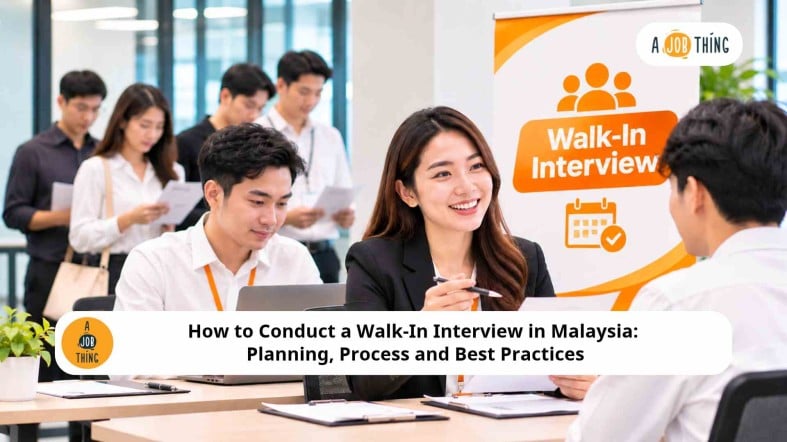
How to Conduct a Walk-In Interview in Malaysia: Planning, Process and Best Practices

Are You Hiring?
Find candidates in 72 Hours with 5+ million talents in Maukerja Malaysia & Ricebowl using Job Ads.
Hire Now
A walk-in interview is a recruitment event where jobseekers can visit a company's venue during a scheduled period and attend an interview without booking an individual appointment in advance. For Malaysian employers, it can be an effective way to recruit multiple employees at once, especially for retail, F&B, customer service, warehouse and operational positions. A successful walk-in interview requires proper planning, candidate registration, organised interview stations, clear assessments and timely follow-up.
Unlike traditional recruitment, where HR schedules individual interviews with shortlisted applicants, walk-in hiring allows companies to meet multiple candidates within a single event.
However, simply announcing an interview date and opening the door to applicants is not enough. Employers need to prepare the venue, assign interviewers, organise candidate flow and establish a consistent evaluation process.
This article explains how Malaysian HR teams and employers can organise a walk-in interview effectively, from planning the hiring event to selecting and following up with suitable candidates.
What Is A Walk-In Interview?
A walk-in interview is an in-person recruitment session where candidates visit an employer's specified location during announced hours to apply for a position and attend an interview.
Candidates usually do not need an individual appointment. Depending on the employer's arrangement, they may register on arrival, submit their resumes, complete an initial screening and proceed to an interview.
For example, a retail company in Kuala Lumpur planning to open three new outlets may organise a walk-in interview to recruit:
- Sales Assistants.
- Cashiers.
- Store Supervisors.
- Customer Service Staff.
- Outlet Managers.
Instead of arranging separate interviews across several days, HR can meet multiple potential candidates at one hiring event.
Walk-in interviews are particularly useful when companies need to recruit several employees within a short period.
When Should Employers Conduct A Walk-In Interview?
A walk-in interview is not suitable for every vacancy. Employers should consider the number of positions, candidate availability and complexity of the recruitment process before organising one.
Here are some situations where walk-in interviews can be useful.
High-Volume Recruitment
Companies that need to hire many employees for similar positions can use walk-in interviews to meet multiple candidates in one session.
For example, a manufacturing company may need 30 production operators for an upcoming production expansion.
A walk-in event allows HR to screen candidates, check their availability and conduct initial interviews in one organised setting.
Opening A New Business Branch
Businesses opening new retail outlets, restaurants, hotels or warehouses may need to recruit several employees at the same time.
A walk-in interview can help employers reach candidates near the new business location.
For example, a restaurant opening in Johor Bahru may organise a hiring event to recruit service crew, kitchen assistants and cashiers before its opening date.
Urgent Recruitment Requirements
Some businesses need to fill operational positions quickly because of employee resignations, increased customer demand or upcoming projects.
A walk-in interview can shorten the initial screening and interview process by allowing HR to meet available candidates directly.
However, employers should still complete the necessary assessments and hiring checks before making an employment decision.
Frontline And Operational Positions
Walk-in interviews are commonly suitable for positions where employers need to assess communication, customer service, practical skills and availability.
Examples include:
- Retail Assistants.
- Sales Executives.
- Restaurant Service Crew.
- Warehouse Assistants.
- Customer Service Representatives.
- Production Operators.
- Security Personnel.
For highly specialised or senior positions, scheduled interviews may be more suitable because candidates often need more detailed screening and technical assessments.
What Are The Benefits Of Conducting A Walk-In Interview?
A well-organised walk-in interview can help employers manage recruitment more efficiently.
Here are five potential benefits.
Meet Multiple Candidates In One Event
Rather than arranging individual interviews over several days, HR teams can meet multiple applicants within a scheduled hiring session.
This is particularly useful for businesses recruiting several employees for similar positions.
Speed Up Initial Candidate Screening
HR can review candidate qualifications, experience, availability and job interests during the event.
Candidates who meet the basic requirements can proceed to further interviews or assessments.
Improve Candidate Interaction
Face-to-face interviews allow employers to understand candidates' communication styles, job interests and expectations more directly.
Candidates can also ask questions about the company, job responsibilities and working arrangements.
Support Local Recruitment
Employers can organise walk-in interviews near their outlets, offices, factories or warehouses.
This may make it easier to reach candidates who live close to the workplace.
Support High-Volume Hiring
A structured event allows multiple interviewers to assess candidates simultaneously.
With proper planning, HR can manage several interview stations, registration counters and candidate assessment activities in one venue.
However, the number of candidates that can be interviewed depends on the venue capacity, interviewer availability and interview duration.
How To Plan A Walk-In Interview In Malaysia
Before announcing a hiring event, employers should prepare the recruitment requirements and event arrangements.
Here are the main steps to organise a successful walk-in interview.
Define Your Hiring Objectives And Positions
Start by identifying why the company needs to conduct a walk-in interview.
Determine:
- How many employees need to be hired?
- Which job positions are available?
- Which departments require additional staff?
- What qualifications and skills are needed?
- When should successful candidates start working?
- Is the company recruiting for one location or multiple branches?
For example, a retail company opening a new outlet may require:
| Job Position | Number Of Employees Needed |
| Sales Assistant | 8 |
| Cashier | 3 |
| Store Supervisor | 2 |
| Customer Service Staff | 2 |
| Total | 15 |
This helps HR estimate the number of interviewers, registration staff and assessment stations required.
HR Tip: Prepare the job descriptions, salary ranges, employment arrangements and selection criteria before advertising the event. This helps interviewers provide consistent information to candidates.
Choose The Right Date, Time And Venue
The event location can influence whether candidates are able to attend.
Choose a venue that is accessible, easy to find and suitable for the expected number of applicants.
Common walk-in interview venues include:
- Company offices.
- Retail outlets.
- Shopping malls.
- Hotel function rooms.
- Training centres.
- Conference rooms.
- Warehouse or factory meeting rooms, where appropriate.
When choosing a venue, consider the following:
| Venue Consideration | What To Check |
| Accessibility | Is the location easy to reach by public transport or car? |
| Parking | Is there sufficient parking for visitors? |
| Space | Can the venue accommodate candidates and interviewers? |
| Privacy | Are there separate areas for interviews? |
| Facilities | Are there sufficient tables, chairs, lighting and ventilation? |
| Internet | Is Wi-Fi available if digital registration is required? |
| Signage | Can candidates easily locate the registration area? |
Also consider the timing of the event.
For example, a walk-in interview for retail and F&B employees may benefit from a weekday or weekend session depending on the target candidates' availability.
Clearly state the event date, operating hours and venue details in every recruitment announcement.
Set A Hiring Budget And Estimate Event Capacity
Before organising the event, HR should estimate the budget and the number of candidates the team can realistically accommodate.
Possible expenses include:
- Venue rental.
- Tables and chairs.
- Banners and signage.
- Registration materials.
- Internet and technical equipment.
- Staff refreshments.
- Candidate assessment materials.
- Transportation and other event-related expenses.
You should also calculate the interview capacity.
For example, a company has four interviewers. Each interview takes approximately 15 minutes, with additional time for recording feedback and preparing for the next candidate.
Assuming each interviewer can handle three candidates per hour over six hours of actual interview time:
4 interviewers × 3 candidates × 6 hours = 72 interview slots.
This is the theoretical interview capacity. HR should leave additional time for delays, longer interviews and unexpected candidate arrivals.
A practical event plan should not assume that every interview slot will be used perfectly.
Promote The Walk-In Interview Before The Event
Once the venue, date and available positions are confirmed, start promoting the hiring event.
Employers can advertise through:
- Job portals and recruitment platforms.
- Company social media accounts.
- Facebook and WhatsApp community groups.
- Employee referrals.
- Posters and banners at business locations.
- Local colleges or training institutions, where relevant.
Your recruitment announcement should include all the information candidates need before attending.
| Information | What To Include |
| Company Name | Name of the employer |
| Event Title | Walk-In Interview or Hiring Day |
| Date | Interview date |
| Time | Start and closing time |
| Venue | Full address, building and floor |
| Available Positions | List of job vacancies |
| Job Requirements | Qualifications and experience |
| Salary | Salary range where available |
| Working Arrangements | Full-time, part-time, shifts or contract terms |
| Documents Required | Resume and relevant supporting documents |
| Contact Details | HR email address or contact number |
For example:
Walk-In Interview: Retail Assistants and Cashiers
- Date: 20 December 2026
- Time: 10:00 AM – 4:00 PM
- Location: Company Office, Kuala Lumpur
- Positions: Retail Assistants, Cashiers and Store Supervisors
- Requirements: Able to work shifts and weekends where required
- Bring: Updated resume and relevant certificates
- Contact: HR Department
Avoid using vague wording such as "Hiring Now, Come Anytime" without providing the actual location, job positions and interview hours.
Candidates should know what positions are available before travelling to the venue.
For more guidance, read How to Create a Job Posting That Attracts the Right Candidates.
Prepare Candidate Registration And Attendance Tracking
Every walk-in interview should have a clear registration process.
This helps HR record who attended, which position they applied for and what stage of recruitment they reached.
Candidates can register through:
- A physical registration form.
- A digital form.
- A QR code check-in system.
- A pre-registration form followed by on-site confirmation.
A simple candidate registration form can include:
| Registration Information | Purpose |
| Full Name | Identify the candidate |
| Contact Number | Follow up after the event |
| Email Address | Send recruitment updates |
| Position Applied For | Identify the preferred vacancy |
| Relevant Experience | Support initial screening |
| Preferred Location | Match candidates with available branches |
| Arrival Time | Monitor event attendance |
Keep the registration process simple so candidates do not spend too much time waiting before their interviews.
Employers should also prepare a backup attendance process in case the internet connection or digital check-in system is unavailable.
When collecting candidate information, explain how it will be used and protect it in accordance with Malaysia's Personal Data Protection Act 2010 (Act 709), where applicable.
Refer to the Personal Data Protection Department's guidance on personal data protection principles.
Set Up Interview Stations And Assign HR Responsibilities
If many candidates are expected, employers should organise separate stations to make the process easier to manage.
Each station should have a clear purpose.
For example:
| Interview Station | Responsibility |
| Registration | Record candidate details and attendance |
| Document Screening | Check resumes and basic job requirements |
| HR Interview | Assess experience, availability and job interest |
| Assessment | Conduct practical tests where required |
| Hiring Manager Interview | Evaluate role suitability and make recommendations |
| Final Follow-Up | Explain next steps and expected response timeline |
Not every company needs six separate stations. Smaller events may combine registration and screening or conduct the assessment during the interview.
HR should assign responsibilities before the event begins.
For example:
- Event Coordinator: Oversees the entire hiring event.
- Registration Staff: Manages candidate check-in.
- HR Recruiters: Conduct initial screening.
- Interviewers: Evaluate candidates.
- Hiring Managers: Review role-specific suitability.
- Event Support Staff: Guide candidates between stations.
Make sure every team member understands their responsibilities.
Prepare Interview Questions And Candidate Assessment Criteria
Interviewers should use consistent questions and evaluation criteria for candidates applying for the same position.
This helps HR compare candidates based on their suitability rather than personal impressions.
Before the event, prepare:
- A list of interview questions.
- Required qualifications and skills.
- Candidate evaluation forms.
- Interview scorecards.
- Role-specific practical assessments.
- Shortlisting criteria.
For example, a company recruiting Customer Service Executives may assess:
| Evaluation Criteria | What To Assess |
| Communication | Ability to communicate clearly |
| Customer Service | Understanding of customer needs |
| Problem-Solving | Ability to respond to customer issues |
| Work Experience | Relevant previous employment |
| Availability | Ability to meet the required work schedule |
| Professionalism | Appropriate workplace behaviour |
A simple scoring system can help interviewers evaluate candidates.
| Score | Rating |
| 1 | Poor |
| 2 | Below Expectations |
| 3 | Meets Expectations |
| 4 | Good |
| 5 | Excellent |
Use the same core evaluation criteria for candidates applying for the same position, while allowing interviewers to ask reasonable follow-up questions.
You can refer to AJobThing's Interview Questions to Ask Candidates in Malaysia: By Role, with Scoring Guide and Template.
Conduct Role-Specific Assessments
For certain positions, an interview alone may not provide enough information about a candidate's actual abilities.
Employers can introduce short, relevant assessments to evaluate practical skills.
Examples include:
| Job Position | Suggested Assessment |
| Sales Executive | Product pitching or customer role-play |
| Customer Service Executive | Responding to a sample customer complaint |
| Cashier | Basic numerical or POS-related exercise |
| Warehouse Assistant | Inventory handling knowledge questions |
| Production Operator | Basic machine and safety knowledge questions |
| Administrative Assistant | Data entry or spreadsheet exercise |
| Marketing Executive | Short campaign planning exercise |
Keep assessments relevant to the actual job requirements.
Explain the instructions clearly, apply consistent evaluation criteria and allow reasonable time for candidates to complete the exercise.
If the assessment involves actual productive work rather than a simulated exercise, employers should consider the appropriate employment and payment arrangements rather than assuming it can be treated as an unpaid interview test.
Prepare The Hiring Decision And Follow-Up Process
Before the event starts, decide what happens after a candidate completes the interview.
Some candidates may be shortlisted immediately, while others may require additional interviews, reference checks or management approval.
Possible recruitment outcomes include:
- Selected for the position.
- Shortlisted for a second interview.
- Requires additional assessment.
- Placed in a talent pool for future opportunities.
- Not suitable for the current vacancy.
HR should record the interviewer's recommendations and communicate the next steps to candidates.
Avoid promising an immediate job offer unless the hiring authority has approved the decision.
For successful candidates, confirm the employment terms, salary, working hours, reporting date and any relevant pre-employment requirements in the formal offer process.
For unsuccessful candidates, provide a polite update rather than leaving them without a response.
What Should HR Do On The Day Of The Walk-In Interview?
Once everything is prepared, HR should follow an event-day checklist to keep recruitment organised.
Here is an example schedule for a one-day hiring event.
| Time | Activity | Responsible Team |
| 8:00 AM – 8:30 AM | Venue setup and equipment checks | Event Coordinator |
| 8:30 AM – 9:00 AM | Interviewer briefing | HR Manager |
| 9:00 AM – 10:00 AM | Candidate registration and screening | Registration Team |
| 10:00 AM – 12:30 PM | Interviews and assessments | Interviewers |
| 12:30 PM – 1:30 PM | Lunch break and station reset | Event Team |
| 1:30 PM – 3:30 PM | Continue interviews and assessments | Interviewers |
| 3:30 PM – 4:00 PM | Final candidate reviews | HR and Hiring Managers |
| 4:00 PM – 4:30 PM | Candidate updates and event closing | HR Team |
This is an illustrative schedule. Employers should adjust it according to the number of candidates, interviewers and available positions.
Walk-In Interview Day Checklist

How To Measure The Success Of A Walk-In Interview?
Organising a walk-in interview is only part of the recruitment process. HR should also evaluate whether the event helped the company find suitable candidates.
Here are five useful recruitment metrics to monitor.
Candidate Attendance Rate
Measures the percentage of candidates who attended compared with those who registered in advance.
Attendance Rate = (Candidates Who Attended ÷ Total Registered Candidates) × 100
For example, 100 candidates registered and 75 attended.
Attendance Rate = (75 ÷ 100) × 100
Answer: 75%
For events that accept completely unregistered walk-ins, this metric may not be applicable.
Interview Completion Rate
Measures the percentage of checked-in candidates who completed their interviews.
Interview Completion Rate = (Candidates Who Completed Interviews ÷ Total Checked-In Candidates) × 100
Qualified Candidate Rate
Measures how many interviewed candidates meet the company's selection requirements.
Qualified Candidate Rate = (Qualified Candidates ÷ Candidates Interviewed) × 100
Offer Acceptance Rate
Measures how many candidates accepted the job offers made after the event.
Offer Acceptance Rate = (Accepted Job Offers ÷ Total Job Offers Made) × 100
Walk-In Hiring Conversion Rate
Measures how many interviewed candidates were successfully hired.
Hiring Conversion Rate = (Candidates Hired ÷ Candidates Interviewed) × 100
By tracking these metrics, HR can identify whether future walk-in events need improvements in candidate promotion, registration, interview capacity or selection criteria.
What Should HR Do After The Walk-In Interview?
The recruitment process should not end when the event finishes.
HR teams should complete several follow-up activities to ensure candidate records are updated and hiring decisions move forward.
Review Candidate Evaluation Results
Collect interview scorecards and assessment results from all interviewers.
Discuss shortlisted candidates with the relevant hiring managers and identify who should proceed.
Contact Shortlisted Candidates
Contact successful candidates to explain the next stage, such as a second interview, reference check or job offer.
Try to communicate within the response timeline given during the event.
Update Unsuccessful Candidates
Candidates who are not selected should receive a professional update.
Even when someone is not suitable for the current position, they may be relevant for other vacancies in the future.
Update Recruitment Records
Record the candidate's attendance, interview outcome, assessment results and recruitment status.
Limit access to candidate information and follow appropriate personal data protection and retention practices.
Evaluate The Event
Review the event's performance.
Consider:
- How many candidates attended?
- How many completed interviews?
- How many were shortlisted?
- How many job offers were made?
- How many candidates accepted?
- Which recruitment channels attracted the most suitable candidates?
- Were there any venue, registration or scheduling problems?
Use this information to improve future hiring events.
How AJobThing Smart Walk-In Can Help Employers Organise Hiring Events
Organising a walk-in interview involves several activities, from promoting vacancies and managing candidate attendance to reviewing interview outcomes.
For employers managing high-volume recruitment, AJobThing Smart Walk-In provides a dedicated solution to organise and manage walk-in hiring campaigns.
With AJobThing Smart Walk-In, employers can:
- Create a walk-in hiring campaign with event dates, interview hours, venue and available positions.
- Promote hiring events across Maukerja, Ricebowl and relevant campaign channels.
- Allow candidates to view event information before attending.
- Use QR code check-in to record candidate attendance and arrival times.
- View candidate information through a recruiter dashboard.
- Update candidate statuses and shortlist suitable applicants during the event.
The platform is particularly suitable for businesses recruiting retail, F&B, hospitality, customer service and frontline operational employees.
Instead of relying entirely on printed registration sheets and manual tracking, HR teams can manage important parts of the walk-in recruitment process digitally.
FAQs
What is a walk-in interview in Malaysia?
A walk-in interview is a recruitment session where candidates visit an employer's venue during specified hours to apply for available positions and attend interviews without booking individual appointments in advance.
What should employers prepare for a walk-in interview?
Employers should prepare the following before the event:
- Interview venue and schedule.
- Job descriptions and available vacancies.
- Candidate registration forms.
- Interview questions and evaluation scorecards.
- Assessment materials, where required.
- HR personnel and assigned interviewers.
- Event announcements with the date, time, location and required documents.
How many candidates can be interviewed in one day?
The number depends on several factors:
- Number of available interviewers.
- Average interview duration.
- Venue capacity.
- Total event hours.
- Time needed for registration and assessments.
Employers should calculate realistic interview capacity and allow extra time for unexpected delays.
What industries are suitable for walk-in interviews?
Walk-in interviews are particularly suitable for businesses with high-volume recruitment needs, including:
- Retail and wholesale.
- Food and beverage (F&B).
- Hospitality and hotels.
- Warehousing and logistics.
- Customer service.
- Security services.
- Manufacturing and production.
How should HR follow up after a walk-in interview?
HR should complete these activities after the event:
- Review interview scores and assessment results.
- Identify and contact shortlisted candidates.
- Send updates to unsuccessful applicants.
- Record candidate attendance and recruitment outcomes.
- Arrange further interviews or issue job offers where appropriate.
Following up promptly helps maintain a positive candidate experience and keeps recruitment activities organised.
Make Your Next Walk-In Hiring Day Easier With AJobThing

Discover AJobThing Smart Walk-In
Organise your hiring event, promote available positions and track candidate attendance through one platform.
With AJobThing Smart Walk-In, you can manage your walk-in campaigns and connect with jobseekers through Maukerja and Ricebowl.
Read More
- What Is a Walk-In Campaign?
- What Do I Need to Prepare for a Walk-In Interview?
- How to Create a Walk-In Campaign?
- How to Manage Your Walk-In Campaigns?
- Interview Questions to Ask Candidates in Malaysia: By Role, with Scoring Guide and Template
- How to Prepare for Interviews and Hire the Right Talent
- Candidate Screening: Methods, Tools and Best Practices for Employers
- 7 Interview Techniques Employers Must Know and Master
- Hiring F&B Staff in Malaysia: Recruitment, Training and Onboarding