
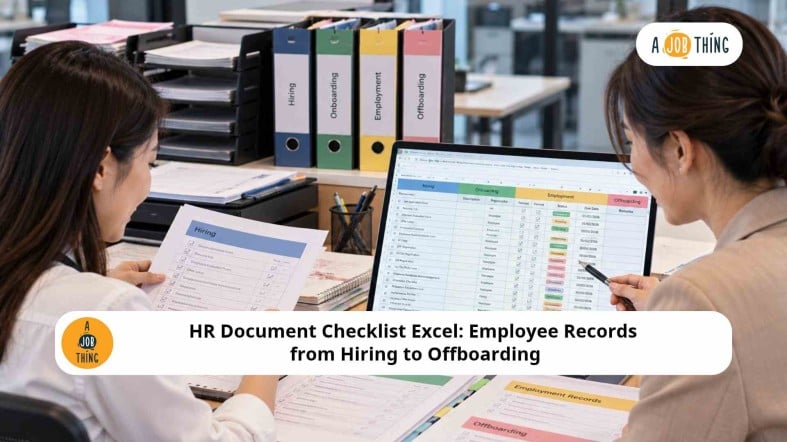
HR Document Checklist Excel: Employee Records from Hiring to Offboarding

Are You Hiring?
Find candidates in 72 Hours with 5+ million talents in Maukerja Malaysia & Ricebowl using Job Ads.
Hire Now
HR teams manage many documents throughout the employee lifecycle, from job applications and employment contracts to payroll records, performance reviews and resignation letters.
Without a clear system, important documents can become difficult to locate, employee information may become outdated, and records may be kept longer than necessary.
An HR document checklist in Excel helps employers organise employee records, assign responsible owners and schedule regular reviews. It also helps HR identify which records have specific legal retention requirements and which need an internal retention policy.
Download our free Excel template to organise employee records from recruitment to offboarding.
Download the Free HR Document Checklist Excel Template
Use our free Excel workbook to manage employee documentation throughout the employee lifecycle.

Download the Free HR Document Checklist Excel Template
The workbook includes four sheets:
-
Start Here: A summary of the workbook and key recordkeeping considerations.
-
Lifecycle Checklist: 42 checklist items covering recruitment, hiring, onboarding, employment, payroll, leave, performance, employee relations and offboarding.
-
Retention Guide: Guidance for 21 record categories, including known retention requirements, relevant conditions and review considerations.
-
Sources: Official Malaysian government and statutory-body references for checking retention requirements.
The checklist includes responsible owners, status dropdowns, review frequency, last-reviewed dates and automatically calculated next-review dates.
You can customise the workbook to reflect your company's HR procedures, document owners and review schedule.
What Employee Records Should HR Keep?
The records a company needs depend on its operations, workforce, industry and applicable legal requirements. The following categories cover common HR documentation needs.
| Employee Lifecycle Stage | Records to Track |
|---|---|
| Recruitment | Job requisitions, job descriptions, job advertisements, applications, CVs, interview notes and reference checks |
| Hiring | Offer letters, employment contracts, relevant employee particulars and employment terms |
| Onboarding | Onboarding checklists, policy acknowledgements, training records and equipment handover |
| Employment | Contract amendments, attendance, working hours, leave applications and approvals |
| Payroll and statutory contributions | Salary records, payslips, allowances, deductions, EPF, PERKESO, EIS and tax records, where applicable |
| Performance and development | Performance reviews, probation assessments, improvement plans and training records |
| Employee relations | Grievances, complaints, investigation records and disciplinary documents, where applicable |
| Offboarding | Resignation or termination documents, final payroll, handover records, asset returns and access removal |
Not every document is required for every employee. HR should collect information that is necessary for legitimate purposes and maintain records according to the applicable requirements.
Why Is Proper HR Documentation Important?
A consistent documentation process helps HR manage employee information and workplace decisions more effectively.
Easier record retrieval: HR can locate employment contracts, payroll records and employee information without searching through scattered emails and files.
Better decision-making: Documented performance reviews, feedback and agreed actions provide useful context when managers assess progress or address concerns.
More consistent HR processes: Standard forms help managers follow the same process for recruitment, onboarding, leave administration and offboarding.
Stronger compliance management: A structured recordkeeping process helps HR identify relevant statutory obligations, outstanding documents and upcoming reviews.
Improved accountability: Assigning an owner to each record helps make sure someone is responsible for maintaining and reviewing it.
How Long Should HR Keep Employee Records in Malaysia?
There is no single retention period that applies to every HR document in Malaysia. Different records may be governed by employment, EPF, PERKESO, tax, data protection or industry-specific requirements.
The following table summarises key requirements that HR teams should consider.
| Record Type | Retention Requirement or Guidance |
|---|---|
| Prescribed employment register particulars | Under Section 61 of the Employment Act 1955 framework, the register must be preserved so that each particular remains available for inspection for at least six years after it is recorded, where the requirement applies. |
| EPF wage and salary records | At least six years from the date the last information was recorded, according to KWSP guidance. |
| PERKESO employee and contribution records | Seven years from the last entry date, according to PERKESO guidance. |
| Employer tax records | LHDN states that employers must maintain records for seven years and keep them accessible for inspection. Check the applicable tax rules for the relevant records and period. |
| Recruitment records and unsuccessful applicants | No single general retention period was confirmed for every item in the official sources reviewed. Set a documented period based on the purpose, applicable requirements and business needs. |
| Performance, disciplinary, medical and training records | Requirements can vary by record type, applicable legislation, industry and circumstances. Check specific requirements before setting a retention period. |
These periods apply to the relevant records and requirements, not automatically to an employee's entire file. The start date used to calculate a retention period can also differ by record type.
Employment Register Records
Under Section 61 of the Employment Act 1955 framework, employers must maintain prescribed employee-register particulars and preserve them so each particular remains available for inspection for at least six years after recording.
The Employment Regulations 1957 set out employee particulars that must be included in the register.
This requirement should not be interpreted as a six-year retention rule for every document in an employee file. Employers must identify the specific records covered by the applicable requirement.
The Employment Act 1955 framework applies in Peninsular Malaysia and Labuan, while Sabah and Sarawak have their own labour ordinances. Employers should check the legislation relevant to their location.
EPF, PERKESO and Payroll Records
Statutory contribution and payroll records have specific recordkeeping requirements.
-
EPF: KWSP states that employers must keep wage and EPF records for at least six years from the date the last information was recorded. Refer to KWSP's employer recordkeeping guidance.
-
PERKESO: Employers must maintain specified employee and contribution records for seven years from the last entry date. Refer to PERKESO's employer guidance.
-
Income tax: LHDN requires employers to maintain records for seven years. Refer to LHDN's employer responsibilities.
When records serve more than one purpose, HR and payroll teams should check every applicable requirement before deciding when the records can be destroyed.
Recruitment and Candidate Records
CVs, applications, interview notes, assessment results and reference checks contain personal information.
HR should establish a documented retention schedule for recruitment records, including applications from unsuccessful candidates. The schedule should reflect why the information is needed, how long it remains useful and any applicable legal or business requirements.
For organisations and records within its scope, Malaysia's Personal Data Protection Standard 2015 requires organisations to take reasonable steps to destroy or permanently delete personal data when it is no longer required for its processing purpose, while accounting for other legal retention requirements.
Refer to the Personal Data Protection Standard 2015.
HR should not retain every candidate's CV indefinitely simply because the person might apply for another vacancy.
Performance, Medical and Employee Relations Records
Performance reviews, improvement plans, grievances, investigation notes and medical records may contain sensitive information.
The official sources reviewed do not establish one universal retention period for every document in these categories. The appropriate period may depend on specific legislation, industry requirements, the purpose of the record and the circumstances involved.
HR should maintain a documented policy, restrict access to authorised personnel and check whether an audit, complaint, investigation, claim or legal hold requires records to be preserved.
How HR Can Keep Employee Records Organised
A checklist is most effective when supported by clear recordkeeping procedures.
Use a consistent file structure. Organise records into categories such as recruitment, employment, payroll, leave, performance, training and offboarding.
Assign a responsible owner. HR, Payroll, Finance, IT, hiring managers and other departments may have different responsibilities. Make these responsibilities clear.
Schedule regular reviews. Review whether records are complete, accurate, current and still required. Set review dates for document categories and recordkeeping processes.
Control access to sensitive information. Restrict access based on job responsibilities. Payroll, medical and disciplinary records may require stricter controls than general company policies.
Update records when circumstances change. Record relevant changes to job titles, departments, employment terms, salary, working arrangements and employment status.
Separate review dates from disposal dates. A review date reminds HR to check a record or process. A disposal date must be calculated using the applicable retention rule and should account for any legal hold.
Keep disposal records. Document approved disposal decisions and use secure methods to destroy physical documents or permanently delete digital records when disposal is authorised.
FAQs
What documents should HR keep in an employee file?
Common records include employment contracts, relevant personal details, payroll information, leave and attendance records, performance reviews, training records and offboarding documents. Recruitment and employee-relations records may also be maintained where appropriate.
How long should HR keep employee records in Malaysia?
The period depends on the record type and applicable law. For example, specified employment-register particulars generally have a six-year preservation requirement under the Employment Act 1955 framework, EPF wage records have a six-year requirement, and PERKESO employee records have a seven-year requirement from the last entry date.
Should HR keep employee records after someone leaves the company?
Some records may need to be retained after employment ends because of employment, payroll, tax, contribution, privacy or other legal requirements. HR should review each category separately rather than keeping all records indefinitely.
Does the same retention period apply to every HR document?
No. Different records can have different retention rules, and some categories do not have one universal period confirmed in the sources reviewed. HR should check the relevant requirements and document its retention policy.
Keep Your HR Processes Organised with AJobThing

Good HR documentation helps employers manage employee information, maintain clear records and support consistent workplace processes.
When your company is ready to grow, a structured recruitment process can also help you reach suitable candidates and manage your hiring activities more effectively.
Post a job ad with AJobThing to connect with jobseekers across Malaysia.
Read More
-
Employee Onboarding: What It Is, How to Do It and Free Checklist
-
Onboarding Checklist for New Hires: Free Downloadable Template
-
Salary Slip and Payslip Malaysia: Format, Sample and Free Download
-
Leave Management System for Malaysian Employers: Free Template
-
Probation Performance Review in Malaysia: How HR Can Evaluate Employees
-
Employee Transfer Letter Malaysia: Sample for Department, Role and Branch Transfer