
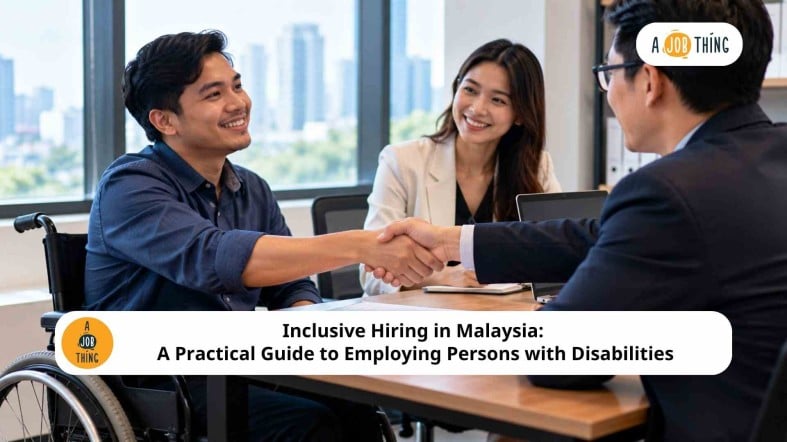
Inclusive Hiring in Malaysia: A Practical Guide to Employing Persons with Disabilities

Are You Hiring?
Find candidates in 72 Hours with 5+ million talents in Maukerja Malaysia & Ricebowl using Job Ads.
Hire Now
Hiring the right employees means looking beyond a candidate's background and focusing on their skills, experience and ability to perform the job. For Malaysian employers, inclusive hiring is an opportunity to reach more talent and create a workplace where employees can contribute and grow.
However, some employers may be unsure how to write inclusive job advertisements, conduct accessible interviews or provide suitable workplace support.
Inclusive hiring does not mean lowering recruitment standards. It means removing unnecessary barriers so qualified candidates, including persons with disabilities, have a fair opportunity to apply, demonstrate their abilities and succeed at work.
Here is how employers and HR teams in Malaysia can build a more inclusive hiring process.
What Is Inclusive Hiring?
Inclusive hiring is a recruitment approach that gives candidates a fair opportunity to apply for jobs and demonstrate their suitability, regardless of disability or other personal characteristics.
In Malaysia, persons with disabilities are commonly referred to as Orang Kurang Upaya (OKU).
Disabilities may include physical, visual, hearing, speech, learning and psychosocial disabilities, among others. Some disabilities are visible, while others may not be immediately apparent.
Depending on the role and the individual's needs, a suitable candidate may benefit from adjustments such as accessible interview arrangements, assistive technology, written instructions or a modified workstation.
The purpose is to assess candidates fairly based on relevant job requirements rather than assumptions about what they can or cannot do.
Why Inclusive Hiring Matters for Malaysian Employers
Inclusive recruitment can benefit both employers and employees in several ways.
1. Reach a Wider Talent Pool
Limiting recruitment to candidates who follow one particular application process or work in one particular way may exclude people with suitable skills and experience.
Making job advertisements, interviews and application channels more accessible can help employers reach a wider range of candidates.
2. Build a More Inclusive Workplace
Employees are more likely to participate when they feel respected and have the tools they need to perform their jobs.
Inclusive practices also encourage managers to communicate expectations clearly and consider different working needs across the team.
3. Improve Recruitment Practices
Reviewing hiring barriers encourages HR teams to distinguish between essential job requirements and preferences that may not be necessary.
For example, a role that mainly involves analysing data may not require frequent travel or prolonged standing. Removing these unnecessary requirements can help employers focus on the skills that actually matter.
4. Support Fair Employment Opportunities
Malaysia's Persons with Disabilities Act 2008 recognises the right of persons with disabilities to access employment on an equal basis. Employers should consider fair recruitment, suitable working conditions and equal opportunities when developing their HR practices.
How to Hire Persons with Disabilities in Malaysia
Step 1: Review the Job Requirements
Start by identifying the essential duties and skills required for the position.
Consider whether every requirement in the job description is necessary to perform the job effectively.
For example, if a position involves customer service through email and chat, strong written communication skills may be more relevant than the ability to speak on the telephone.
Review the following before advertising a vacancy:
-
Essential duties and responsibilities
-
Required technical and communication skills
-
Working hours and location
-
Physical tasks that are genuinely necessary
-
Available workplace adjustments
Keep the selection criteria consistent and relevant to the role.
Step 2: Write an Inclusive Job Advertisement
A job advertisement is often the first point of contact between an employer and a potential candidate. Its language can influence who feels encouraged to apply.
Avoid requirements that unnecessarily exclude people with disabilities.
| Avoid | Better Approach |
|---|---|
| Must be physically fit | State the specific physical tasks required, if relevant. |
| Must have excellent hearing | Describe the actual communication duties and available communication methods. |
| Must be able to work without assistance | Explain the job responsibilities and performance expectations. |
| Looking for a normal and healthy candidate | Describe the relevant skills, qualifications and experience. |
| Must be able to drive | Include this requirement only if driving is essential to the role. |
Employers should also explain the application process clearly and provide contact details for candidates who need an alternative application format or interview arrangement.
Read our related guide: How HR in Malaysia Can Remove Bias from Job Ads.
Step 3: Make the Application Process Accessible
Review whether candidates can complete every stage of the recruitment process without facing unnecessary barriers.
Practical improvements include:
-
Offering an alternative way to submit an application if the online process is inaccessible.
-
Using application forms that work with assistive technology where possible.
-
Providing interview details and instructions in advance.
-
Asking candidates whether they require any adjustments for the interview.
-
Making sure the interview venue is accessible to candidates who need it.
Employers should avoid assuming what assistance a candidate needs. Ask the candidate directly and discuss suitable arrangements with them.
Step 4: Conduct Fair and Accessible Interviews
An interview should help employers assess whether a candidate can perform the role.
Use structured questions and consistent assessment criteria for all candidates applying for the same position.
Depending on the candidate's requirements, reasonable interview adjustments may include:
-
Providing written questions or instructions.
-
Allowing additional time for an assessment where appropriate.
-
Arranging an accessible interview location.
-
Providing captions or an interpreter when needed.
-
Offering a suitable alternative to an assessment that creates an unrelated accessibility barrier.
Focus on the candidate's skills, experience, problem-solving ability and relevant qualifications.
Avoid asking personal questions about a disability unless the information is genuinely necessary and there is a lawful basis to request it. Where appropriate, discuss the job's requirements and any support needed to perform them.
Step 5: Provide Suitable Workplace Adjustments
Workplace adjustments help employees perform their responsibilities effectively.
The appropriate arrangements depend on the person's needs and the job itself. They may include:
| Type of Adjustment | Examples |
|---|---|
| Physical Accessibility | Accessible entrances, suitable workstations and clear pathways |
| Assistive Technology | Screen readers, magnification software or adapted keyboards |
| Communication | Captions, written instructions or sign language interpretation |
| Work Arrangements | Flexible scheduling, adjusted breaks or remote work where suitable |
| Work Environment | Reduced background noise, suitable lighting or a quieter workspace |
| Workplace Safety | Accessible emergency information and evacuation procedures |
Not every employee will require adjustments, and not every adjustment will be appropriate for every role.
HR should discuss the options with the employee, assess what is practical and review whether the arrangements are working.
Step 6: Make Onboarding and Training Inclusive
Inclusive hiring should continue after an employee accepts a job offer.
Prepare the employee's workstation, system access and any agreed adjustments before their first day where possible.
Managers should also explain the employee's responsibilities, performance expectations, reporting lines and available support.
Provide training in accessible formats where possible and ensure the employee has the same opportunity to participate in meetings, development activities and career progression.
Avoid making assumptions about an employee's capabilities based solely on their disability. Discuss performance and development using the same relevant standards applied to other employees.
Where Can Malaysian Employers Get Support?
Employers do not need to manage every aspect of inclusive recruitment alone. Several Malaysian organisations provide relevant resources and assistance.
1. JKM Job Coach Programme
The Department of Social Welfare (Jabatan Kebajikan Masyarakat, JKM) provides a Job Coach programme to support persons with disabilities in the open employment market.
The programme can help with candidate assessment, workplace assessment, job matching, support and follow-up.
Employers can explore the service through district social welfare offices, the Industrial Training and Rehabilitation Centre (PLPP) in Bangi or Community-Based Rehabilitation Centres (PPDK).
Official resource: Job Coach Programme.
2. MYFutureJobs and PERKESO
MYFutureJobs provides employment-related services and information for employers, including support for recruiting persons with disabilities.
Its employer resources describe candidate assessment, skills development and employer engagement activities that can help organisations explore inclusive recruitment.
Visit MYFutureJobs' PWD Employer Resources for more information about available support.
Check the relevant programme's latest eligibility criteria and application period before relying on any financial incentive, as programme conditions may change.
Inclusive Hiring Checklist for HR
Use this checklist when preparing a vacancy and reviewing your recruitment process.
| No. | Checklist Item | Completed |
|---|---|---|
| 1 | Ensure job requirements focus on essential duties, skills and qualifications. | ☐ |
| 2 | Use respectful, inclusive language in job advertisements. | ☐ |
| 3 | Provide clear and accessible application instructions. | ☐ |
| 4 | Allow candidates to request suitable interview adjustments. | ☐ |
| 5 | Use consistent interview questions and assessment criteria. | ☐ |
| 6 | Check workplace accessibility and identify possible adjustments. | ☐ |
| 7 | Train hiring managers to communicate respectfully with persons with disabilities. | ☐ |
| 8 | Ensure onboarding, training and career development offer fair opportunities. | ☐ |
| 9 | Handle candidates' and employees' personal information confidentially. | ☐ |
| 10 | Review recruitment practices regularly to identify and remove unnecessary barriers. | ☐ |
FAQs
What does OKU mean in Malaysia?
OKU stands for Orang Kurang Upaya, the term commonly used in Malaysia for persons with disabilities. It includes people with different types of disabilities, and individual support requirements may vary.
Are Malaysian employers required to hire persons with disabilities?
Malaysia's Persons with Disabilities Act 2008 recognises access to employment on an equal basis. The government's policy setting a minimum target of 1% OKU appointments relates to the public sector. Employers should check the current legislation, applicable policies and any sector-specific requirements relevant to their organisation.
What adjustments can employers provide to employees with disabilities?
Depending on the role and the employee's needs, adjustments may include accessible workstations, assistive technology, alternative communication formats, flexible working arrangements or changes to the work environment.
Discuss suitable arrangements directly with the employee rather than assuming what they need.
Where can employers find support for hiring persons with disabilities?
Employers can contact JKM to explore its Job Coach programme or use MYFutureJobs and PERKESO employment services. Available support and programme eligibility should be confirmed with the relevant organisation.
Should employers use different performance standards for employees with disabilities?
Performance standards should be based on the essential duties and expected outcomes of the role. Employers should provide appropriate support and adjustments where suitable while assessing performance fairly and consistently.
Make Inclusive Hiring Part of Your Recruitment Strategy
%20copy.jpg)
Reach a wider talent pool by creating clear, inclusive job advertisements that focus on skills and qualifications.
Create and post your job ads with AJobThing to connect with more qualified candidates.
Read More:
-
Elaun Tanggung Kerja: Meaning, Eligibility, Rate and How to Calculate
-
Malaysia Minimum Wage 2026: Proposed Hike, MSME Exemption & Budget 2027 Update
-
Annual Bonus in Malaysia: How Employers Can Calculate, Structure & Pay Bonuses
-
Employee Transfer Letter Malaysia: Sample for Department, Role & Branch Transfer
-
Public Holidays in Malaysia 2027: Full List by Date and State for Workplace Planning
-
Job Requisition: What It Is, What to Include & How HR Can Create One
-
Candidate Experience Survey: Questions, Examples & How to Improve Recruitment
-
Staff Immediate Resignation in Malaysia: Employer Rights & Responsibilities
-
How to Manage Underperforming Employees in Malaysia: Tips for Employers & HR
-
Warning Letter for Poor Performance in Malaysia: How to Write One (With Sample)
-
Can Employers Reject Annual Leave in Malaysia? Rights, Rules & Employee Entitlements
-
Payroll and Attendance Management in Malaysia: Process, Formula & Best Practices for Employers
-
Workplace Conflict Management in Malaysia: Causes, Solutions, and Best Practices
-
Recruitment Process Outsourcing (RPO): What It Is, Benefits & How It Works in Malaysia
-
Leave Encashment Malaysia: How to Calculate Unused Annual Leave
-
Performance Bonus in Malaysia: How It Works, Calculation & Employer Guide
-
Cost Per Hire Malaysia: Formula, Examples & How Employers Can Reduce Hiring Costs
-
Letter of Extension of Contract Malaysia: Free Template, Format & Sample
-
Promotion Letter in Malaysia: How to Write One (+ Free Template & Sample)
-
Talent Pool: Benefits, Examples & How to Build One for Better Hiring
-
Overtime Rates in Malaysia: When Do 1.5x, 2x and 3x Pay Apply?
-
Prorated Salary in Malaysia: How to Calculate an Employee's First Salary
-
Remote Jobs in Malaysia: Most In-Demand Roles, Salaries & Hiring Guide (2026)
-
Effective Ways to Reduce Absenteeism in the Workplace for HR & Employers
-
Medical Benefits for Employees in Malaysia: Types, Legal Requirements & Best Practices
-
EOR vs PEO: What's the Difference and Which Is Right for Your Business?
-
Constructive Dismissal Malaysia: Meaning, Examples & What To Do
-
Contract of Service vs Contract for Service Malaysia: How to Classify Workers Correctly
-
Employee Retention in Malaysia: Meaning, Importance & How to Improve It
-
Employee Turnover in Malaysia: Causes, Warning Signs & How to Reduce It
-
Retrenchment in Malaysia: Meaning, Process & Employee Rights
-
7 Key Contract Employee Rights in Malaysia Every HR Should Know
-
GLC vs Private Company Malaysia: Salary, Culture & Hiring Differences
-
Types of Payroll Calculation in Malaysia: Adhoc, Prorated Salary & Final Settlement Explained
-
Types of Payroll Cycle in Malaysia: Which One Is Best for Your Business?
-
Types of Insurance in Malaysia and Their Impact on Employee Benefits
-
How Notice Period Really Works in Malaysia for Employers and HR
-
Performance Evaluation: Description, Types, and How to Conduct