
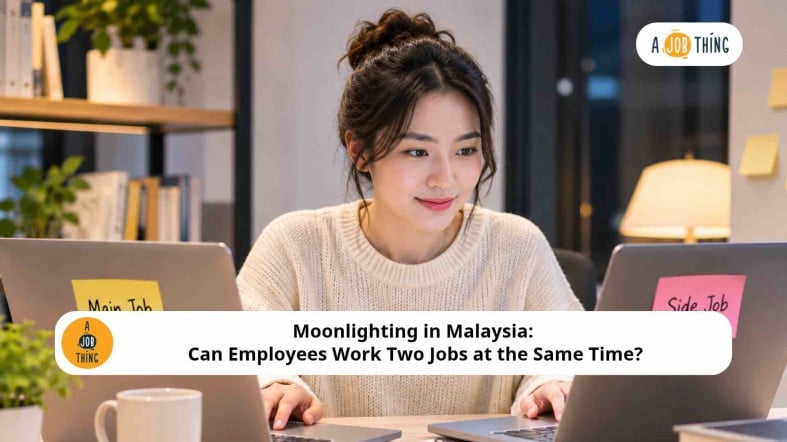
Moonlighting in Malaysia: Can Employees Work Two Jobs at the Same Time?

Are You Hiring?
Find candidates in 72 Hours with 5+ million talents in Maukerja Malaysia & Ricebowl using Job Ads.
Hire Now
Some employees take on a second job to earn extra income, gain experience or explore other career opportunities. They may work part-time, freelance, run an online business or accept another full-time job.
For employers and HR teams, this raises an important question: Can employees in Malaysia work two jobs at the same time?
Having a second job is not automatically prohibited for every private-sector employee in Malaysia. However, it can become a workplace issue if it breaches the employment contract, creates a conflict of interest, affects work performance or involves the misuse of company information.
This guide explains what Malaysian employers should know about moonlighting, how to manage outside employment and what to include in a company policy.
What Is Moonlighting?
Moonlighting means having another job or earning additional income while keeping an existing job.
It can involve working for another employer, providing freelance services or running a small business outside normal working hours.
Here are some common examples:
| Type of Moonlighting | Example |
| Second full-time job | An employee works for two different companies |
| Part-time job | An office employee works at a restaurant during weekends |
| Freelance work | A marketing executive takes freelance design projects after office hours |
| Online business | An employee sells products through Shopee or TikTok Shop |
| Gig work | An employee drives for Grab or provides delivery services after work |
| Side business | An employee runs a small business outside normal working hours |
Not every additional income activity creates a problem for an employer. The main concern is whether the activity affects the employee's existing responsibilities or the company's legitimate business interests.
Can Employees Legally Work Two Jobs In Malaysia?
For private-sector employees, the Employment Act 1955 does not set out a general one-job-only rule that automatically prevents employees from holding a second job.
However, this does not mean employees can accept any outside work without considering their existing employment obligations.
Their employment contract, company policies and responsibilities to their employer may contain conditions about outside employment, conflicts of interest and disclosure.
For example, an employment contract may require employees to:
- Obtain written approval before accepting certain outside employment.
- Inform HR about business activities that may create a conflict of interest.
- Avoid working for direct competitors.
- Protect confidential company information.
- Make sure outside activities do not interfere with their main job.
This means employees should check their employment terms before accepting another job.
What About Government Employees?
Public officers are subject to separate rules.
Under Regulation 5 of the Public Officers (Conduct and Discipline) Regulations 1993, public officers generally need prior written permission from their Head of Department before undertaking outside employment or certain business activities.
The approval process considers whether the outside activity:
- Takes place outside official working hours.
- Affects the officer's ability to perform their duties.
- Conflicts with the interests of the public service.
For more details, refer to the Public Service Department (JPA) guidelines on outside employment.
Important for Malaysian employers: The Employment Act 1955 applies to Peninsular Malaysia and Labuan. Sabah and Sarawak have their own Labour Ordinances. Employers should check the legislation applicable to the employee's work location.
Official References:
- Employment Act 1955, updated text by the Attorney General's Chambers
- Labour Ordinance of Sabah, Department of Labour Sabah
- Labour Ordinance of Sarawak, Department of Labour Sarawak
What Should Employers Consider Before Allowing Moonlighting?
A second job does not automatically mean an employee is doing something wrong. HR should look at the nature of the outside work and whether it creates any genuine business concerns.
Conflict Of Interest
A conflict of interest happens when an employee's outside activity may interfere with their responsibilities or the interests of their main employer.
For example, an employee working in sales for a technology company may also work for a direct competitor.
This can create concerns about customer information, business opportunities and the employee's ability to act in their current employer's interests.
HR should pay attention to outside activities involving:
- Direct competitors.
- Existing customers or suppliers.
- Similar products or services.
- Business opportunities connected to the employee's position.
A second job that has no connection to the employer's business may present a lower risk, depending on the circumstances.
Work Performance And Attendance
Employees are still expected to complete their duties and meet the performance requirements of their main job.
Moonlighting may become a problem when employees frequently arrive late, miss deadlines, become absent or struggle to complete their responsibilities because of another job.
For example, an employee who regularly works late-night shifts elsewhere may become tired and less productive during normal office hours.
HR should focus on actual attendance and performance issues rather than assuming that every second job will affect an employee's work.
Confidential Company Information
Employees may have access to important company information, including:
- Customer and supplier details.
- Business strategies.
- Pricing and sales information.
- Financial records.
- Internal reports and employee information.
This information should not be shared with another employer or used for personal business activities.
Employers should make sure their confidentiality policies clearly explain what information employees must protect.
Use Of Company Time And Resources
Employees should not use company working hours, equipment or resources to manage outside employment unless the company has expressly allowed it.
Examples include:
- Completing freelance projects during office hours.
- Using company laptops for personal business.
- Managing orders for a side business during working hours.
- Using company contacts to attract customers for another business.
These activities can affect productivity and create concerns about the use of company resources.
Work Schedule And Employee Well-Being
Having two jobs can mean working longer hours and having less time to rest.
For example, an employee who works a full-time office job and takes evening shifts elsewhere may struggle to maintain a consistent work schedule.
Employers should consider whether the arrangement creates practical concerns involving attendance, job performance or workplace safety.
The focus should be on the employee's ability to meet their agreed responsibilities, not simply the fact that they have another job.
Examples Of Moonlighting Situations For HR
The following examples show why employers should assess each situation based on the actual circumstances.
| Situation | Possible HR Concern | Suggested Action |
| An employee works as a weekend barista | No obvious business conflict, but the schedule may affect attendance | Check whether company policy requires disclosure |
| A sales employee works for a direct competitor | Possible conflict of interest and customer information risk | Review the contract and assess the potential conflict |
| An HR executive provides freelance recruitment services | Possible overlap with the employer's recruitment business | Check for overlapping clients and business activities |
| An employee runs an online clothing store after work | Usually no direct competition with the employer | Check whether it affects work responsibilities or company resources |
| An employee frequently arrives late because of a second job | Attendance and performance concerns | Address the attendance issue through normal HR procedures |
The purpose of having a moonlighting policy is not to prevent employees from earning extra income. It is to make sure outside activities do not create avoidable problems for the company.
Can Employers Prohibit Employees From Having A Second Job?
Employers can set rules about outside employment through employment contracts and company policies.
For example, a company may require employees to disclose or obtain approval for outside activities that involve competitors, customers, suppliers or other potential conflicts of interest.
However, employers should distinguish between activities that create genuine business risks and unrelated personal activities.
A practical policy should explain:
- Whether employees must disclose outside employment.
- When written approval is required.
- Which activities may create a conflict of interest.
- Whether working for direct competitors is restricted.
- How confidential information must be protected.
- Whether company equipment and working hours can be used for outside activities.
For example, a recruitment company may have stronger restrictions on employees providing freelance recruitment services to competitors than on employees working unrelated weekend jobs.
HR tip: Avoid assuming that a blanket ban on every type of outside activity will automatically be enforceable. The wording of the employment terms, the circumstances and applicable laws matter. Have restrictive clauses reviewed before including them in employment contracts.
How To Create A Moonlighting Policy For Employees
Companies should have a written outside employment or moonlighting policy so employees and managers understand the same requirements.
A useful policy can cover these areas:
| Policy Area | What HR Should Include |
| Disclosure | Whether employees need to inform HR about outside jobs or businesses |
| Approval | When employees must obtain written permission |
| Conflict of Interest | Activities involving competitors, customers or suppliers |
| Confidentiality | Rules for protecting company information |
| Working Hours | Employees must meet their agreed work schedules and responsibilities |
| Company Resources | Restrictions on using company equipment, systems and time |
| Policy Breaches | How concerns will be reviewed and handled |
The policy should be practical and relevant to the company's business.
For example, a company may allow unrelated freelance work but require approval before employees accept work from a direct competitor.
Sample Moonlighting Policy Clause
Employers can adapt the following wording for their employee handbook or employment contract.
Outside Employment and Business Activities
Employees must disclose to HR any outside employment, freelance engagement or business activity that may create a conflict of interest, affect their work responsibilities or involve the company's customers, suppliers or competitors.
Employees must obtain written approval before accepting outside activities where approval is required under company policy.
Employees must not use company working hours, equipment, resources, customer information or confidential business information for outside employment or personal business activities.
The company will review requests based on the nature of the activity, potential conflicts of interest and its impact on the employee's work responsibilities.
Note: This is a general sample clause, not a complete legal contract. Employers should review the wording against their existing employment contracts, company policies and applicable Malaysian laws before using it.
What Should HR Do If An Employee Is Working Two Jobs Without Permission?
Discovering that an employee has a second job does not mean HR should immediately issue a warning or terminate the employee.
The company should first understand the situation and check whether an actual breach has occurred.
Review The Employment Contract And Company Policy
Check whether the employee is required to disclose outside employment or obtain approval before accepting another job.
Understand The Nature Of The Second Job
Find out whether it involves a competitor, customer, supplier or business activity that could create a conflict of interest.
Speak To The Employee
Give the employee an opportunity to explain the arrangement. Confirm the working schedule, responsibilities and whether company resources or information have been used.
Assess The Actual Impact
Consider whether the second job has affected attendance, performance, confidentiality or the employee's ability to fulfil their responsibilities.
Decide On A Fair Response
Depending on the situation, HR may consider allowing the outside activity with clear conditions, requesting changes to the arrangement or starting the appropriate disciplinary process if a genuine breach is established.
Can An Employee Be Dismissed For Moonlighting?
Not automatically.
Having a second job alone does not mean an employee can immediately be dismissed. HR should establish whether the employee has breached their employment terms or committed misconduct.
For employees covered by the Employment Act 1955, Section 14 allows an employer to take disciplinary action for misconduct that is inconsistent with the express or implied conditions of service, after due inquiry.
Possible outcomes under this section include dismissal without notice, downgrading or another lesser punishment.
This does not mean every case of moonlighting qualifies as misconduct. HR should consider the contract, company policy, evidence and circumstances before deciding on disciplinary action.
For further guidance, read AJobThing's What You Need to Know About Termination Due to Misconduct.
Official Reference: Employment Act 1955, Section 14.
For Sabah and Sarawak, employers should refer to the respective Labour Ordinances and obtain advice on the applicable disciplinary requirements.
Does An Employee Working Two Jobs Need To Pay EPF?
Yes. Employees working for more than one employer may be subject to EPF contributions from both employers.
According to KWSP, an employee who works with more than one employer is subject to EPF contributions.
Each employer should handle the applicable contributions based on the wages paid to the employee and the relevant EPF requirements.
This is important for employers hiring part-time or existing employees who have another job.
However, not every side activity is an employment relationship. Freelancers and independent contractors may have a different arrangement from employees working under a contract of service.
Employers should identify the actual working relationship before deciding on statutory contribution responsibilities.
For more information, refer to:
- KWSP: Employer Mandatory Contribution
- KWSP: Contribution Payment Channels and Multiple-Employer FAQ
- AJobThing: Contract of Service vs Contract for Service Malaysia
FAQs
Is it illegal for employees in Malaysia to have two jobs?
Having a second job is not automatically prohibited for every private-sector employee. However, employees should check their employment contracts and company policies for restrictions on outside employment, conflicts of interest and approval requirements.
Can an employer stop an employee from working part-time elsewhere?
An employer may set reasonable rules through applicable employment terms and company policies, especially where outside work creates a conflict of interest or affects job responsibilities.
The wording and circumstances matter. Employers should seek legal advice before introducing broad restrictions.
Do employees need to inform HR about their second job?
It depends on the employment contract and company policy. If disclosure or written approval is required, employees should follow the company's procedure.
Informing HR can also help prevent potential conflicts of interest.
Can an employee be fired for moonlighting?
Not automatically. HR should consider whether the employee has breached their employment terms, created a genuine conflict of interest, misused confidential information or failed to meet work responsibilities.
Any disciplinary action should follow the applicable employment requirements and a fair process.
Are government employees allowed to work two jobs in Malaysia?
Public officers covered by the Public Officers (Conduct and Discipline) Regulations 1993 generally need prior written permission from their Head of Department before undertaking outside employment or certain business activities.
Does an employer need to pay EPF for an employee who already has another job?
Yes, where the employee works for more than one employer under arrangements covered by EPF requirements. KWSP confirms that employees working with multiple employers are subject to EPF contributions.
Manage Your Recruitment And HR Needs With AJobThing

Clear employment policies help employers manage outside work, conflicts of interest and employee responsibilities more effectively.
When your business needs additional staff, AJobThing can help you reach jobseekers through Maukerja, Ricebowl and Epicareer, while managing recruitment activities through one platform.
Looking for new employees? Post a job with AJobThing and connect with potential candidates in Malaysia.
Read More
- How Employers Should Handle Employee Misconduct in Malaysia Fairly
- Understanding Employment Contracts in Malaysia
- How to Create an Impactful Employee Handbook (Malaysia Guide)
- Suspension of Employee in Malaysia: HR Guidelines, Employment Law and Procedures
- Ways to Terminate Employment in Malaysia
- Getting to Know Working Hours and Overtime in Malaysia
- Contract of Service vs Contract for Service Malaysia: How to Classify Workers Correctly
- EPF, SOCSO & EIS Contribution for Part-Time, Contract & Foreign Workers in Malaysia