


Remote Job Offer Letter: What Employers Should Include (+ Example)

As more companies embrace remote and hybrid work arrangements, employers need to ensure their job offer letters clearly outline how the role will operate.
A remote job offer letter goes beyond the standard details found in a traditional offer letter. It should explain where employees can work, working hour expectations, equipment arrangements, and any remote work policies that may affect the employment relationship.
Getting these details right from the beginning can help employers avoid misunderstandings and create a smoother onboarding experience for remote hires.
This guide explains what makes a remote job offer letter different, what information employers should include, and provides a free template you can customise for your organisation.
Why Remote Job Offer Letters Are Different
When employees work from the office, many expectations are already understood.
For example:
-
Working hours are usually fixed.
-
Office equipment is provided.
-
Employees work from a designated location.
-
Face-to-face communication happens naturally.
With remote work, many of these expectations are no longer obvious.
Questions such as:
-
Is the role fully remote or hybrid?
-
What are the expected working hours?
-
Who provides the laptop and equipment?
-
Can employees work from another state or country?
Need to be addressed clearly.
A well-written remote job offer letter helps answer these questions before the candidate accepts the offer.
What Should Be Included in a Remote Job Offer Letter?
Most of the information found in a standard job offer letter still applies.
However, remote roles usually require several additional details.
Remote Work Arrangement
Clearly explain whether the role is:
-
Fully remote
-
Hybrid
-
Remote with occasional office visits
For example:
This role is fully remote, and you will not be required to work from a company office.
Or:
This role is primarily remote. Employees are expected to attend quarterly team meetings in Kuala Lumpur.
Avoid vague wording such as "flexible work arrangements" as different people may interpret it differently.
Working Hours and Time Zone Expectations
Remote employees may work from different cities or countries.
For example, an employee based in Johor Bahru may be working with a team located in Kuala Lumpur, Singapore, or another country.
Employers should clearly communicate:
-
Core working hours
-
Time zone requirements
-
Meeting expectations
For example:
Employees are expected to be available between 9:00 AM and 5:00 PM (Malaysia Time) for meetings and collaboration.
Equipment and Home Office Arrangements
One of the most common questions remote employees ask is:
"Will the company provide equipment?"
The offer letter should clearly state:
-
Whether a laptop will be provided
-
Home office allowance availability
-
Internet reimbursement policies
-
Equipment ownership
For example:
The Company will provide a laptop and other equipment necessary to perform your duties.
Or:
Employees will receive a RM1,000 home office allowance during their first month of employment.
Work Location
Employers should clearly record the employee's primary work location.
For example:
Your primary work location will be your residence in Penang, Malaysia.
This helps establish expectations and may be relevant for tax, payroll, and employment compliance purposes.
Conditions of Employment
Remote employees should still be subject to the same hiring requirements as office-based employees.
Examples include:
-
Reference checks
-
Qualification verification
-
Right-to-work verification
These conditions should be stated clearly in the offer letter.
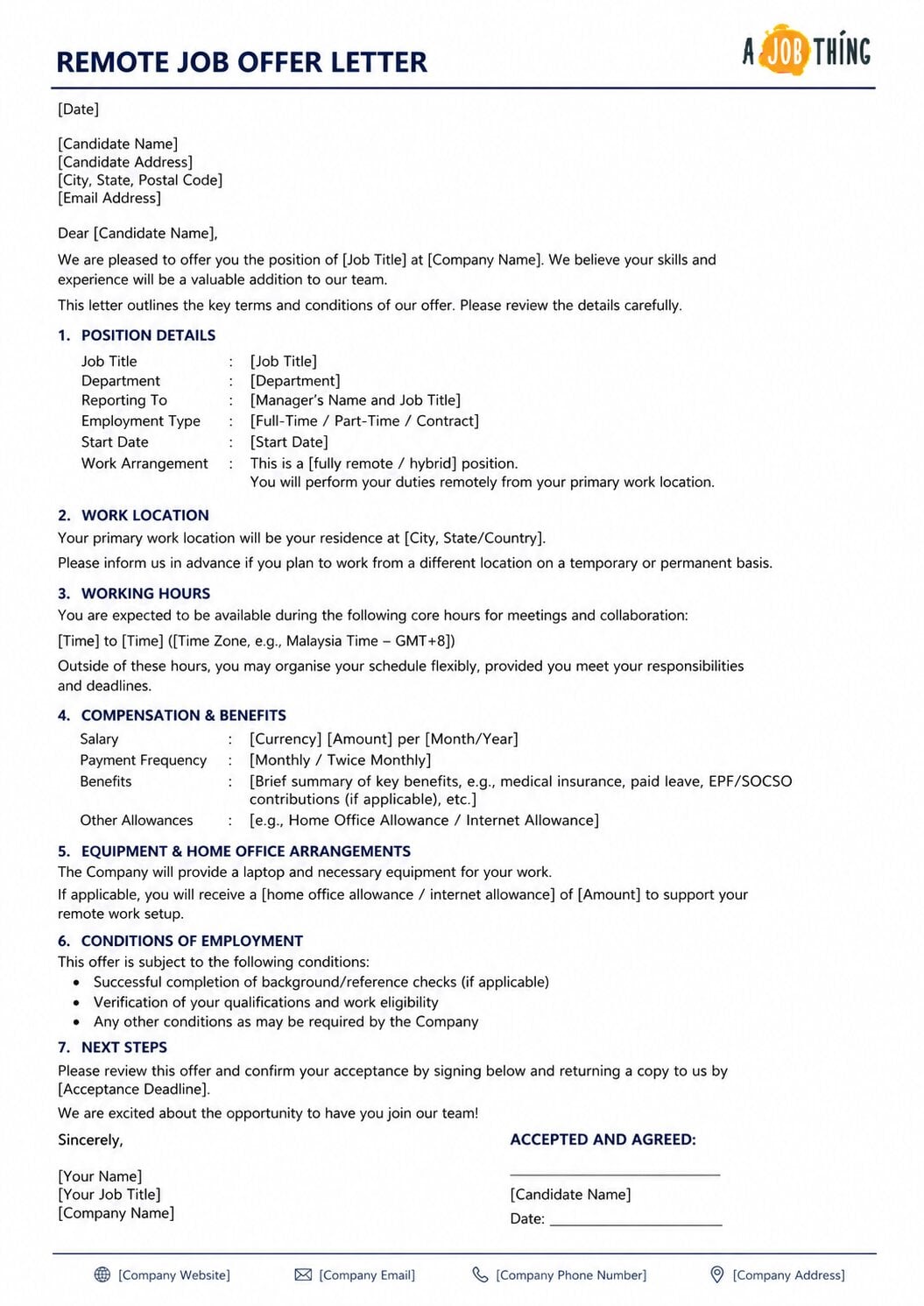
Sample Remote Job Offer Letter
Use the sample below as a starting point when preparing a remote job offer letter.
Hiring Remote Employees Across Different Locations
Remote work allows companies to hire talent from different cities and countries.
However, employers should be aware that employment laws, tax requirements, and statutory obligations may vary depending on where employees are located.
For example:
-
Malaysian employment requirements may differ from Singapore.
-
Employment benefits may vary between countries.
-
Tax and payroll obligations can differ across jurisdictions.
Before hiring remote employees across borders, employers should seek professional HR or legal advice to ensure compliance with local regulations.
Common Mistakes Employers Make
Even experienced employers can overlook important details when preparing remote job offer letters.
Being Vague About Remote Work Arrangements
Candidates should clearly understand whether the role is fully remote, hybrid, or requires occasional office attendance.
Not Clarifying Working Hours
Employees should know when they are expected to be available, especially when teams operate across different locations.
Forgetting Equipment Policies
Remote employees should not have to guess whether equipment will be provided.
Ignoring Work Location Requirements
Some companies allow employees to work from anywhere, while others restrict remote work to specific locations.
State these requirements clearly.
Using a Standard Offer Letter Template
A traditional offer letter may not include the information remote employees need.
Updating templates for remote hiring can help reduce confusion and improve the onboarding experience.
FAQs
What is a remote job offer letter?
A remote job offer letter is a document that confirms a job offer for a role performed remotely. It includes standard employment details as well as remote work arrangements.
What should be included in a remote job offer letter?
A remote job offer letter should include the job title, salary, start date, remote work arrangement, working hours, equipment policy, and conditions of employment.
Should remote work arrangements be stated in the offer letter?
Yes. Employers should clearly explain whether the role is fully remote, hybrid, or requires occasional office attendance.
Can employees sign a remote job offer letter electronically?
Yes. Many employers use electronic signatures to simplify remote hiring and onboarding.
Is a remote job offer letter legally binding?
Depending on the wording and applicable employment laws, a job offer letter may carry legal significance. Employers should ensure the information provided is accurate and consistent with the employment contract.
Looking to Hire Remote Employees?
%20copy.jpg)
AJobThing helps employers find qualified candidates and simplify the hiring process.
Post a job today and reach thousands of job seekers across Malaysia.
Read More:
-
Job Offer Letter vs. Employment Contract: What's the Difference? (+ Free Templates)
-
Constructive Dismissal Malaysia: Meaning, Examples & What To Do
-
Contract of Service vs Contract for Service Malaysia: How to Classify Workers Correctly
-
Job Offer Letter Templates: Examples, Formats & Best Practices for HR
-
Employee Retention in Malaysia: Meaning, Importance & How to Improve It
-
Employee Turnover in Malaysia: Causes, Warning Signs & How to Reduce It
-
Retrenchment in Malaysia: Meaning, Process & Employee Rights
-
Gmail Templates for HR: Faster Replies for Interviews, Offers & Rejections
-
7 Key Contract Employee Rights in Malaysia Every HR Should Know
-
GLC vs Private Company Malaysia: Salary, Culture & Hiring Differences
-
Types of Payroll Calculation in Malaysia: Adhoc, Prorated Salary & Final Settlement Explained
-
Types of Payroll Cycle in Malaysia: Which One Is Best for Your Business?
-
Types of Insurance in Malaysia and Their Impact on Employee Benefits
-
How to Create a Strong Candidate Shortlist for Better Hiring Decisions
-
How HR in Malaysia Can Offer a Job Over the Phone (with Script)
-
How Notice Period Really Works in Malaysia for Employers and HR
-
How to Create a Job Posting That Attracts the Right Candidates
-
How HR in Malaysia Can Improve Resume Screening and Candidate Shortlisting
-
How HR Can Reject a Candidate the Right Way (with Templates)
-
How to Conduct a Background Check for Employment in Malaysia
-
Onboarding Process Tips: What HR Needs to Know for Better Retention
-
Onboarding Checklist for New Hires (Free Downloadable Template)
-
Performance Evaluation: Description, Types, and How to Conduct
-
Cover Letter Examples Employers Should Know (With Tips to Spot the Best Ones)
-
Step-by-Step Guide to Writing a Great Job Description (Free Templates)