
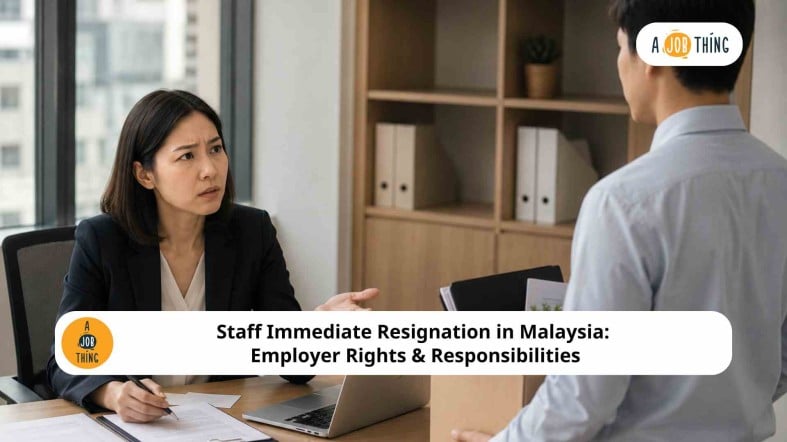
Staff Immediate Resignation in Malaysia: Employer Rights & Responsibilities

Are You Hiring?
Find candidates in 72 Hours with 5+ million talents in Maukerja Malaysia & Ricebowl using Job Ads.
Hire Now
Resigning from a job is a normal part of employment. In most cases, employees leave after serving the notice period stated in their employment contract.
However, some employees choose to leave immediately without serving notice. This is known as immediate resignation.
Can employees resign immediately in Malaysia? Can employers reject an immediate resignation? Is payment in lieu of notice required?
This guide explains what employers and employees should know about immediate resignation in Malaysia under the Employment Act 1955.
What Is Immediate Resignation?
Immediate resignation means an employee ends their employment without serving the required notice period stated in the employment contract.
For example, if an employee is required to serve one month's notice but leaves on the same day they submit their resignation, this is generally considered an immediate resignation.
What Does the Employment Act 1955 Say?
Under Section 13 of the Employment Act 1955, either the employer or the employee may terminate the employment contract by giving the required notice.
The Act also allows either party to terminate the contract without serving the required notice by paying an indemnity in lieu of notice. The indemnity is generally equal to the wages that would have been earned during the notice period, unless otherwise agreed.
This means an employee may resign immediately, but whether payment in lieu of notice applies depends on the employment contract and the circumstances.
Can Employees Resign Immediately in Malaysia?
Yes.
Employees may resign immediately, but employers should first review:
-
The notice period stated in the employment contract.
-
Whether payment in lieu of notice applies.
-
Whether both parties have agreed to waive the notice period.
-
Any other terms stated in the employment contract.
Every resignation should be assessed based on its own circumstances.
Immediate Resignation vs Resignation with Notice
| Immediate Resignation | Resignation with Notice |
|---|---|
| Employee leaves immediately. | Employee continues working during the notice period. |
| Payment in lieu of notice may apply. | Usually no payment in lieu of notice is required. |
| Limited time for handover. | Allows time for knowledge transfer and business continuity. |
Can Employers Reject an Immediate Resignation?
Generally, employers cannot force an employee to continue working.
However, this does not mean the employee is automatically released from all contractual obligations.
Depending on the employment contract and the Employment Act 1955, employers may still have rights relating to:
-
Notice periods.
-
Payment in lieu of notice.
-
The return of company property.
-
Confidentiality obligations.
-
Other contractual terms.
Employers should review the employment contract before deciding on the appropriate course of action.
Will Employees Still Receive Their Final Salary?
Generally, employees remain entitled to receive wages they have already earned before their employment ends.
When calculating an employee's final salary, employers should consider:
-
Outstanding salary.
-
Approved overtime payments.
-
Payment in lieu of notice, where applicable.
-
Any lawful deductions permitted under the Employment Act 1955.
Final salary should always be calculated according to the Employment Act 1955, the employment contract and company policies.
What Happens to Unused Annual Leave After Immediate Resignation?
Immediate resignation does not automatically mean an employee loses their annual leave entitlement.
Whether an employee is entitled to payment for unused annual leave depends on the Employment Act 1955, the employment contract and the company's leave policy.
When processing annual leave, employers should review:
-
The employee's remaining annual leave balance.
-
Whether unused annual leave can be carried forward or encashed under the employment contract or company policy.
-
Any applicable provisions under the Employment Act 1955.
Employers should calculate annual leave entitlements carefully and ensure any payments are handled according to the law and the employment contract.
Can Employers Take Action if an Employee Resigns Immediately?
It depends on the circumstances.
If an employee does not comply with the notice period stated in the employment contract, employers may have rights under the Employment Act 1955 or the employment contract.
Before taking any action, employers should:
-
Review the employment contract.
-
Determine whether payment in lieu of notice applies.
-
Consider the circumstances surrounding the resignation.
-
Seek professional HR or legal advice where necessary.
Each case should be assessed individually.
What if an Employee Resigns During Probation?
Immediate resignation during probation is another common question.
Whether a probation employee may resign immediately depends on the notice period stated in the employment contract. Many employers provide a shorter notice period during probation, but this varies between organisations.
Before accepting an immediate resignation during probation, employers should review the employment contract and ensure the resignation is handled according to its terms.
Things Employers Should Consider Before Accepting an Immediate Resignation
When an employee resigns immediately, employers should:
-
Review the employee's notice period in the employment contract.
-
Determine whether payment in lieu of notice applies.
-
Calculate the employee's final salary and annual leave entitlements.
-
Arrange for the return of company property.
-
Disable access to company systems where appropriate.
-
Complete the employee's offboarding process.
-
Keep written records of the resignation and related communication.
Taking these steps helps employers manage the resignation professionally while reducing the risk of disputes.
FAQs
Can employees resign immediately in Malaysia?
Yes. Employees may resign immediately, but payment in lieu of notice may apply depending on the employment contract, the Employment Act 1955 and the circumstances.
Can employers reject an immediate resignation?
Generally, employers cannot force employees to continue working. However, contractual obligations such as notice periods or payment in lieu of notice may still apply.
Do employees need to pay compensation for immediate resignation?
Employees may need to pay an indemnity in lieu of notice if they do not serve the required notice period, unless the employer agrees otherwise or the Employment Act 1955 provides otherwise.
What happens to annual leave after immediate resignation?
This depends on the Employment Act 1955, the employment contract and the company's leave policy. Employers should review the employee's remaining leave entitlement when processing the final employment benefits.
Will employees still receive their final salary after immediate resignation?
Generally, yes. Employees are entitled to wages they have already earned, subject to any lawful deductions permitted under the Employment Act 1955 and the employment contract.
Looking to Hire New Employees?
%20copy.jpg)
Whether you're replacing an employee or growing your team, AJobThing helps employers connect with qualified candidates across Malaysia.
Post your job ad today and hire faster.
Read More:
-
Late Salary Payment in Malaysia: Can Employers Delay Employee Salaries?
-
Internship vs Apprenticeship in Malaysia: Key Differences for Employers & HR
-
How to Manage Underperforming Employees in Malaysia: Tips for Employers & HR
-
Warning Letter for Poor Performance in Malaysia: How to Write One (With Sample)
-
Can Employers Reject Annual Leave in Malaysia? Rights, Rules & Employee Entitlements
-
Payroll and Attendance Management in Malaysia: Process, Formula & Best Practices for Employers
-
Workplace Conflict Management in Malaysia: Causes, Solutions, and Best Practices
-
Recruitment Process Outsourcing (RPO): What It Is, Benefits & How It Works in Malaysia
-
SME Hiring Guide: How to Plan, Hire, and Grow Your Team Successfully
-
Competency-Based Interviews: Improve Hiring Quality with a Consistent Interview Process
-
Leave Encashment Malaysia: How to Calculate Unused Annual Leave
-
Online Seller Requirements in Malaysia: 10 Business Details You Must Display
-
Performance Bonus in Malaysia: How It Works, Calculation & Employer Guide
-
Cost Per Hire Malaysia: Formula, Examples & How Employers Can Reduce Hiring Costs
-
Letter of Extension of Contract Malaysia: Free Template, Format & Sample
-
Promotion Letter in Malaysia: How to Write One (+ Free Template & Sample)
-
Probation Extension Letter Malaysia: Template, Sample, and What Employers Need to Know
-
Talent Pool: Benefits, Examples & How to Build One for Better Hiring
-
Sales Turnover: What It Is, Formula, Examples & Tips to Increase It
-
Overtime Rates in Malaysia: When Do 1.5x, 2x and 3x Pay Apply?
-
Prorated Salary in Malaysia: How to Calculate an Employee's First Salary
-
Remote Jobs in Malaysia: Most In-Demand Roles, Salaries & Hiring Guide (2026)
-
Effective Ways to Reduce Absenteeism in the Workplace for HR & Employers
-
Medical Benefits for Employees in Malaysia: Types, Legal Requirements & Best Practices
-
Fresh Graduate Salary in Malaysia (2026): How Much Should Employers Pay?
-
Salary Benchmarking in Malaysia: Are You Paying Enough to Attract Candidates?
-
e-Invoicing Malaysia Explained: What Every Employer and Business Needs to Know
-
EOR vs PEO: What's the Difference and Which Is Right for Your Business?
-
Remote Job Offer Letter: What Employers Should Include (+ Example)
-
Job Offer Letter vs. Employment Contract: What's the Difference? (+ Free Templates)
-
Constructive Dismissal Malaysia: Meaning, Examples & What To Do
-
Contract of Service vs Contract for Service Malaysia: How to Classify Workers Correctly
-
Job Offer Letter Templates: Examples, Formats & Best Practices for HR
-
Employee Retention in Malaysia: Meaning, Importance & How to Improve It
-
Employee Turnover in Malaysia: Causes, Warning Signs & How to Reduce It
-
Retrenchment in Malaysia: Meaning, Process & Employee Rights
-
Gmail Templates for HR: Faster Replies for Interviews, Offers & Rejections
-
7 Key Contract Employee Rights in Malaysia Every HR Should Know
-
GLC vs Private Company Malaysia: Salary, Culture & Hiring Differences
-
Types of Payroll Calculation in Malaysia: Adhoc, Prorated Salary & Final Settlement Explained
-
Types of Payroll Cycle in Malaysia: Which One Is Best for Your Business?
-
Types of Insurance in Malaysia and Their Impact on Employee Benefits
-
How to Create a Strong Candidate Shortlist for Better Hiring Decisions
-
How HR in Malaysia Can Offer a Job Over the Phone (with Script)
-
How Notice Period Really Works in Malaysia for Employers and HR
-
How to Create a Job Posting That Attracts the Right Candidates
-
How HR in Malaysia Can Improve Resume Screening and Candidate Shortlisting
-
How HR Can Reject a Candidate the Right Way (with Templates)
-
How to Conduct a Background Check for Employment in Malaysia
-
Onboarding Process Tips: What HR Needs to Know for Better Retention
-
Onboarding Checklist for New Hires (Free Downloadable Template)
-
Performance Evaluation: Description, Types, and How to Conduct
-
Cover Letter Examples Employers Should Know (With Tips to Spot the Best Ones)
-
Step-by-Step Guide to Writing a Great Job Description (Free Templates)