
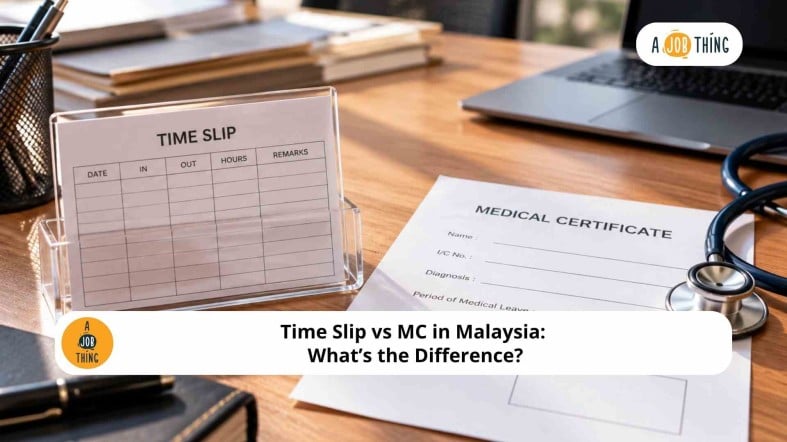
Time Slip vs MC in Malaysia: What’s the Difference?

Are You Hiring?
Find candidates in 72 Hours with 5+ million talents in Maukerja Malaysia & Ricebowl using Job Ads.
Hire Now
When an employee needs to visit a clinic during working hours, they may receive a time slip, attendance note or Medical Certificate (MC) depending on the circumstances.
This can sometimes create confusion for both employees and HR.
Does a time slip count as sick leave? Can an employee use a time slip instead of an MC? Does an MC always mean the employee gets the day off?
The answer depends on what the document is certifying and how the absence is handled under applicable employment law and company policy.
In simple terms, a time slip or attendance note can confirm that a person attended a clinic, while an MC is used to certify that a patient is unfit to work because of illness. The Malaysian Medical Council (MMC) makes this distinction in its guidance on Medical Sick Certificates.
What Is a Time Slip?
A time slip is generally used to show that a person attended a clinic, hospital or medical appointment during a particular period.
It may be useful when an employee needs to explain a temporary absence from work.
For example, an employee may need to leave the workplace to:
-
Attend a medical consultation
-
Go for a follow-up appointment
-
Undergo a medical test
-
Receive treatment
-
Attend a dental appointment
-
Accompany a family member for treatment
The exact name and format can differ between healthcare providers. The Malaysian Medical Council refers to documents such as an attendance note or time-off slip in certain situations.
A time slip primarily shows attendance or time spent at a medical facility. It does not, by itself, certify that the employee is medically unfit to work.
What Is an MC?
An MC, or Medical Sick Certificate, is a medical document used to certify that a patient is unfit to perform their duties because of illness.
The Malaysian Medical Council states that a Medical Sick Certificate is a legal document issued by a Registered Medical Practitioner for the purpose of certifying that a patient is unfit to perform their duties due to illness. It should be issued after an appropriate consultation.
An MC normally states the period of sick leave, including the dates and duration.
A doctor does not necessarily have to issue an MC simply because someone visits a clinic. If the illness is considered too minor to interfere with the patient's work, the practitioner may choose not to issue one and may instead provide an attendance note.
Time Slip vs MC: What Is the Difference?
| Time Slip / Attendance Note | MC | |
|---|---|---|
| Main purpose | Shows that a person attended a medical facility | Certifies that a patient is unfit to work |
| Usually relates to | A medical visit or appointment | A specified period of sick leave |
| Automatically means sick leave? | No | Used to certify sick leave |
| Employee can return to work? | Generally possible if fit and company policy requires it | Depends on the period stated on the MC |
| Main HR use | Supporting an absence for a medical appointment | Recording certified sick leave |
| Issued based on | Attendance at the medical facility | Medical assessment of the patient's fitness to work |
The easiest distinction is:
Time slip = proof of medical attendance.
MC = certification that the patient is unfit to work.
Does a Time Slip Count as Sick Leave in Malaysia?
Not automatically.
A time slip can support the fact that an employee attended a clinic, but it does not itself certify that the employee was unfit to work.
For example, an employee starts work at 9:00 AM, leaves at 10:30 AM for a medical appointment and returns at 12:00 PM with a time slip.
The time slip can help explain the period spent away from work.
If the employee is medically unfit to work for the rest of the day, the doctor may issue an MC covering the relevant period.
How the medical appointment time is recorded should follow the employer's applicable policy and employment terms.
Does Every Clinic Visit Result in an MC?
No.
A person may visit a clinic without receiving an MC.
The Malaysian Medical Council explains that an MC is intended for cases where the illness is sufficiently serious to justify the patient being excused from work. When the practitioner considers the illness too minor to interfere with work, they may choose not to issue an MC and may instead provide an attendance note.
This is why a clinic visit and sick leave should not automatically be treated as the same thing.
When Would an Employee Usually Receive a Time Slip?
A time slip or attendance note may be relevant when the purpose is to document the medical visit rather than certify a period of incapacity.
Medical Appointment
An employee attends a consultation and is fit to continue working afterwards.
Follow-Up Appointment
An employee returns to a clinic or hospital for a review but does not require full-day sick leave.
Medical Test
An employee attends a blood test, screening or another medical procedure during working hours.
Accompanying Another Person
The MMC specifically states that an MC should certify the patient who is sick and unable to work. An accompanying person may instead be given an attendance note or time-off slip.
When Would an Employee Need an MC?
An MC is relevant when a medical practitioner determines that the patient is not fit to perform their duties for the certified period.
For example, an employee may visit a clinic with symptoms that prevent them from working. Following an appropriate consultation, the doctor may issue an MC covering one or more days.
The duration should be based on the medical circumstances. The MMC states that the duration of medical sick leave must be commensurate with the illness.
What Does Malaysian Employment Law Say About Sick Leave?
For employees covered by the Employment Act 1955, Section 60F provides statutory paid sick leave after examination by an appropriate registered medical practitioner, medical officer or, where applicable, dental surgeon.
The ordinary paid sick leave entitlement is:
| Length of Service | Ordinary Paid Sick Leave |
|---|---|
| Less than 2 years | 14 days per calendar year |
| 2 years to less than 5 years | 18 days per calendar year |
| 5 years or more | 22 days per calendar year |
In addition, hospitalisation leave is 60 days under the amended framework.
Employees should also notify, or attempt to notify, their employer of the sick leave within 48 hours from the commencement of the sick leave. Section 60F provides that failure to do so may result in the absence being treated as absence without permission and without reasonable excuse.
Important Note on Coverage
The Employment Act 1955 applies to Peninsular Malaysia and the Federal Territory of Labuan. JTKSM states that Sabah and Sarawak continue to be governed by their respective labour ordinances.
Employers operating in different parts of Malaysia should therefore check the legislation applicable to the employee's place of employment.
Can an Employee Use a Time Slip Instead of an MC?
It depends on the reason for the absence.
A time slip may be appropriate where the employee is documenting attendance at a medical appointment.
An MC is relevant where the employee has been certified as unfit to work.
Case 1: Medical Appointment
An employee attends a clinic for a short consultation, remains fit to work and returns to the office.
A time slip or attendance note may help document the absence.
Case 2: Sick Leave
An employee is examined by a doctor and is determined to be unfit for work for the day.
The doctor issues an MC covering that period.
The two situations should not be treated as identical simply because both involved a clinic visit.
Can a Time Slip Cover a Full Day?
A time slip does not automatically mean that an employee is entitled to remain away from work for the entire day.
What matters is what the medical document actually certifies.
If the employee is only attending an appointment and remains fit to work, the employer may expect the employee to return after the appointment, subject to company policy.
If the doctor determines that the employee is unfit to work, the appropriate medical certification should reflect the relevant sick-leave period.
There is no general rule in the Employment Act 1955 stating that a time slip automatically gives an employee a specific number of hours or a full day of leave. Employers should therefore avoid relying on informal claims such as a universal "two-hour" or "three-hour" entitlement.
Can Employers Reject a Time Slip?
Employers should first determine what the document is intended to prove.
A time slip can support the fact that an employee attended a clinic, but it does not automatically establish statutory sick leave.
The employer should then apply the company's attendance and medical appointment policy consistently.
For example, the company may have a policy covering:
-
Medical appointments during working hours
-
Required notice before leaving the workplace
-
Submission of supporting documents
-
Return-to-work expectations
-
Treatment of approved medical appointment time
The exact treatment of the absence can therefore depend on the applicable law, employment terms and company policy.
What Should HR Do When an Employee Submits a Time Slip?
HR can use a simple process.
1. Check the Document
Review the date, time and type of document submitted.
2. Check the Employee's Working Hours
Compare the medical appointment with the employee's scheduled work period.
3. Confirm the Type of Absence
Determine whether the employee is reporting:
-
A medical appointment
-
Temporary absence from work
-
Certified sick leave
-
Another form of approved leave
4. Apply the Company's Policy
Record the absence under the appropriate category based on the company's documented procedure.
5. Keep Proper Records
Maintain the attendance and leave records required for HR and payroll administration.
This gives HR a consistent process without automatically treating every clinic visit as sick leave.
What Should Employees Do After Visiting a Clinic?
Employees can reduce misunderstandings by informing their manager or HR as early as possible and submitting the document required under company policy.
A practical approach is:
For a medical appointment: submit the attendance note or time slip where required.
For certified sick leave: submit the MC according to the company's procedure.
When unsure: check the employee handbook or ask HR before assuming how the absence will be treated.
Employees should also avoid assuming that receiving any document from a clinic automatically means they are entitled to a full paid day away from work.
What If HR Has Doubts About an MC?
The Malaysian Medical Council provides guidance on what employers can do when there are doubts about a Medical Sick Certificate.
The MMC recommends contacting the issuing Registered Medical Practitioner for clarification where necessary.
Employers should also remember that medical information is sensitive. The MMC states that a diagnosis is normally not required on an MC, and where additional illness information is requested, the patient's consent is required before such information is released.
HR should therefore focus on the information needed to administer attendance and leave rather than unnecessarily requesting confidential medical details.
Can an Employer Verify an MC?
Yes. Where there are genuine doubts about an MC, the MMC advises the employer to contact the issuing Registered Medical Practitioner for clarification.
Employers can also verify whether the practitioner is registered with the Malaysian Medical Council and holds a valid Annual Practising Certificate through the MMC's registration system.
Employers should use a consistent verification process rather than making assumptions based on the appearance of a certificate.
Example: Time Slip vs MC
Consider two employees who visit a clinic on the same morning.
Employee A: Time Slip
Amir leaves the office at 10:00 AM for a medical appointment. He is fit to continue working and returns at 12:00 PM with a time slip.
The document helps explain his absence during the appointment. The company should record the time away according to its medical appointment policy.
Employee B: MC
Sarah becomes unwell and visits a clinic. After examining her, the doctor determines that she is unfit to work and issues an MC covering the day.
Sarah submits the MC and informs her employer according to company procedures.
Although both employees visited a clinic, the documents serve different purposes.
What Should Employers Include in a Medical Appointment Policy?
A clear HR policy can prevent many attendance disputes.
Employers may want to specify:
-
Whether employees need to inform their manager before attending an appointment
-
How much notice should be given where an appointment is planned
-
What supporting documents are required
-
Whether employees are expected to return to work after the appointment
-
How medical appointment time is recorded
-
How certified sick leave is recorded
-
Who employees should contact when they cannot attend work
-
How the company handles repeated medical appointments
The policy should also be applied consistently across employees in comparable situations.
Common Mistakes to Avoid
Assuming Every Clinic Visit Is Sick Leave
An employee can attend a clinic without being certified unfit to work.
Treating Every Time Slip as a Full-Day MC
A time slip generally documents attendance, not incapacity to work.
Assuming There Is a Fixed Legal Number of Hours
The Employment Act 1955 does not establish a universal "time slip of two hours" or "three hours" entitlement.
Asking for Unnecessary Medical Details
An employer may need documentation for attendance and leave administration, but the MMC states that diagnosis is normally not required on a Medical Sick Certificate.
Applying Different Rules to Similar Cases
HR policies should be clear and consistently applied to avoid unnecessary employee disputes.
Relying on Outdated Information
Employment rules and official guidance can change. HR teams should refer to current legislation and official sources when handling leave and attendance matters.
Time Slip vs MC: Quick Guide for HR
| Situation | Likely Document | HR Consideration |
|---|---|---|
| Employee attends a short medical appointment | Time slip / attendance note | Record according to company policy |
| Employee is medically unfit to work | MC | Process as sick leave where applicable |
| Employee accompanies another person | Attendance note / time-off slip may be provided | Apply the company's appointment policy |
| Employee submits an MC with unclear details | MC | Verify through the appropriate channel if necessary |
| Employee wants the whole day off after a short appointment | Depends on circumstances | Check medical certification and company policy |
Time Slip vs MC: What Employers and Employees Need to Remember
The main difference is the purpose of the document.
A time slip or attendance note can show that someone attended a clinic or medical appointment, while an MC is used to certify that a patient is unfit to work for the stated period.
For employees, understanding this difference helps them submit the appropriate document and communicate with HR properly.
For employers and HR teams, a clear medical appointment and sick-leave policy can make attendance management more consistent and reduce misunderstandings.
When dealing with sick leave, employers should also consider the applicable employment legislation. For Peninsular Malaysia and Labuan, Section 60F of the Employment Act 1955 provides statutory sick-leave provisions, while Sabah and Sarawak have separate labour legislation.
FAQs
Is a time slip the same as an MC?
No. A time slip or attendance note generally documents attendance at a medical facility, while an MC certifies that a patient is unfit to work for the stated period.
Does a time slip automatically count as sick leave?
No. A time slip does not automatically certify that an employee is medically unfit to work.
Can an employee return to work after getting a time slip?
Yes, where the employee remains fit to work and the employer's policy requires or allows the employee to return after the appointment.
How many days of paid sick leave are employees entitled to in Malaysia?
Under the Employment Act 1955 framework applicable in Peninsular Malaysia and Labuan, ordinary paid sick leave is 14, 18 or 22 days per calendar year depending on length of service, while hospitalisation leave is 60 days.
How soon must an employee inform the employer about sick leave?
Under Section 60F, an employee must inform or attempt to inform the employer within 48 hours from the commencement of the sick leave.
Manage Hiring and Build Your Workforce With AJobThing
%20copy.jpg)
Managing attendance is one part of HR. Building the right team starts with finding the right people.
AJobThing helps Malaysian employers connect with suitable candidates and manage recruitment more efficiently, so your HR team can spend more time focusing on your people and business.
Find the right talent with AJobThing
Read More:
-
Malaysia Calls for Better Workforce Planning as AI, Gig Economy and E-Commerce Reshape Jobs
-
Malaysia Faces AI Skills Gap of 500,000+ Workers as PEOPLElogy Targets 5 Million by 2030
-
DEWI 2026: Dana Ekonomi Usahawan Wanita, Financing & How to Apply
-
Malaysia Minimum Wage 2026: Proposed Hike, MSME Exemption & Budget 2027 Update
-
Annual Bonus in Malaysia: How Employers Can Calculate, Structure & Pay Bonuses
-
Employee Transfer Letter Malaysia: Sample for Department, Role & Branch Transfer
-
Public Holidays in Malaysia 2027: Full List by Date and State for Workplace Planning
-
Probation Performance Review in Malaysia: How HR Can Evaluate Employees
-
Candidate Withdrawal During the Hiring Process: How HR Can Reduce Drop-Off
-
How to Keep Candidates Interested During a Long Hiring Process
-
Job Requisition: What It Is, What to Include & How HR Can Create One
-
Candidate Experience Survey: Questions, Examples & How to Improve Recruitment
-
Staff Immediate Resignation in Malaysia: Employer Rights & Responsibilities
-
Internship vs Apprenticeship in Malaysia: Key Differences for Employers & HR
-
How to Manage Underperforming Employees in Malaysia: Tips for Employers & HR
-
Warning Letter for Poor Performance in Malaysia: How to Write One (With Sample)
-
Can Employers Reject Annual Leave in Malaysia? Rights, Rules & Employee Entitlements
-
Payroll and Attendance Management in Malaysia: Process, Formula & Best Practices for Employers
-
Workplace Conflict Management in Malaysia: Causes, Solutions, and Best Practices
-
Recruitment Process Outsourcing (RPO): What It Is, Benefits & How It Works in Malaysia
-
Leave Encashment Malaysia: How to Calculate Unused Annual Leave
-
Performance Bonus in Malaysia: How It Works, Calculation & Employer Guide
-
Cost Per Hire Malaysia: Formula, Examples & How Employers Can Reduce Hiring Costs
-
Letter of Extension of Contract Malaysia: Free Template, Format & Sample
-
Promotion Letter in Malaysia: How to Write One (+ Free Template & Sample)
-
Probation Extension Letter Malaysia: Template, Sample, and What Employers Need to Know
-
Talent Pool: Benefits, Examples & How to Build One for Better Hiring
-
Overtime Rates in Malaysia: When Do 1.5x, 2x and 3x Pay Apply?
-
Prorated Salary in Malaysia: How to Calculate an Employee's First Salary
-
Remote Jobs in Malaysia: Most In-Demand Roles, Salaries & Hiring Guide (2026)
-
Effective Ways to Reduce Absenteeism in the Workplace for HR & Employers
-
Medical Benefits for Employees in Malaysia: Types, Legal Requirements & Best Practices
-
e-Invoicing Malaysia Explained: What Every Employer and Business Needs to Know
-
EOR vs PEO: What's the Difference and Which Is Right for Your Business?
-
Remote Job Offer Letter: What Employers Should Include (+ Example)
-
Job Offer Letter vs. Employment Contract: What's the Difference? (+ Free Templates)
-
Constructive Dismissal Malaysia: Meaning, Examples & What To Do
-
Contract of Service vs Contract for Service Malaysia: How to Classify Workers Correctly
-
Employee Retention in Malaysia: Meaning, Importance & How to Improve It
-
Employee Turnover in Malaysia: Causes, Warning Signs & How to Reduce It
-
Retrenchment in Malaysia: Meaning, Process & Employee Rights
-
7 Key Contract Employee Rights in Malaysia Every HR Should Know
-
GLC vs Private Company Malaysia: Salary, Culture & Hiring Differences
-
Types of Payroll Calculation in Malaysia: Adhoc, Prorated Salary & Final Settlement Explained
-
Types of Payroll Cycle in Malaysia: Which One Is Best for Your Business?
-
Types of Insurance in Malaysia and Their Impact on Employee Benefits
-
How to Create a Strong Candidate Shortlist for Better Hiring Decisions
-
How Notice Period Really Works in Malaysia for Employers and HR
-
Performance Evaluation: Description, Types, and How to Conduct