
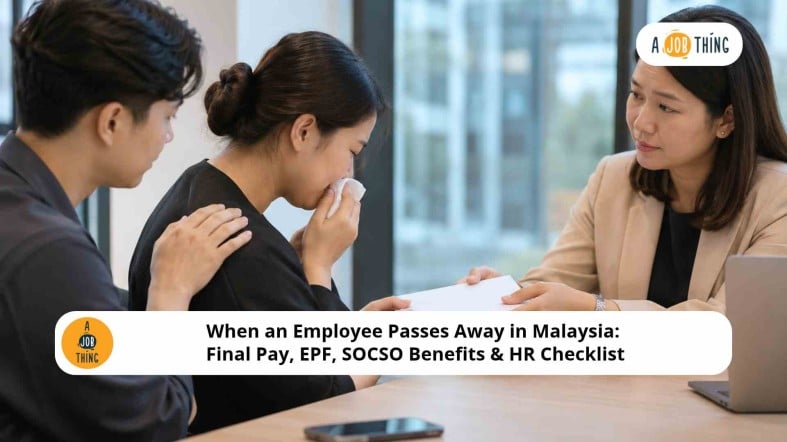
When an Employee Passes Away in Malaysia: Final Pay, EPF, SOCSO Benefits & HR Checklist

Are You Hiring?
Find candidates in 72 Hours with 5+ million talents in Maukerja Malaysia & Ricebowl using Job Ads.
Hire Now
When an employee passes away, it is a difficult situation for their family, colleagues and employer. Apart from offering support to the family, HR teams must also handle important administrative responsibilities, including final salary, outstanding payments, EPF records, SOCSO matters and tax clearance.
For Malaysian employers, understanding what to do can help prevent administrative delays, reduce payment mistakes and ensure the employee's family receives the information they need to make the relevant claims.
This guide explains what employers should do when an employee dies while employed in Malaysia, including how to handle outstanding salary, EPF nominations, SOCSO dependants' benefits, LHDN notifications and the documents HR should prepare.
| QUICK ANSWER |
| When an employee passes away in Malaysia, the employer should confirm the death, update employment records, calculate outstanding salary and other contractual payments, review EPF and SOCSO contribution records, and notify LHDN where required. The employer should also identify the person legally authorised to receive payments and prepare supporting employment documents. EPF withdrawals are handled by KWSP, while eligible dependants may claim SOCSO benefits depending on the cause of death and contribution conditions. |
What Should An Employer Do When An Employee Passes Away?
When HR receives news that an employee has passed away, the first priority should be to respond with care and respect. Administrative matters should be handled sensitively, especially when communicating with the employee's family.
The process may differ depending on whether the employee died at work, outside work, in Malaysia or overseas. The employee's nationality, employment contract and statutory contribution records may also affect the next steps.
Generally, employers should take the following actions:
- Confirm the information: Obtain confirmation from an appropriate family representative and request the death certificate when available.
- Contact the family respectfully: Offer condolences and identify the appropriate person for future communication.
- Secure company property: Arrange the return of laptops, access cards, company devices, documents and other assets. Handle personal belongings carefully.
- Update employment records: Record the date of death and update the employee's HR and payroll status.
- Calculate outstanding payments: Review unpaid salary, approved claims, overtime and other amounts due under the employment contract or company policy.
- Review statutory records: Check EPF and SOCSO contribution records and identify any outstanding contributions.
- Handle tax notification: Check whether CP22A or CP22B must be submitted to LHDN.
- Prepare supporting documents: Organise employment and payroll records for the authorised representative and relevant agencies.
HR should appoint one person to coordinate communication with the family. This helps prevent repeated requests for documents and conflicting information from different departments.
Does The Cause Of Death Affect The Employer's Responsibilities?
Yes. Employers should establish whether the death may be related to employment because it can affect the SOCSO claim process and workplace reporting obligations.
| Situation | What HR Should Consider |
| Death due to a workplace accident | Preserve relevant records, report the incident where required and contact PERKESO about the Employment Injury Scheme. |
| Death while travelling for work | Record the circumstances and supporting evidence. PERKESO should assess whether the incident falls within employment injury protection. |
| Death due to illness or other non-work-related causes | Review possible eligibility under the PERKESO Invalidity Scheme, subject to contribution and other qualifying conditions. |
| Death overseas | Request relevant death documentation and confirm procedures with PERKESO, KWSP and other authorities. |
HR TIP: Do not decide whether a death qualifies for SOCSO benefits based only on the family's description. Record the available facts and let PERKESO assess the claim under the relevant scheme.
How To Handle Final Salary And Outstanding Payments
One of the employer's responsibilities is to identify and calculate the money the employee earned before passing away. This may include unpaid salary, approved overtime, outstanding claims and other payments due under the employment contract or company policy.
However, calculating the amount and deciding who can legally receive it are two separate matters. HR should prepare the final payroll calculation but verify the authorised recipient before releasing payment.
Calculate Outstanding Salary
Review the employee's wage period, attendance and payroll records to calculate salary earned but not yet paid. For monthly-paid employees who have not completed a full wage period, Section 18A of the Employment Act 1955 provides a formula for calculating wages for an incomplete month in the circumstances covered by that section.
The formula is:
For example, if an employee earns RM3,000 per month and the wage period has 30 days, with 15 eligible days in that period:
RM3,000 ÷ 30 × 15 = RM1,500
This is an illustration of the incomplete-month calculation, not a universal formula for every death-related final payment. HR should confirm the applicable wage period, date treatment and legal basis before finalising the amount.
Check Unpaid Overtime And Other Wages
Review attendance and payroll records to identify any unpaid amounts, such as:
- Overtime payments that have not yet been processed.
- Work performed on rest days or public holidays.
- Approved commissions or incentives that are already due.
- Outstanding salary adjustments.
- Other contractual wage payments.
Section 19 of the Employment Act 1955 generally requires wages to be paid no later than the seventh day after the end of the wage period. Different timing provisions apply to certain overtime, rest-day and public-holiday payments. However, employers should not assume that the ordinary wage-payment timetable alone resolves how payment must be made after an employee's death.
Review Unused Annual Leave And Other Entitlements
Check the employee's leave balance, employment contract and company policy. Determine whether unused annual leave should be paid or otherwise handled under the applicable law and terms.
Do not automatically treat every unused leave day as cash payable. The correct treatment depends on the applicable entitlement, the circumstances and the relevant contractual terms.
Check Deductions And Outstanding Obligations
Review any deductions or outstanding amounts before preparing the final payroll statement. Employers should only make deductions permitted by law and should not deduct company losses, equipment costs or other amounts without a valid legal basis.
HR should also check whether any salary payment needs to be withheld pending LHDN tax clearance.
Confirm Who Is Authorised To Receive The Final Payment
The employee's spouse, child, parent or next of kin may contact the employer to ask about final salary. However, being a family member does not automatically establish legal authority to receive every amount owed to the deceased employee.
Depending on the circumstances, the employer may need instructions or supporting documents from the executor, administrator, estate representative or another person legally authorised to receive the payment.
Before making payment, HR should obtain appropriate confirmation and keep a record of the documents reviewed, the payment amount, the recipient and the payment approval.
HR TIP: Prepare a final payroll statement first. If the correct recipient or tax clearance status is not confirmed, keep the amount properly recorded and seek legal or agency guidance before releasing it.
Example: What Should Be Included In The Final Payroll Review?
Suppose an employee earns RM3,500 per month and has outstanding salary, approved overtime and a pending reimbursement. HR should prepare a breakdown before deciding how the payment will be released.
| Item To Review | Illustrative Amount | HR Action |
| Outstanding salary | RM1,750 | Verify eligible days and wage period. |
| Approved overtime | RM200 | Check attendance and approval records. |
| Approved business claim | RM150 | Verify receipts and reimbursement policy. |
| Illustrative total for review | RM2,100 | Confirm deductions, tax clearance and authorised recipient. |
This example is for illustration only. It does not establish the amount legally payable in a particular case or determine the correct recipient.
For more guidance on payroll calculations and final settlement, read Types of Payroll Calculation in Malaysia: Adhoc, Prorated Salary & Final Settlement Explained.
EPF After An Employee's Death: Nominee And Withdrawal
When an EPF member passes away, their savings may be claimed through KWSP's Death Withdrawal process. The claim is handled by KWSP, not the employer.
The employer's role is to ensure that contribution records are accurate, outstanding contributions are handled correctly and the family knows where to obtain official information.
What Happens To EPF Savings After A Member Dies?
The process depends on whether the deceased member made a valid EPF nomination and the applicable KWSP rules.
| Situation | How The Claim Is Handled |
| Valid EPF nomination exists | The nominee can apply for the nominated portion, subject to KWSP's requirements and the rules applicable to the member. |
| No valid EPF nomination | The eligible applicant depends on the member's marital status and circumstances. KWSP's rules identify different applicants for married and unmarried members. |
For Muslim members, a nominee generally acts as a wasi or administrator responsible for distributing the savings to the rightful beneficiaries according to Islamic law. For non-Muslim members, a nominee is generally the beneficiary of the nominated savings.
HR should not advise family members on inheritance distribution. Direct them to KWSP and, where needed, the relevant legal or estate administration authority.
What If The Employee Did Not Nominate An EPF Beneficiary?
The absence of a nomination does not mean the EPF savings are automatically forfeited. KWSP has a process for Death Withdrawal without nomination.
KWSP's current guidance identifies the following applicants:
- Married member: The widow or widower, or an administrator appointed through the relevant legal process. KWSP's detailed guidance also sets out other eligible family-member categories depending on the applicable procedure.
- Unmarried member: The member's parents or an administrator.
The amount that can be released and whether an official appointment document is required depend on the savings balance and the timing of the application. For larger balances, court, legal institution or Amanah Raya Berhad documentation may be required.
HR should not decide who is entitled to receive the EPF savings. The applicant should confirm the correct procedure directly with KWSP.
What Documents May Be Needed For An EPF Death Withdrawal?
KWSP's published document list includes items such as:
- Completed KWSP 9KM (AHL) Death Withdrawal form and checklist.
- Identification documents of the applicant.
- Death certificate of the EPF member.
- Birth certificate, marriage certificate or other proof of relationship, where required.
- Bank account details or relevant estate account information.
- Power of attorney or official court, legal institution or Amanah Raya Berhad documentation, where applicable.
- Additional declarations or supporting documents depending on the member's circumstances.
The exact documents depend on the case. Applicants should check the latest KWSP checklist before submitting a claim.
Is There An EPF Death Assistance Payment?
KWSP may consider a one-time Death Assistance payment of RM2,500 for eligible dependants. This payment is made at KWSP's discretion and is not automatic.
Published eligibility conditions include:
- The member must meet the applicable citizenship or membership conditions.
- The member must have passed away before age 60.
- The member must still have savings with EPF.
- The Death Withdrawal application must be received within six months from the date of death.
- The applicant must be an eligible dependant, subject to the member's marital status.
Eligible family members should confirm the latest conditions and application process directly with KWSP.
What Should Employers Do For EPF Matters?
HR should:
- Check whether the employee's EPF contributions were submitted correctly up to the relevant final payroll period.
- Identify any unpaid employer and employee contributions.
- Keep the employee's EPF contribution and payroll records.
- Provide employment or salary confirmation documents when appropriately requested.
- Refer the family to KWSP for nomination and Death Withdrawal procedures.
Employers should not request or attempt to change the deceased employee's EPF nomination. Nomination and withdrawal matters are handled by KWSP and the relevant claimants.
For more information about employer contribution responsibilities, read Statutory Contributions in Malaysia Explained for Employers and HR.
SOCSO Benefits When An Employee Dies
Eligible dependants may receive benefits from PERKESO when an insured employee passes away. The benefit depends on the cause of death, the employee's contribution history and the applicable qualifying conditions.
There are two important schemes HR should understand:
- Employment Injury Scheme: Provides protection when death results from an employment injury, subject to the scheme's rules.
- Invalidity Scheme: Provides 24-hour protection for death due to causes unrelated to employment, subject to contribution and eligibility conditions.
1. Death Due To An Employment Injury: Dependants' Benefit
If an insured employee dies as a result of an employment injury, eligible dependants may qualify for PERKESO's Dependants' Benefit under the Employment Injury Scheme.
An employment injury may include an accident arising out of and in the course of employment, subject to the applicable legal requirements. Certain work-related journeys may also be covered, depending on the circumstances.
The benefit is paid to eligible dependants according to PERKESO's rules. The amount and distribution depend on the insured person's assumed wage and the dependant category.
2. Death Unrelated To Employment: Survivors' Pension
If an employee dies due to an illness or another cause unrelated to employment, their eligible dependants may qualify for a Survivors' Pension under the Invalidity Scheme.
PERKESO's qualifying conditions generally include the following circumstances:
- The insured person dies before reaching 60 years of age and fulfils the full or reduced qualifying contribution period; or
- The insured person was already receiving an Invalidity Pension at the time of death, regardless of age.
What Are The Contribution Requirements?
For the full qualifying period, the insured person must generally meet one of these contribution tests:
- At least 24 monthly contributions within the 40 consecutive months before the month of death; or
- Monthly contributions for at least two-thirds of the complete months between the date contributions first became payable and the date of death, with at least 24 monthly contributions in total.
For the reduced qualifying period, the insured person must generally have contributions for at least one-third of the complete months between the date contributions first became payable and the date of death, with at least 24 monthly contributions in total.
How Much Is The Survivors' Pension?
For a full qualifying period, the Survivors' Pension generally starts at 50% of the average assumed monthly wage. It increases by 1% for every 12 months of contributions paid beyond the first 24 months, up to a maximum of 65%.
For a reduced qualifying period, the rate is generally 50% of the average assumed monthly wage, subject to the applicable minimum pension.
PERKESO's published Invalidity Scheme guidance states a minimum pension of RM475 per month for the relevant insured-person category. Different minimum amounts and conditions may apply to foreign workers and other coverage categories. PERKESO determines the actual amount based on the insured person's record and applicable rules.
3. Funeral Benefit
PERKESO provides a Funeral Benefit of up to RM3,000 under the applicable schemes. The payment is based on actual funeral expenses or the maximum prescribed amount, whichever is lower.
Under the Invalidity Scheme, PERKESO states that the Funeral Benefit may be paid when the insured person dies due to any cause. The benefit is paid to the eligible person or, where there is no such person, to the person who actually incurred the funeral expenses.
For foreign workers, specific coverage and funeral or repatriation arrangements may apply. Employers should check the relevant PERKESO guidance for the employee's coverage category.
Comparison Of SOCSO Death-Related Benefits
| Benefit | When It May Apply | Who Handles The Claim? |
| Dependants' Benefit | Death caused by an employment injury. | Eligible dependants apply through PERKESO. |
| Survivors' Pension | Death unrelated to employment, subject to qualifying conditions. | Eligible dependants apply through PERKESO. |
| Funeral Benefit | Eligible death-related cases under the applicable PERKESO scheme. | Eligible dependant or person who incurred the funeral expenses. |
What Should Employers Do For SOCSO Matters?
HR should:
- Check the employee's SOCSO registration and contribution history.
- Determine whether the death may be work-related and preserve relevant incident records.
- Report workplace incidents to PERKESO where required.
- Prepare employment, wage and contribution information requested for a claim.
- Direct eligible family members to PERKESO for the correct benefit and application process.
HR TIP: Do not promise a specific pension amount or claim outcome to the family. PERKESO determines eligibility, benefit rates and the rightful recipients.
LHDN Notification And Tax Clearance
Tax clearance is an important part of the employer's responsibilities when an employee passes away. Employers should check whether the deceased employee falls within the notification requirements administered by the Inland Revenue Board of Malaysia (LHDN).
Does An Employer Need To Submit CP22A Or CP22B?
Where the notification requirement applies, LHDN requires employers to submit:
- Form CP22A: For employees in the private sector.
- Form CP22B: For employees in the public sector.
For an employee who has passed away, the form must generally be submitted no later than 30 days after the employer is informed of the death.
Since 1 January 2024, the original notification must be submitted online through the MyTax portal using the e-SPC application. Employers should check the latest LHDN instructions for the current submission process and applicable exemptions.
Does The Employer Need To Withhold The Deceased Employee's Money?
LHDN's employer guidance states that money payable to an employee must be withheld for 90 days after LHDN receives the relevant notification, or until a tax clearance letter is received, subject to the applicable rules and any permission from LHDN to release the money earlier.
This means HR should not automatically release the final payment immediately after receiving the death certificate. The company should first confirm whether the tax clearance and withholding requirements apply to the employee's circumstances.
Employers should also check whether an exemption applies before deciding that notification or withholding is unnecessary.
What Should HR Prepare For LHDN?
- Employee identification and employment details.
- Date the employer was informed of the employee's death.
- Final salary and remuneration details.
- Relevant payroll and PCB records.
- Other information requested through the e-SPC process.
HR TIP: Keep a record of the CP22A or CP22B submission, LHDN correspondence and the date tax clearance is received. This helps payroll understand when payment can be released.
Other Payments And Employment Matters HR Should Review
Besides salary, EPF, SOCSO and tax matters, HR should review the employee's contract and company policies to identify other payments or arrangements that may apply.
Group Insurance And Personal Accident Coverage
Check whether the employee was covered under company-provided group life insurance, group personal accident insurance or another employee protection plan.
HR should contact the insurer or benefits provider to confirm:
- Whether the employee had active coverage on the date of death.
- Who is recorded as the policy beneficiary.
- What claim forms and supporting documents are required.
- Whether there are any claim submission deadlines.
Insurance claims are subject to policy terms and the insurer's assessment. Employers should not guarantee a payout.
Outstanding Medical Or Business Expenses
Review any approved expenses or reimbursement claims that the employee submitted before passing away. Examples may include business travel expenses, medical claims or other work-related reimbursements.
Check the company's policy and obtain the necessary supporting documents before processing payment.
Bonuses, Commissions And Incentives
Review the employee's employment contract and incentive plan to determine whether any bonus, commission or incentive payment had already become payable.
Some payments may depend on performance conditions, payment dates or continued employment requirements. HR should review the applicable terms rather than assuming that every future or unpaid incentive is automatically payable.
Company Property And Access
Arrange the return of company property, including:
- Laptop, mobile phone and other electronic devices.
- Access cards, keys and security passes.
- Company credit cards and equipment.
- Documents, files and work-related records.
Handle personal belongings carefully. Coordinate with the family to arrange collection and keep a record of items returned.
Employee Records And Data Protection
Update the employee's HR information and restrict access to sensitive records to authorised personnel. Preserve payroll, employment, contribution and tax records according to the applicable record-keeping requirements.
Do not share the employee's personal or medical information with colleagues unless there is a valid reason and appropriate authorisation.
Documents Employers Should Prepare
Keeping the relevant documents organised can make it easier to respond to requests from the family, KWSP, PERKESO, LHDN and insurance providers.
| Document | Purpose |
| Death certificate | Confirms the employee's death for administrative and claim purposes. |
| Employee identification and personal details | Supports employment, payroll and statutory records. |
| Employment contract and latest salary details | Helps establish salary, benefits and contractual entitlements. |
| Final payroll calculation | Shows outstanding salary, approved payments and lawful deductions. |
| EPF and SOCSO contribution records | Supports statutory record checks and relevant claim enquiries. |
| CP22A or CP22B, where applicable | Supports the employer's tax notification and clearance process. |
| Attendance, overtime and leave records | Helps verify final salary and other employment entitlements. |
| Insurance policy and claim forms | Supports claims under applicable company insurance coverage. |
| Authorisation or estate administration documents | Helps verify the person legally authorised to receive payments or act for the estate. |
The family may need additional documents for individual claims. KWSP and PERKESO have their own application forms and supporting document requirements.
HR Checklist When An Employee Passes Away
Download this free HR checklist to help your team manage the necessary steps when an employee passes away.

Family Communication Email Template
HR can adapt this message when contacting the employee's family about the administrative process.
Subject: Our Condolences and Employment Matters for [Employee Name]
Dear [Family Member's Name],
On behalf of [Company Name], please accept our sincere condolences on the passing of [Employee Name]. We are deeply sorry for your loss.
We are reviewing the necessary employment and payroll matters, including any outstanding salary and applicable employee benefits. We will contact you if supporting documents are required and will guide you on the relevant administrative steps.
For the time being, please let us know the most appropriate person for our HR team to contact regarding these matters. We will handle the information and documents provided with care and confidentiality.
Please take the time you need. We will do our best to make the administrative process as clear and manageable as possible.
With sympathy,
[Name]
Human Resources
[Company Name]
Final Thoughts
When an employee passes away, employers have an important responsibility to handle the situation with care while completing the necessary HR and statutory processes.
HR teams should calculate outstanding salary accurately, verify the authorised recipient, review EPF and SOCSO records, check LHDN notification requirements and prepare the necessary employment documents.
Most importantly, employers should communicate respectfully with the employee's family and avoid making assumptions about benefit eligibility or inheritance matters. Directing family members to KWSP, PERKESO and LHDN for official guidance can help them understand the relevant claims and next steps.
A clear HR process helps the company manage its responsibilities while treating the employee and their family with dignity.
FAQs
What happens when an employee dies while still employed in Malaysia?
The employer should record the employee's date of death, calculate outstanding salary and contractual payments, review statutory contribution records, handle applicable LHDN notification requirements and prepare supporting documents. The employer should also verify who is authorised to receive any payment.
Does the employer have to pay the deceased employee's final salary?
The employer must account for wages and other payments earned or payable under the applicable law and employment terms. However, the employer should verify the correct recipient and check whether LHDN tax clearance rules require the money to be withheld before releasing payment.
Can the employee's spouse collect the final salary?
Not automatically. A spouse may be an appropriate contact, but HR should confirm the person's legal authority to receive the deceased employee's money. Depending on the circumstances, an executor, administrator or other authorised representative may be required.
What happens to EPF savings when an employee passes away?
The employee's EPF savings can be claimed through KWSP's Death Withdrawal process. The process depends on whether the member made a valid nomination and the applicable rules for the member's circumstances. Family members should apply directly to KWSP.
How much is the EPF Death Assistance payment in Malaysia?
KWSP may consider a one-time Death Assistance payment of RM2,500 for eligible dependants, subject to its conditions and discretion. The family should confirm eligibility and application requirements directly with KWSP.
Does SOCSO pay benefits if an employee dies from illness?
Potentially. Eligible dependants may qualify for a Survivors' Pension under PERKESO's Invalidity Scheme when the death is unrelated to employment. The employee must meet the applicable contribution and qualifying conditions, or have been receiving an Invalidity Pension.
How much is the SOCSO Funeral Benefit?
PERKESO's published Funeral Benefit is up to RM3,000, based on actual funeral expenses or the prescribed maximum amount, whichever is lower. Eligibility and supporting document requirements depend on the applicable scheme.
Does an employer need to inform LHDN when an employee dies?
Where the notification requirement applies, the employer must submit CP22A for private-sector employees or CP22B for public-sector employees no later than 30 days after being informed of the employee's death. The submission is made online through MyTax using e-SPC. Employers should check LHDN's current guidance for applicable exemptions.
Can an employer release the final salary immediately after receiving the death certificate?
Not necessarily. HR should first check the applicable LHDN tax clearance and withholding requirements and verify the person legally authorised to receive the money. A death certificate confirms the death but does not, by itself, establish who can receive all payments owed to the deceased employee.
Does the employer need to pay unused annual leave after an employee dies?
HR should review the employee's remaining leave balance, employment terms and applicable legal requirements. The treatment of unused annual leave depends on the circumstances and should not be assumed without checking the relevant rules.
Chat With Candidates And Hire 2x Faster

Find the right talent faster with AJobThing. Chat with candidates directly and manage your hiring process in one app.
Download the AJobThing Hire & Chat app on the App Store or Google Play to connect with candidates and manage hiring on the go.
Read More
- EPF Death Assistance Malaysia: Eligibility, Claims Process & HR Guide
- HR Guide: Tax Clearance Letter, Form CP22 and Form CP22A
- Complete Guide to CP Forms: CP21, CP22, CP22A & CP22B
- How to Handle Salary Payout After Resignation in Malaysia
- Pro-Rated Annual Leave in Malaysia: How to Calculate It
- HR Document Checklist Excel: Employee Records from Hiring to Offboarding
- HR Documentation: What Records Should HR Keep?
- What Employers Must Submit Through LHDN e-Filing in Malaysia
- What You Need to Know About Employee Benefits in Malaysia