
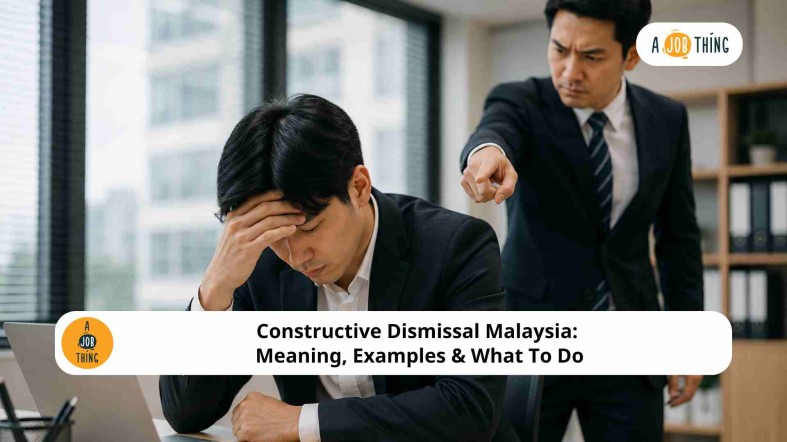
Constructive Dismissal Malaysia: Meaning, Examples & What To Do

Are You Hiring?
Find candidates in 72 Hours with 5+ million talents in Maukerja Malaysia & Ricebowl using Job Ads.
Hire Now
Have you ever felt so uncomfortable at work that you had no choice but to quit?
Maybe your boss suddenly cut your salary without any explanation. Or your role was quietly changed to something you never agreed to. Or you were sidelined, ignored, or made to feel unwelcome — until leaving felt like the only option.
If this sounds familiar, what happened to you might actually be constructive dismissal.
And in Malaysia, it's taken very seriously by the law.
What Is Constructive Dismissal?
Constructive dismissal happens when an employee is forced to resign because the employer made the working conditions so unbearable that staying was no longer a reasonable option.
In simple terms:
-
The employee technically resigns
-
But the employer’s actions pushed them to leave
-
The law may treat it as if the employer dismissed them
The key legal framework in Malaysia comes from the Industrial Relations Act 1967.
Under Section 20, employees who believe they were dismissed without just cause or excuse, including through constructive dismissal, may file a claim at the Industrial Court.
Malaysian courts have consistently recognised constructive dismissal as a form of unfair dismissal, even though the employee technically resigned voluntarily.
Simple definition: Constructive dismissal = employer behaves unfairly → employee has no reasonable choice but to resign → law may treat it as dismissal.
Why Does Constructive Dismissal Matter?
Some people think: “If the employee resigned, why is it the employer’s problem?”
Here’s why it matters:
For Employees
Employees should understand their rights because:
-
Resigning does not always remove legal protection
-
Employers cannot pressure employees into quitting unfairly
-
Employees may still file claims at the Industrial Court
Employees generally have 60 days from their last working day to file a representation under Section 20 of the Industrial Relations Act 1967.
For Employers & HR Teams
Constructive dismissal claims can seriously affect businesses.
Possible consequences include:
-
Reinstatement of employees
-
Back wages
-
Compensation payments
-
Legal expenses
-
Reputational damage
-
HR management challenges
For SMEs and growing companies in Malaysia, even one Industrial Court case can consume significant time and resources.
Common Examples of Constructive Dismissal in Malaysia
This is where it becomes practical.
What situations may actually amount to constructive dismissal?
Salary Cut Without Consent
An employer suddenly reduces salary without obtaining proper employee agreement.
Example
Aiman earns RM4,500 per month. Without warning, his employer reduces his salary to RM3,000 due to “restructuring.”
Aiman disagrees with the reduction and resigns.
This may amount to constructive dismissal because salary is a fundamental term of employment.
Demotion Without Justification
Being moved into a lower role or stripped of responsibilities without proper explanation.
Example
Sarah is a Marketing Manager. After returning from maternity leave, she is reassigned as a Marketing Coordinator with no managerial responsibilities.
No discussion. No explanation.
She resigns shortly after.
This could potentially support a constructive dismissal claim.
Forced Transfer to Another Location
Transfers may become problematic if they are unreasonable or not supported by the employment contract.
Example
Raj works in Kuala Lumpur. His employer suddenly instructs him to relocate to Sabah within two weeks despite there being no transfer clause in his contract.
Raj resigns because the relocation is unreasonable for his family situation.
Toxic or Hostile Work Environment
Bullying, harassment, humiliation, or discrimination may also contribute to constructive dismissal.
Example
Mei’s supervisor repeatedly humiliates her during meetings. She complains to HR several times, but no action is taken.
The behaviour continues for months until she resigns.
Removing Job Responsibilities
An employer gradually removes important responsibilities until the employee feels sidelined.
Example
Danial is a Senior Finance Executive. Over time, all meaningful responsibilities are transferred to junior staff.
Eventually, he is left doing filing and basic administrative work.
Failure to Pay Salary Properly
Late salary payments or unpaid wages may breach Malaysian employment laws and contribute to constructive dismissal claims.
Constructive Dismissal vs Unfair Dismissal
Many Malaysians confuse these two terms.
Here’s the difference:
| Matter | Constructive Dismissal | Unfair Dismissal |
|---|---|---|
| Who leaves the company? | Employee resigns | Employer terminates employee |
| Why does it happen? | Employer’s conduct forces resignation | Employer dismisses employee directly |
| Legal protection | Industrial Relations Act 1967 | Industrial Relations Act 1967 |
| Possible claim? | Yes | Yes |
Bottom Line
Both situations may still be considered dismissal without just cause or excuse under Malaysian employment law.
How to Prove Constructive Dismissal in Malaysia
Employees cannot simply resign and automatically win a claim.
There are several important elements that usually need to be proven.
Step 1: Show There Was a Breach of Contract
The employee must show that the employer breached a fundamental term of employment.
Examples include:
-
Salary
-
Job scope
-
Workplace dignity
-
Working conditions
-
Employment benefits
Step 2: Show the Breach Was Serious
Minor workplace disagreements are usually not enough.
The breach must be serious enough that a reasonable employee could no longer continue working.
Step 3: Show the Resignation Was Caused by the Breach
The resignation must clearly be connected to the employer’s conduct.
If the employee continues working for too long after the incident, the court may view it as acceptance of the situation.
Step 4: Resign Promptly
Employees should generally resign within a reasonable period after the breach occurs.
Waiting too long may weaken the case.
Step 5: File a Claim Within 60 Days
Employees generally have 60 days from their last working day to file a representation under Section 20 of the Industrial Relations Act 1967.
Missing the deadline may disqualify the claim completely.
Who Has the Burden of Proof?
In constructive dismissal cases, the employee usually carries the initial burden of proof.
This means the employee must first show:
-
The employer committed a serious breach
-
The resignation happened because of that breach
The employer may then defend or justify their actions during Industrial Court proceedings.
Can Employees Resign Immediately?
In some situations, yes.
If the employer’s conduct is extremely serious, employees may resign immediately and pursue a constructive dismissal claim.
However, employees should:
-
Keep proper documentation
-
Save emails and messages
-
Record incidents carefully
-
Seek HR or legal advice if possible
Resigning emotionally without evidence can weaken a case significantly.
Red Flags Employees Should Watch Out For
Not sure if what’s happening qualifies as constructive dismissal?
Here are some warning signs.
-
Salary reduced without agreement
-
Sudden demotion without explanation
-
Job responsibilities removed unfairly
-
Workplace bullying or humiliation
-
Unreasonable transfer
-
Exclusion from meetings or projects
-
Pressure to resign
-
Delayed salary payments
If several of these happen together, employees should seek professional HR or legal advice before resigning.
Signs Your Company May Be at Risk of a Constructive Dismissal Claim
Employers and HR teams should also recognise potential risks early.
Common Employer Mistakes
-
Changing employment terms without consent
-
Ignoring employee grievances
-
Allowing toxic management behaviour
-
Poor communication during restructuring
-
Unfair transfers or demotions
-
Delayed salary payments
-
Lack of HR documentation
Many constructive dismissal claims happen because managers act emotionally or too quickly without understanding legal consequences.
What Employers Can Do to Avoid Constructive Dismissal Claims
Most constructive dismissal disputes are preventable with proper HR practices.
Get Written Consent Before Changing Employment Terms
Always obtain written agreement before changing:
-
Salary
-
Job scope
-
Work location
-
Employment benefits
Unilateral changes are one of the most common causes of constructive dismissal claims.
Have Clear HR Policies
Employers should maintain clear policies on:
-
Transfers
-
Performance management
-
Salary revisions
-
Workplace grievances
-
Harassment complaints
Investigate Complaints Quickly
Ignoring employee complaints may increase company liability.
Keep Proper Documentation
Documentation is extremely important in Industrial Court disputes.
Maintain records for:
-
Warnings
-
Salary discussions
-
Transfers
-
Complaints
Train Managers Properly
Many constructive dismissal cases happen because managers lack HR or employment law knowledge.
Basic HR training can help reduce unnecessary legal risks.
Consult HR or Legal Professionals Before Major Decisions
A quick consultation before making major employment changes may prevent months of legal disputes later.
Constructive Dismissal Prevention Checklist for Employers
-
Obtain written consent before salary changes
-
Document transfers and role changes
-
Investigate grievances promptly
-
Train managers regularly
-
Maintain proper HR records
-
Communicate restructuring clearly
-
Seek HR or legal advice before major employment decisions
-1 (2).jpg)
What Happens After Filing a Claim?
Here’s a simplified overview of the process in Malaysia.
| Stage | What Happens |
|---|---|
| Employee resigns | Due to employer conduct |
| File representation | Within 60 days |
| Conciliation meeting | Industrial Relations Department attempts settlement |
| Industrial Court hearing | If settlement fails |
| Court award | Compensation or reinstatement may be granted |
Depending on the complexity of the dispute, the process may take several months or longer.
Disclaimer
This article is for general informational purposes only and does not constitute legal advice. For advice specific to your situation, please consult a qualified employment lawyer or HR professional.
FAQs
What is constructive dismissal in Malaysia?
Constructive dismissal happens when an employee resigns because the employer seriously breached the employment contract or created unbearable working conditions.
Can I claim constructive dismissal if I resigned?
Yes. Employees may still file a claim if the resignation happened because of the employer’s conduct.
How long do I have to file a constructive dismissal claim in Malaysia?
Employees generally have 60 days from their last working day to file a representation under Section 20 of the Industrial Relations Act 1967.
Can I resign immediately for constructive dismissal in Malaysia?
In some situations, yes. However, employees should gather evidence and understand their legal position before resigning.
What are common examples of constructive dismissal?
Examples include:
-
Salary cuts without agreement
-
Unfair demotion
-
Forced transfers
-
Removal of job responsibilities
-
Unpaid salary
What compensation can employees receive?
Depending on the case, successful claims may result in:
-
Back wages
-
Compensation
-
Reinstatement
How can employers avoid constructive dismissal claims?
Employers should:
-
Communicate properly
-
Follow HR procedures
-
Avoid sudden employment changes
-
Investigate grievances fairly
-
Keep proper documentation
Managing Employees in Malaysia?
%20copy.jpg)
Avoid costly workplace disputes by following proper HR practices and building a stronger company culture.
With AJobThing, Malaysian employers can hire better talent, manage recruitment more efficiently, and support healthier workplaces from the start.
Read More:
-
Contract of Service vs Contract for Service Malaysia: How to Classify Workers Correctly
-
Job Offer Letter Templates: Examples, Formats & Best Practices for HR
-
Elaun Pasca Cuti Bersalin: Eligibility, Leave Period & One-Off Payment Guide
-
Hiring Marketing Staff in Malaysia: Key Skills, Interview Questions & Recruitment Tips
-
Employee Retention in Malaysia: Meaning, Importance & How to Improve It
-
Employee Turnover in Malaysia: Causes, Warning Signs & How to Reduce It
-
Retrenchment in Malaysia: Meaning, Process & Employee Rights
-
Gmail Templates for HR: Faster Replies for Interviews, Offers & Rejections
-
7 Key Contract Employee Rights in Malaysia Every HR Should Know
-
Find the Right Customer Service Candidates in Malaysia (Step-by-Step Guide)
-
Retail Hiring Guide in Malaysia: How to Find and Keep the Best Staff
-
How to Hire the Right Salesperson in Malaysia: Skills, Tips & Interview Guide
-
GLC vs Private Company Malaysia: Salary, Culture & Hiring Differences
-
P-Hailing in Malaysia: Roles, Earnings and Key Employer Insights
-
E-Hailing Drivers in Malaysia: What They Do and What Employers Must Know
-
Types of Payroll Calculation in Malaysia: Adhoc, Prorated Salary & Final Settlement Explained
-
Types of Payroll Cycle in Malaysia: Which One Is Best for Your Business?
-
Types of Insurance in Malaysia and Their Impact on Employee Benefits
-
How to Create a Strong Candidate Shortlist for Better Hiring Decisions
-
How HR in Malaysia Can Offer a Job Over the Phone (with Script)
-
How Notice Period Really Works in Malaysia for Employers and HR
-
How to Create a Job Posting That Attracts the Right Candidates
-
How HR in Malaysia Can Improve Resume Screening and Candidate Shortlisting
-
How HR Can Reject a Candidate the Right Way (with Templates)
-
How to Conduct a Background Check for Employment in Malaysia
-
Onboarding Process Tips: What HR Needs to Know for Better Retention
-
Onboarding Checklist for New Hires (Free Downloadable Template)
-
Performance Evaluation: Description, Types, and How to Conduct
-
Cover Letter Examples Employers Should Know (With Tips to Spot the Best Ones)
-
Step-by-Step Guide to Writing a Great Job Description (Free Templates)