
Job Offer Letter vs. Employment Contract: What's the Difference? (+ Free Templates)

Are You Hiring?
Find candidates in 72 Hours with 5+ million talents in Maukerja Malaysia & Ricebowl using Job Ads.
Hire Now
If you've ever wondered whether your company needs both a job offer letter and an employment contract, you're not alone.
Many HR teams, hiring managers, and business owners use these terms interchangeably. In practice, however, they serve different purposes and should be used at different stages of the hiring process.
A job offer letter is typically used to confirm key employment details and secure a candidate's acceptance. An employment contract, on the other hand, establishes the legal terms and conditions that govern the employment relationship.
Understanding the difference is important. Using the wrong document, or including the wrong information in either document can create confusion, delay onboarding, and increase legal risk.
This guide explains the key differences between a job offer letter and an employment contract, what information should appear in each document, and common mistakes employers should avoid.
The Simplest Way to Think About It
The job offer letter says:
"We would like to hire you. Here are the key terms. Do you accept?"
The employment contract says:
"You accepted the offer. Here are the complete terms and conditions of employment."
One document helps secure the candidate's acceptance. The other establishes the legal employment relationship.
The offer letter comes first. The employment contract follows.
Quick Comparison: Job Offer Letter vs Employment Contract
|
Item |
Job Offer Letter |
Employment Contract |
|
Purpose |
Confirm the offer and key employment terms |
Establish the full legal employment relationship |
|
When Issued |
After candidate selection |
Before employment begins |
|
Length |
Usually 1–3 pages |
Usually several pages |
|
Legal Detail |
Basic terms only |
Comprehensive legal terms |
|
Candidate Signature |
Often requested |
Usually required |
|
Salary Information |
Yes |
Yes |
|
Benefits Information |
Summary only |
Full details |
|
Termination Terms |
Brief mention |
Detailed clause |
|
Confidentiality Clause |
Rarely included |
Commonly included |
|
Legal Enforceability |
Depends on jurisdiction and wording |
Generally enforceable |
For most employers, the offer letter helps secure the candidate, while the employment contract protects both parties by clearly documenting the employment relationship.
What Is a Job Offer Letter?
A job offer letter is a document sent to a candidate after the hiring decision has been made.
It confirms that the company intends to hire the candidate and outlines the key employment details, including:
-
Job title
-
Salary
-
Start date
-
Benefits summary
-
Reporting manager
-
Any conditions that must be met before employment begins
The purpose of the offer letter is to provide the candidate with enough information to decide whether to accept, negotiate, or decline the offer.
For many companies, the offer letter also serves as a professional way to welcome a candidate before the formal onboarding process begins.
Sample Job Offer Letter
Below is a sample job offer letter that employers can use as a reference.
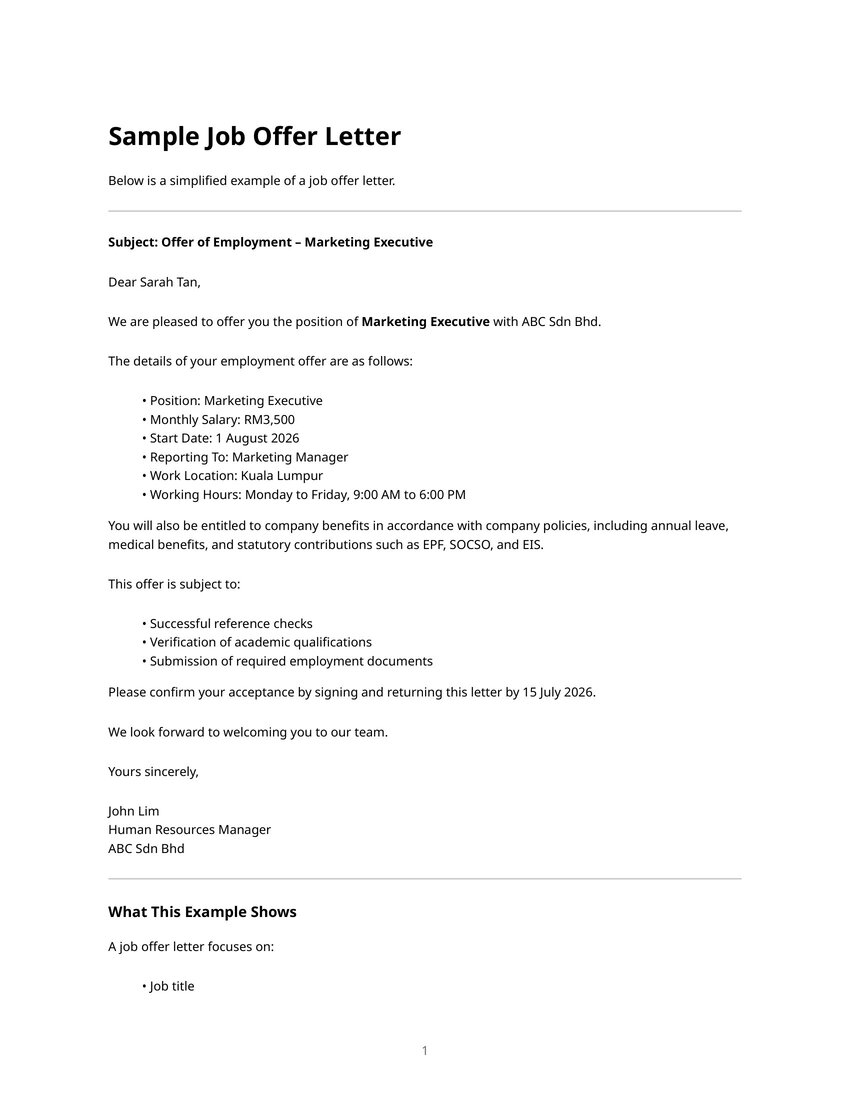
Download job offer letter here.
What Is an Employment Contract?
An employment contract is a legally binding agreement that governs the employment relationship.
Unlike an offer letter, an employment contract contains comprehensive legal and operational terms, including:
-
Salary and payment terms
-
Confidentiality obligations
-
Intellectual property ownership
-
Termination procedures
-
Disciplinary processes
-
Governing law
The employment contract provides legal protection for both the employer and the employee by clearly documenting rights, responsibilities, and expectations.
Sample Employment Contract
Below is a sample employment contract that employers can use as a reference.
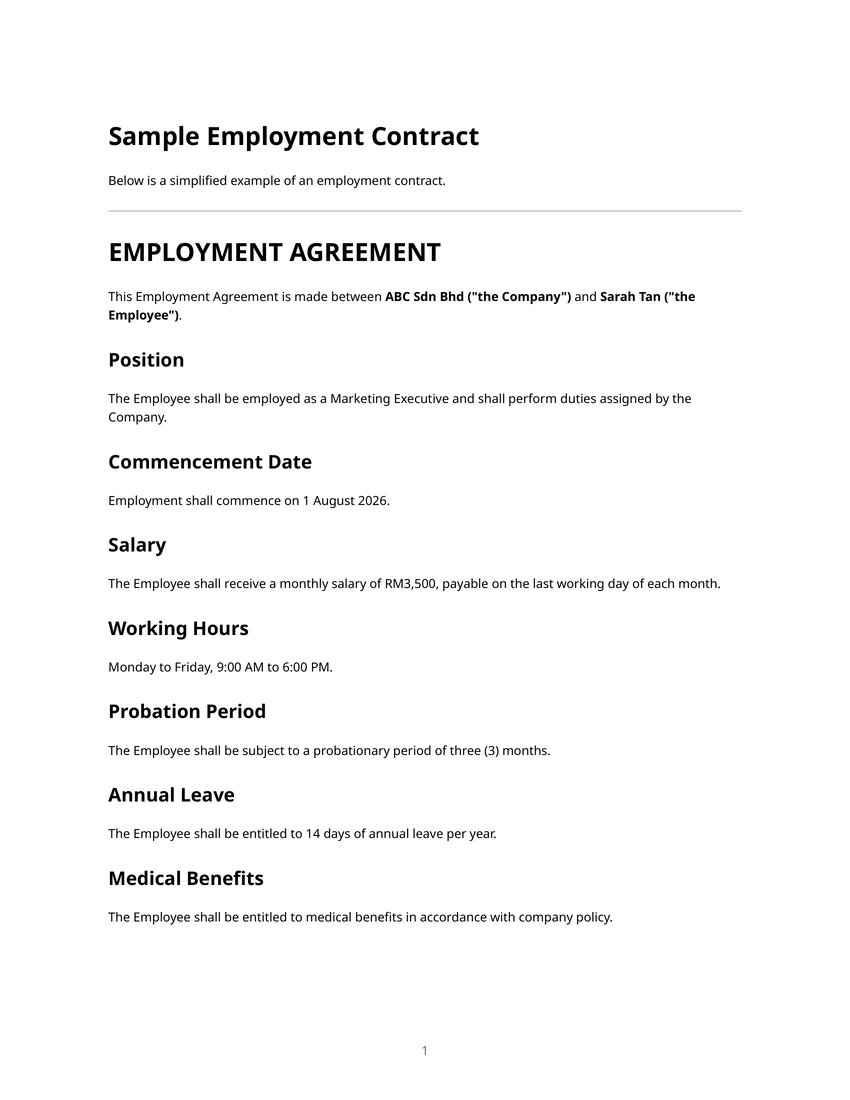
Download employment contract PDF here.
The Timeline: When Each Document Appears
Understanding the hiring timeline makes the distinction much clearer.
Step 1: Verbal Offer
The company verbally informs the candidate that they have been selected for the role.
Step 2: Job Offer Letter
A written offer letter is sent to confirm the key employment terms.
Step 3: Candidate Acceptance
The candidate accepts the offer and confirms their intention to join the company.
Step 4: Employment Contract
The company prepares and issues the employment contract for review and signing.
Step 5: Employee's First Day
The employee officially starts work.
Best Practice
Employers should ensure the employment contract is signed before the employee's first day whenever possible.
Side-by-Side: What Goes Where?
|
Content |
Offer Letter |
Employment Contract |
|
Job Title |
Yes |
Yes |
|
Start Date |
Yes |
Yes |
|
Salary |
Yes |
Yes |
|
Benefits |
Summary Only |
Full Details |
|
Working Hours |
Yes |
Yes |
|
Work Location |
Yes |
Yes |
|
Conditions of Employment |
Yes |
Sometimes |
|
Probation Period |
Optional |
Yes |
|
Confidentiality Clause |
Rarely |
Yes |
|
Intellectual Property Clause |
No |
Yes |
|
Non-Compete Clause |
No |
Yes |
|
Non-Solicitation Clause |
No |
Yes |
|
Termination Clause |
Brief Mention |
Detailed |
|
Disciplinary Procedures |
No |
Yes |
|
Governing Law |
No |
Yes |
What Belongs Only in a Job Offer Letter?
Some information works well in an offer letter but does not belong in an employment contract.
Examples include:
-
A welcoming message
-
Congratulations on receiving the offer
-
Information about company culture
-
A summary of employee benefits
-
Contact details for questions
-
Instructions for accepting the offer
These elements help create a positive candidate experience.
What Belongs Only in an Employment Contract?
Some clauses are too important to appear only in an offer letter.
These typically include:
-
Confidentiality obligations
-
Intellectual property ownership
-
Non-compete clauses
-
Non-solicitation clauses
-
Termination provisions
-
Disciplinary procedures
-
Grievance procedures
-
Governing law provisions
These clauses require precise legal wording and should be included in the employment contract.
The Risk of Accidentally Creating a Contract
One common mistake employers make is turning an offer letter into an employment contract without intending to.
This may happen when the offer letter includes:
-
Detailed termination provisions
-
Extensive legal obligations
-
Intellectual property clauses
-
Confidentiality agreements
-
Non-compete restrictions
If a dispute arises later, the offer letter may carry more legal weight than originally intended.
To reduce risk, keep offer letters concise and reserve detailed legal provisions for the employment contract.
What Legitimately Appears in Both Documents?
Some information naturally appears in both documents.
These include:
Salary
The offer letter states the salary figure.
The employment contract provides detailed payment terms.
Start Date
The offer letter proposes the start date.
The employment contract formally records it.
Job Title
The offer letter identifies the position.
The employment contract defines responsibilities and reporting lines.
Benefits
The offer letter provides a summary.
The employment contract explains eligibility and conditions in greater detail.
If any conflict exists between the two documents, the employment contract should generally take precedence.
What About Employers in Malaysia?
While employment practices vary across countries, Malaysian employers should ensure employees receive clear written documentation regarding their employment terms.
Many companies use both:
-
A job offer letter to secure the candidate's acceptance.
-
An employment contract to document the complete employment relationship.
Employment contracts commonly include:
-
Working hours
-
Leave entitlements
-
Salary arrangements
-
Probation periods
-
Confidentiality obligations
-
Termination procedures
-
Company policies
Providing clear documentation helps reduce misunderstandings and creates a smoother onboarding experience.
For specialised roles or situations involving complex employment terms, employers should consider obtaining professional HR or legal advice before finalising documentation.
Common Mistakes Employers Make
Even experienced HR teams occasionally make mistakes when preparing employment documents.
Treating the Offer Letter as a Contract
Some employers include extensive legal clauses in offer letters that should only appear in the employment contract.
Delaying the Employment Contract
Waiting until after an employee starts work can create uncertainty regarding employment terms.
Inconsistent Information
Salary, benefits, probation periods, and reporting lines should remain consistent across both documents.
Using Outdated Templates
Employment laws and company policies change over time. Templates should be reviewed regularly.
Failing to Explain the Difference
Candidates may assume signing an offer letter means all employment terms have been finalised.
Employers should explain when the employment contract will be issued and what additional terms it contains.
FAQs
Is a job offer letter the same as an employment contract?
No. A job offer letter confirms the key employment terms and secures a candidate's acceptance, while an employment contract contains the full terms and conditions of employment.
Do I need both a job offer letter and an employment contract?
Many employers use both. The job offer letter is issued first, followed by the employment contract before the employee starts work.
What should be included in a job offer letter?
A job offer letter typically includes the job title, salary, start date, work location, benefits summary, and acceptance deadline.
What should be included in an employment contract?
An employment contract usually includes salary details, working hours, leave entitlements, probation period, confidentiality clauses, and termination terms.
Which document should be issued first?
The job offer letter is usually issued first. Once the candidate accepts the offer, the employment contract is prepared and signed before employment begins.
Need Help Hiring and Onboarding Employees?
%20copy.jpg)
AJobThing helps employers attract candidates, manage applications, and streamline the hiring process from job posting to offer stage.
Read More:
-
Geran LiKES TalentCorp 2026: RM2,000 Grant & 50% Reimbursement for Intern Hiring
-
Constructive Dismissal Malaysia: Meaning, Examples & What To Do
-
Contract of Service vs Contract for Service Malaysia: How to Classify Workers Correctly
-
Job Offer Letter Templates: Examples, Formats & Best Practices for HR
-
Employee Retention in Malaysia: Meaning, Importance & How to Improve It
-
Employee Turnover in Malaysia: Causes, Warning Signs & How to Reduce It
-
Retrenchment in Malaysia: Meaning, Process & Employee Rights
-
Gmail Templates for HR: Faster Replies for Interviews, Offers & Rejections
-
7 Key Contract Employee Rights in Malaysia Every HR Should Know
-
GLC vs Private Company Malaysia: Salary, Culture & Hiring Differences
-
Types of Payroll Calculation in Malaysia: Adhoc, Prorated Salary & Final Settlement Explained
-
Types of Payroll Cycle in Malaysia: Which One Is Best for Your Business?
-
Types of Insurance in Malaysia and Their Impact on Employee Benefits
-
How to Create a Strong Candidate Shortlist for Better Hiring Decisions
-
How HR in Malaysia Can Offer a Job Over the Phone (with Script)
-
How Notice Period Really Works in Malaysia for Employers and HR
-
How to Create a Job Posting That Attracts the Right Candidates
-
How HR in Malaysia Can Improve Resume Screening and Candidate Shortlisting
-
How HR Can Reject a Candidate the Right Way (with Templates)
-
How to Conduct a Background Check for Employment in Malaysia
-
Onboarding Process Tips: What HR Needs to Know for Better Retention
-
Onboarding Checklist for New Hires (Free Downloadable Template)
-
Performance Evaluation: Description, Types, and How to Conduct
-
Cover Letter Examples Employers Should Know (With Tips to Spot the Best Ones)
-
Step-by-Step Guide to Writing a Great Job Description (Free Templates)