
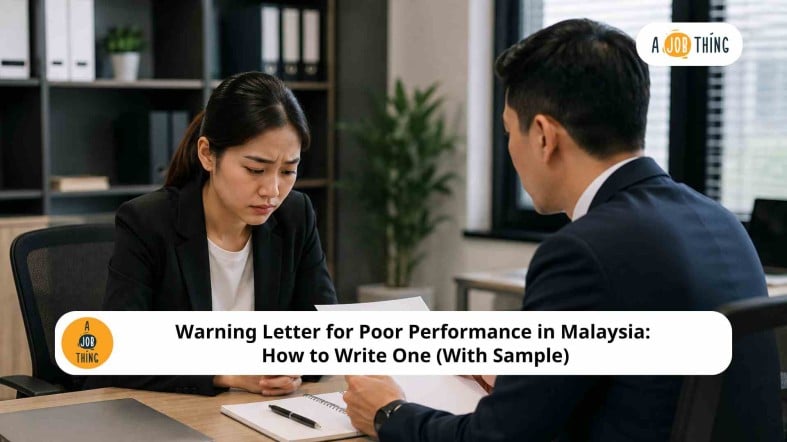
Warning Letter for Poor Performance in Malaysia: How to Write One (With Sample)

Are You Hiring?
Find candidates in 72 Hours with 5+ million talents in Maukerja Malaysia & Ricebowl using Job Ads.
Hire Now
Poor employee performance can affect productivity, customer satisfaction, team morale, and overall business performance. When an employee consistently fails to meet expected standards, employers should address the issue early instead of allowing it to continue.
One common way to formally document ongoing performance concerns is by issuing a warning letter for poor performance.
A properly written warning letter helps employees understand what needs to improve while providing employers and HR with clear documentation of the performance management process.
In this guide, you'll learn when to issue a warning letter, how many warning letters employers should give, what a warning letter should include, HR best practices, common mistakes to avoid, and a free sample you can customise for your organisation.
What Is a Warning Letter for Poor Performance?
A warning letter for poor performance is a formal document issued by an employer to an employee whose work performance consistently falls below the expected standard.
The purpose of the letter is to:
-
Explain the performance concerns clearly.
-
Inform the employee about the expected level of performance.
-
Give the employee an opportunity to improve.
-
Record the issue as part of the employee's employment file.
-
Support a fair and consistent performance management process.
A warning letter should always focus on work performance, not personal opinions or assumptions.
Before Issuing a Warning Letter
A warning letter should usually not be the first step when dealing with poor performance.
Before issuing a formal warning, employers and HR should:
-
Meet privately with the employee.
-
Explain the performance concerns clearly.
-
Understand whether there are any underlying issues affecting performance.
-
Provide coaching, guidance, or additional training where appropriate.
-
Set clear expectations for improvement.
-
Allow the employee reasonable time to improve.
If performance remains below expectations after these discussions and support, issuing a formal warning letter may be appropriate.
How Many Warning Letters Can an Employer Give?
There is no fixed number of warning letters that employers must issue under Malaysian employment laws. The appropriate number depends on the circumstances, the employee's performance, the company's disciplinary policy, and whether the employee has been given a fair opportunity to improve.
Many employers follow a progressive disciplinary process, which may include:
-
Verbal counselling or coaching.
-
First written warning.
-
Final written warning if performance does not improve.
-
Further action in accordance with the company's policies.
Some organisations may have different disciplinary procedures set out in their employee handbook or HR policies.
Instead of focusing on the number of warning letters, employers should ensure they:
-
Clearly explain the performance concerns.
-
Provide reasonable coaching or support.
-
Allow sufficient time for improvement.
-
Keep proper documentation throughout the process.
-
Apply company policies consistently to all employees.
Following a fair and well-documented process helps employers manage performance professionally while giving employees a reasonable opportunity to improve.
When Should Employers Issue a Warning Letter?
Employers may consider issuing a warning letter when an employee repeatedly fails to meet expected performance standards despite receiving guidance or support.
Examples include:
-
Consistently missing KPIs or performance targets.
-
Repeated poor quality of work.
-
Frequent mistakes affecting customers or business operations.
-
Failure to complete assigned tasks.
-
Low productivity despite coaching and feedback.
-
Repeated failure to meet deadlines.
Every situation is different, so employers should assess each case fairly and consistently.
Poor Performance vs Misconduct
Poor performance and misconduct are different workplace issues and should not be treated the same way.
| Poor Performance | Misconduct |
|---|---|
| Missing KPIs | Theft |
| Low productivity | Fraud |
| Frequent work errors | Harassment |
| Poor work quality | Fighting at work |
| Missing deadlines | Serious breach of company policy |
Poor performance is generally managed through coaching, regular feedback, performance reviews, and performance improvement measures.
Misconduct may require a different disciplinary process depending on the seriousness of the behaviour and the company's policies.
What Should a Warning Letter Include?
A professional warning letter should include:
-
Employee's full name.
-
Employee ID (if applicable).
-
Job title and department.
-
Date of the warning letter.
-
Clear description of the performance issues.
-
Specific examples of poor performance.
-
Expected performance improvements.
-
Timeline for improvement.
-
Support or training that will be provided.
-
Possible consequences if performance does not improve.
-
Employer's signature.
-
Employee acknowledgement (if required by company policy).
The letter should be factual, respectful, and easy to understand.
Sample Warning Letter for Poor Performance
|
Subject: First Warning Letter for Poor Performance Dear [Employee Name], This letter serves as a formal warning regarding your recent work performance. Over the past few weeks, your performance has not met the expected standards for your position. Some examples include:
We have previously discussed these concerns and provided guidance to support your improvement. However, we have not seen sufficient progress. You are expected to improve your performance over the next 30 days. During this period, your manager will continue providing guidance, feedback, and support. Please note that failure to demonstrate satisfactory improvement may result in further action in accordance with the company's policies. If you are experiencing any challenges affecting your performance, we encourage you to discuss them with your manager or HR so appropriate support can be considered. Yours sincerely, [Manager Name] [Company Name] |
How HR Should Document Poor Performance
Proper documentation is an important part of managing employee performance.
HR should keep records such as:
-
KPI reports.
-
Coaching sessions.
-
One-to-one meeting notes.
-
Email communications.
-
Customer complaints (where relevant).
-
Attendance records (if related to performance).
-
Previous warning letters.
Maintaining accurate records helps ensure a fair, transparent, and consistent process for both employers and employees.
Should Employers Use a Performance Improvement Plan (PIP)?
For ongoing performance issues, many organisations choose to implement a Performance Improvement Plan (PIP) before considering further disciplinary action.
A PIP typically includes:
-
Clear performance goals.
-
Specific improvement areas.
-
Review meetings with the employee.
-
Support and coaching from managers.
-
A defined review period.
-
Measurable success criteria.
A PIP gives employees a structured opportunity to improve while helping employers document the performance management process.
HR Best Practices When Issuing a Warning Letter
Be Specific
Avoid vague statements such as:
"Your performance is poor."
Instead, explain the actual issue.
For example:
"Your monthly sales target was 35%, compared to the agreed KPI of 80%."
Specific examples help employees understand what needs to improve.
Be Consistent
Apply the same performance management standards to employees in similar situations.
Consistency helps build trust and reduces misunderstandings.
Offer Support
Poor performance does not always mean an employee lacks commitment.
Consider providing:
-
Additional training.
-
Coaching.
-
Regular feedback.
-
Better resources.
-
Clearer expectations.
Supporting employees can often improve performance before more serious action becomes necessary.
FAQs
Is a warning letter compulsory before terminating an employee?
The appropriate process depends on the circumstances, your company policies, the employment contract, and applicable employment laws. Employers should ensure employees are treated fairly throughout the performance management process.
Can an employee respond to a warning letter?
Yes. Employees should have an opportunity to explain their situation or provide additional information if they disagree with the performance concerns.
How long should the improvement period be?
Many employers provide between 30 and 90 days, depending on the employee's role, responsibilities, and the nature of the performance issues.
Should HR keep a copy of the warning letter?
Yes. A copy should be kept in the employee's personnel file together with any supporting documentation related to the performance management process.
Is poor performance the same as misconduct?
No. Poor performance and misconduct are different issues and may require different management or disciplinary processes depending on the circumstances.
Need to Replace an Underperforming Employee?
%20copy.jpg)
Whether you're replacing an underperforming employee or expanding your team, AJobThing helps employers and HR professionals attract qualified candidates and hire faster.
Read More:
-
AI Untuk Rakyat 2026: Registration Guide, Eligibility & Free 3-Month AI Software
-
Can Employers Reject Annual Leave in Malaysia? Rights, Rules & Employee Entitlements
-
Payroll and Attendance Management in Malaysia: Process, Formula & Best Practices for Employers
-
Workplace Conflict Management in Malaysia: Causes, Solutions, and Best Practices
-
Recruitment Process Outsourcing (RPO): What It Is, Benefits & How It Works in Malaysia
-
SME Hiring Guide: How to Plan, Hire, and Grow Your Team Successfully
-
Competency-Based Interviews: Improve Hiring Quality with a Consistent Interview Process
-
Leave Encashment Malaysia: How to Calculate Unused Annual Leave
-
Online Seller Requirements in Malaysia: 10 Business Details You Must Display
-
Performance Bonus in Malaysia: How It Works, Calculation & Employer Guide
-
Cost Per Hire Malaysia: Formula, Examples & How Employers Can Reduce Hiring Costs
-
Letter of Extension of Contract Malaysia: Free Template, Format & Sample
-
Promotion Letter in Malaysia: How to Write One (+ Free Template & Sample)
-
Probation Extension Letter Malaysia: Template, Sample, and What Employers Need to Know
-
Talent Pool: Benefits, Examples & How to Build One for Better Hiring
-
Sales Turnover: What It Is, Formula, Examples & Tips to Increase It
-
Overtime Rates in Malaysia: When Do 1.5x, 2x and 3x Pay Apply?
-
Prorated Salary in Malaysia: How to Calculate an Employee's First Salary
-
Remote Jobs in Malaysia: Most In-Demand Roles, Salaries & Hiring Guide (2026)
-
Effective Ways to Reduce Absenteeism in the Workplace for HR & Employers
-
Medical Benefits for Employees in Malaysia: Types, Legal Requirements & Best Practices
-
Fresh Graduate Salary in Malaysia (2026): How Much Should Employers Pay?
-
Salary Benchmarking in Malaysia: Are You Paying Enough to Attract Candidates?
-
e-Invoicing Malaysia Explained: What Every Employer and Business Needs to Know
-
EOR vs PEO: What's the Difference and Which Is Right for Your Business?
-
Remote Job Offer Letter: What Employers Should Include (+ Example)
-
Job Offer Letter vs. Employment Contract: What's the Difference? (+ Free Templates)
-
Constructive Dismissal Malaysia: Meaning, Examples & What To Do
-
Contract of Service vs Contract for Service Malaysia: How to Classify Workers Correctly
-
Job Offer Letter Templates: Examples, Formats & Best Practices for HR
-
Employee Retention in Malaysia: Meaning, Importance & How to Improve It
-
Employee Turnover in Malaysia: Causes, Warning Signs & How to Reduce It
-
Retrenchment in Malaysia: Meaning, Process & Employee Rights
-
Gmail Templates for HR: Faster Replies for Interviews, Offers & Rejections
-
7 Key Contract Employee Rights in Malaysia Every HR Should Know
-
GLC vs Private Company Malaysia: Salary, Culture & Hiring Differences
-
Types of Payroll Calculation in Malaysia: Adhoc, Prorated Salary & Final Settlement Explained
-
Types of Payroll Cycle in Malaysia: Which One Is Best for Your Business?
-
Types of Insurance in Malaysia and Their Impact on Employee Benefits
-
How to Create a Strong Candidate Shortlist for Better Hiring Decisions
-
How HR in Malaysia Can Offer a Job Over the Phone (with Script)
-
How Notice Period Really Works in Malaysia for Employers and HR
-
How to Create a Job Posting That Attracts the Right Candidates
-
How HR in Malaysia Can Improve Resume Screening and Candidate Shortlisting
-
How HR Can Reject a Candidate the Right Way (with Templates)
-
How to Conduct a Background Check for Employment in Malaysia
-
Onboarding Process Tips: What HR Needs to Know for Better Retention
-
Onboarding Checklist for New Hires (Free Downloadable Template)
-
Performance Evaluation: Description, Types, and How to Conduct
-
Cover Letter Examples Employers Should Know (With Tips to Spot the Best Ones)
-
Step-by-Step Guide to Writing a Great Job Description (Free Templates)